Rainy Season

Ever lived in the tropics? Even been there during the rainy season?

Well, it’s not the rain that gets me (I live on a mountain so flooding isn’t a problem). It’s the inescapable dampness that permeates everything.

There are parts of my cement floor that haven’t looked dry since the first rain. I had to put my opened pack of gum in a ziplock bag…because the air turns the sticks of gum into a sticky, mushing goo. Every leather item in my house—wallet, belt, bracelet—I regulated to a ziplock bag. Even though I stored those items well off the floor and in the driest places in my house, a nice blue-green film grew on them. My wooden cooking utensil are now spotted with mold from just waiting to be used.

Washing clothes is a bear because the clothes won’t dry on the line. And despite my diligence, a small crop of mold started to form in my wardrobe. I had to wash about three quarters of my clothes as salvation from the infectious growth and certain squalor.

It’s between 60 and 75 degrees Fahrenheit and it feels like the pits of winter (and technically is here). It’s partly the breeze that cuts through my uninsulated house without shame that makes mild temperatures seem frigid, but it’s mostly because in the shade the dankness is finger-numbing.

Of course, winter only lasts a couple months. I have grapefruits, oranges, and mandarines sitting on trees, ripe and ready for picking, whenever I need a vitamin C boost. The sweatpants, knitted socks, sleeping bag, and heavy comforter that seem outlandish in the thick of summer are my key to survival when bedtimes comes these days. Bedtime comes hours early and wake up time comes hours late. It’s just too dark or too cold to function at optimal rates.

What would you say?

Celebrating Teachers' Day

Celebrating Teachers’ Day

Community member: Do you have a boyfriend?

Me: No.

Community member: But you’re pretty.

Me: …

~

Community member: When are you going to have kids?

Me: I don’t want to have kids.

Community member: You’re bad.

Me: …

~

Community member: Give me your eyes.

Me: What?

Community member: I want your eyes.

Me: …

~

Community member: Have you gained weight?

Me: No, I’m the same as I was.

Community member: You’ve gained weight.

Me: …

~

Community member: Do you have a boyfriend?

Me: No.

Community member: In your country?

Me: No.

Community member: How about a Paraguayan?

Me: No.

Community member: Why not?

Me: …

~

Community member: What is your religion?

Me: I don’t practice religion.

Community member: But you’re Christian, right?

Me: I don’t have a religion.

Community member: God exists.

Me: …

Meaning of Military

My grandfather was a veteran. That has many layers of meaning to those born in the USA. For me it invokes conflicting thoughts. But, in Paraguay the understanding of the military is different. I do not know how the history of the dictatorship or the history of several high-casualty wars influence Paraguayans’ views of Paraguayan soldiers. I know soldiers are respected here. But, from what I understand (grain of salt) joining the military is held high in Paraguay because it’s a good, solid job. One has to work hard to get in, and once he or she is in he or she will always be able to provide for his or her family.

In Paraguay, the military is a providers’ choice. Paraguay doesn’t wage wars these days like the States still does. Paraguay has never been charged by scholars as trying to be the “world’s policeman.” In Paraguay, the military is a secure way to pull oneself up his or her bootstraps. Paraguayan soldiers have a small chance of being shipped off to a land they don’t know to fight a guerrilla war. In the current political climate, they seem unlikely to use their weapons on any kind of battlefield.

Several of the most difficult conversations I’ve had in Paraguay were about military service. I’m close to the family of a young man who is studying in the Paraguayan military academy. His sister once asked me if I like soldiers. His aunt talked about what a hard-working person the soldier-to-be is. His mother and father explained how they’ve had to sacrifice to send him to military school. They hope he will help his younger sister when it’s her turn to go to college.

During those conversations, I thought of Arlington cemetery and the news—why I don’t like watching the news. I thought of the base shootings. I thought of the pledge of allegiance. I thought of baseball games and the National Symphony Orchestra’s concert each Memorial Day on the Capitol lawn. I thought of my grandfather in uniform. I thought of the star spangled banner.

In those conversations with Paraguayans about the military I chose to listen. I chose to limit my commentary. There are cultural things that can be explained—food, for example. There are parts of culture that run too deep to neatly fit in words. What do Paraguayans think when I tell them my grandfather was a soldier? How would they react to his funeral? Do Paraguayan soldiers have special burial rites? If so, who gets them and under what circumstances? Are Paraguayan mothers worried about their children or just proud when they enlist?

Lost But Not Forgotten

He was honored and not forgotten,” my father said of my grandfather’s funeral. My grandfather was a soldier for 20 years. He fought in WWII and Korea. He suffered for it. But, his comrades remembered him and in doing so they helped bring some peace to his family. Shiny pins and folded flags don’t pay for the dead, but ceremony does help those who are left behind.

It’s easy to forget. To close the door when the job is “done.” But, being able to talk to my father the week of his father’s funeral and hear the pride in his voice for how my grandfather was sent off—I’m glad that someone, many, took the time to remember. My grandfather lost a lot of himself in those 20 years. But, I will not criticize his motivation. His sacrifice was founded in a dedication to country and all people, a desire to do good. Further, I will not criticize the loyalty of his fellow veterans.

The thought of remembering struck me, as I sat alone in my little house thinking about my family so far away. I thought about why I left them. All the crazy phrases my grandfather used are on the tip of my tongue these days. They come to me as I’m going about my business. Sometimes, I try to expression them into Spanish, but they don’t have the same ring. “I’m taking hat, brother,” for example. Sombrero means “hat” in Spanish, in Paraguay it also can mean “lover on the side.”

In Paraguay, people pray for nine days when someone dies. Each day friends and family are invited to pray and eat snacks. On the last day, there are many snacks and there is extra praying. People remember their dead on specific anniversaries thereafter by holding similar praying sessions.

Introvert

Typical girl birthday party table center pieces/guest gifts.

Typical girl birthday party table center pieces/guest gifts.

Why don’t you just ask?

Pause, frozen, unable to move:

They could look at me funny.

Maybe they won’t understand me.

Maybe they’ll be mean…they could lie.

What if they think I’m stupid?

I don’t want to inconvenience them.

I wouldn’t want to make them uncomfortable.

What should I say? How should I start?

~

Why don’t you just go and buy it?

Oh, it’s not the money. I’m good at saving.

So exhausting, the thought of shopping.

How many people will I have to talk to?

Are the prices on the items? What…I have to ask?

Is the salesperson going to follow me around?

Will I be able to try it on? Privately.

What are the dressing rooms like?

The store might be packed or it might be empty,

but I’m not sure which is worse.

How do I say I don’t want to buy it?

Is it weird that I need time to think?

~

Don’t be lame, parties are fun.

Yes, but where to begin.

Who should I talk to first?

How many people do I have to talk to?

Should I say “hi” to everyone?

And if I don’t know the people there…

Will they talk to me?

So, when someone ends the conversation,

Does that mean they were bored?

Or is that just the normal sequence of things…

At a party?

Fun, yes, but exhausting. Every word, enervating.

~

It’s all about who you know. Your network.

What does “know” mean exactly?

So, like, do I invite them out to coffee?

Schedules are complicated.

Do I just follow up with a note?

What should I say?

How often should I talk to them?

It’s so painful to think that

I might annoy them…

Or that they thought I was boring.

If they don’t remember me, does that mean I’m forgettable?

But I don’t want to know them JUST

So I can ask them for something…

No, I can’t do that.

So how can I get to know them…

As something more than an acquaintance?

They are so busy. They’ve made that clear.

~

Why didn’t you come?

Truth: I don’t know. I guess…

I was worried I wouldn’t have time to recover.

I wanted to see all of you, but didn’t know

What to say or if you wanted me there.

I was worried it was just a polite invite.

But, not a heartfelt one. I should be more confidant.

The travel. So many hours with people

I don’t know.

Then there’s all the smiling.

The catching up because

I didn’t know that was happening in your life.

~

What’s the problem exactly?

We’re in a sea of social bonds

Instead of hydrogen bonds

Extroverts are buoyant

Introverts are dissolved

It’s science. A hard truth. Reality.

Roots

Villa Florida, Misiones, Paraguay

Villa Florida, Misiones, Paraguay

The day I felt most successful in Paraguay was the day I fixed my sink, fixed my toilet, taught 5 hours, and then tutored someone in English. But, it wasn’t the teaching or tutoring that made me feel like a champion. There is something incomparably gratifying about fixing things all on my own.

A simple joy derived from working with my hands on tangible things stems from my roots. My father is a carpenter, furniture maker, set builder, scenic designer, and general jack-of-all-trades when it comes to buildings things (petty much any medium). My mother is an artist (painter and sculptor) whose dabbles (and dives) into costume design, house building, furniture making, and set design. My stepfather is a furniture maker who also builds houses, fixes just about anything, goes logging with his horse, and changes his truck’s oil on his own. My stepmother, she’ll try to tell you she’s not crafty, but she knits, draws, and knows more about remodelling than she lets on.

A lot of what I do in the Peace Corps is intangible. I teach life skills. I teach English. I talk about health theoretically and US culture. I try to set an example for all the young women who cross my path. But, aside from the occasional breakthrough—like when one of my youth answers a question with an answer so profound it makes me pause or one of my students strings together a good sentence or two in English—I don’t see results.

On the flip side, when I fixed my sink and toilet I instantly saw my success. One minute my sink was clogged—so obviously I took it apart and in doing so discovered a critical screw was stripped (from years of abuse) and I couldn’t put it back together—hours later it was functioning better than it had before I tampered with it. As for my toilet, the connection between the pipe that brings clean water into the toilet every time I flush and the toilet itself was demolished. Every time I flushed there was a jet of water. The water was only clean, which was nice. A trip to the hardware stone, lots of explaining and acting out what I needed, and I came home with all I needed to fix everything. Whoop! Done. Master carpenter right here, in the middle of Paraguay! Take that Mr. Machismo.

I can get all fancy with my talk of and work in social marketing, behavior change, and capacity building, but it will always come back to the same thing. The day I changed the lock on my door with just a knife I was ecstatic. The day I fixed my sink and toilet, I could have taken on anything. I can fly as far away as I want, but I won’t forget my roots. Not for nothing.

Oh, I Couldn’t Because…

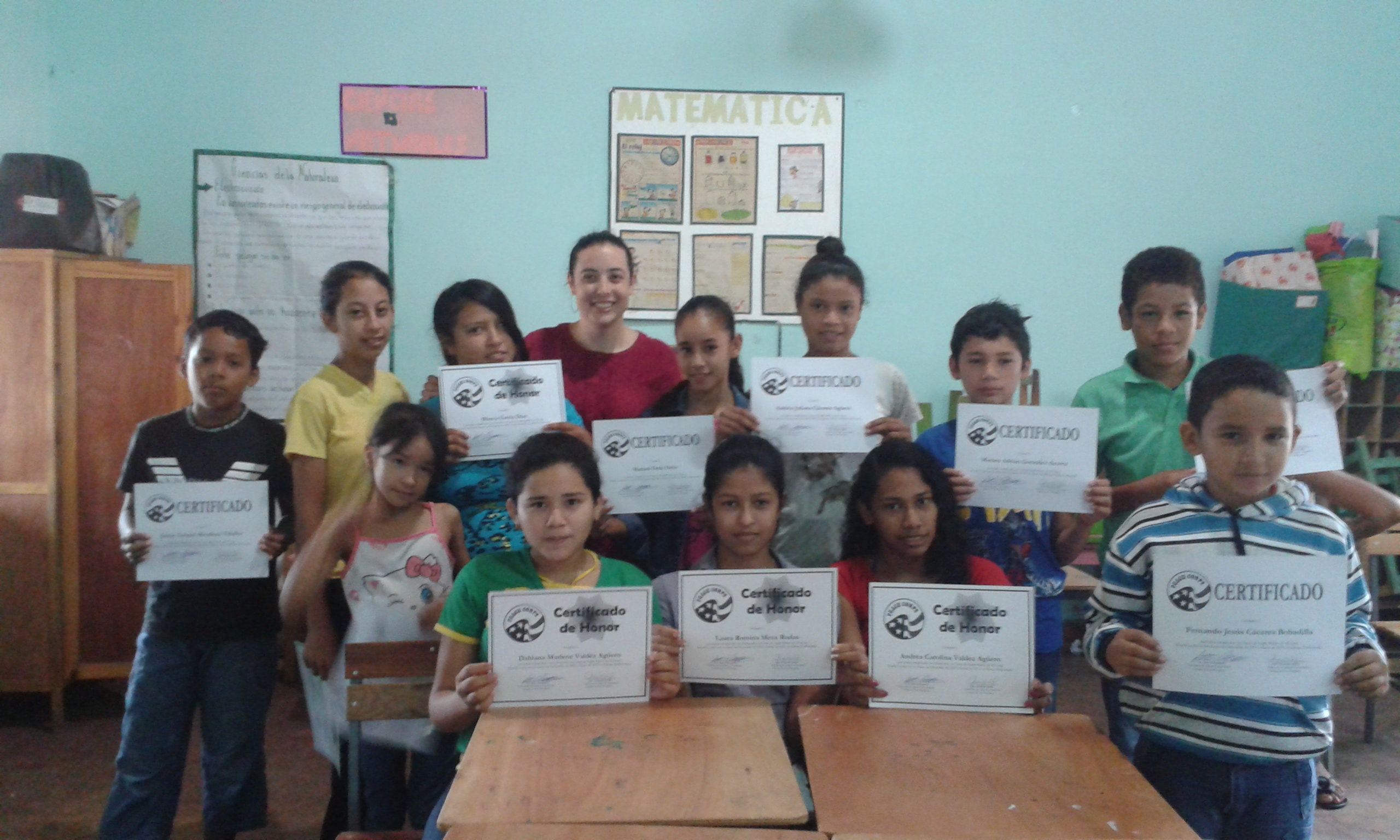
Summer English Class Champions

Summer English Class Champions

Because I had to wash my clothes. Because I had to clean my house. Because I didn’t have the energy. Those excuses would NOT fly in my US world, but in Paraguay they aren’t only legit excuses but won’t be questioned.

It’s amazing. I can come up with an excuse that would be completely understandable to my friends in the US. Like, “I had a ton of work for the next day and I needed to study.” If I try that excuse in my community people give the half nod that means something like, “Right, you just didn’t want to come. Lame.” Conversely, I can simply say, “I needed to wash my clothes. It’s been raining lately, so it’s been hard to wash them.” People will nod understandingly. No questions asked. Done. I didn’t come because I had to wash my clothes. Obviously. I had to take advantage of the sun.

As for cleaning the house. I’m a woman, after all. I couldn’t let my house be dirty, right? What would that say about my womanhood? Done. I didn’t visit because my house had to be cleaned that instant.

The excuse that I didn’t go because I didn’t have the energy is the hardest for me. I get the clothes washing. I wash clothes by hand. It’s a chore, and if it rains clothes don’t dry well. The sun is a valid concern. I also get the house cleaning bit. I might not agree with it, but the house is the women’s domain in Paraguay. Women in Paraguay are very proud of how they keep their homes, and to fail on that front would make people judge me. I do what I can to keep my house almost up to Paraguayan standards. However, I do fail on the lawn sweeping and spider web reduction parts of the job. But, what exactly does it mean to not have energy to do something? Isn’t that the same as just being lazy and lame?

No, it is not, according to Paraguay. It’s a polite reason not to go. Sometimes it has nothing to do with being lazy. Maybe it was raining. Maybe it was too hot. Maybe the terere I was drinking was simply too good to leave.

Culture. It permeates everything. Even the excuses we use to get out of things.

From the Same Country But Lightyears Apart

The View from My HouseCulture shock and disparities between host country and US culture are popular topics in Peace Corps training and volunteer stories. But, less talked about, is the diversity of Peace Corps volunteers themselves.

We volunteers come from all parts of the US. We have unique life experiences, reasons for joining Peace Corps, and life goals. We are in no sense homogeneous after you discount the fact that we are all US citizens. Our diversity is often overlooked, and by more parties that you might expect.

It’s not surprising that host country nationals might think all Americans are the same. As volunteers, we might be the first person from the US our community members have met. It’s also not entirely shocking that people in the US tend to stereotype volunteers. Most people in the US only know several returned volunteers personally. More surprising, however, is that Peace Corps staff and volunteers also often make the assumption that because all volunteers are from the States we have a lot in common.

Let me give an example. In Paraguay, one common topic in Peace Corps training and subsequent conversations with volunteers is catcalling. Street harassment is something that happens in Paraguay and, depending on where you are, it can be frequent and daily.

What I’ve found fascinating about the numerous powwows to discuss street harassment I’ve experienced with volunteers is how it is discussed as though it is something that does not happen in the States. Catcalling often is brought up as one of those unsavory parts of Paraguayan culture with which one has to deal.

I find this a mystery. Catcalling is not unique to Paraguay or foreign places. It is alive and well in the US too—from boys whistling to men who follow you down the street offering undesired commentary. My sister and I sometimes talked about our street harassment experiences when I still lived in the States: She lives in New York City and I lived in Washington, DC.

Catcalling is something new to many volunteers in Paraguay, and they find it very upsetting. But, for others, like me, who experienced catcalling in the States it is not new and we had strategies to deal with it before coming to Paraguay.

Experience with street harassment is one example of how volunteers are disimilar, but there are many examples. Our variance highlights the vastness and diversity of the US and reminds me that nationality isn’t what makes us similar or different. Nationality is one of many fragments that make up a person; it is not the summary of a person.

A Centralized Country

CaterpillarAsunción, the capital city, is the center of Paraguay in almost every sense of the word “center.” Imagine if Washington, DC was the only city in the entire USA with everything you might need. Picture a USA where NYC, Los Angeles, Houston, Chicago, Philadelphia, Boston…all the big cities didn’t exist, or Washington, DC alone filled each’s role.

My Point:

Paraguay is a centralized country in the sense that as you get farther from Asunción you have less access to resources like consumer goods, government services, and employment opportunities. For example, you might be able to buy sneakers in any urban center, but not the brand you want. You might be able to see a doctor to get your cough checked out, but you might not be able to get tested for HIV or see a dermatologist. You might be able to work for a nonprofit, but not an international NGO. You might be able to join a gym, but not a cross-fit gym.

Snapshot:

Let’s say I want to buy a tent, Asics running shoes, peanut butter, a violin, and a good bicycle. Let’s also say I want to go to the movies, go to a sit down restaurant that serves non-Paraguayan cosine, and sleep in a room with air conditioning. I want to withdraw money from an ATM, use wifi, make some calls with my cell phone, and get my Mac computer fixed. On top of that, I need to go see a specialist and get a new government ID. I also want to work for a big company, volunteer at a nonprofit that focuses on girls’ empowerment, and be part of a young professionals’ group. I want do karate and join a book club. Lastly, I like to travel so I want to have access to an airport with flights to other continents and a bus terminal with buses to other parts of Paraguay and to neighboring countries. The only place in Paraguay where ALL those things exist is Asunción.

Summary:

In Paraguay, it’s not just a question of city versus countryside. It’s a question of Asunción versus anywhere else in Paraguay.

One Year In Site

SunriseI’ve made it halfway. One year down, one year to go. But, don’t think of it as a countdown. When the day comes to leave Paraguay my feelings will be ambiguous at best.

April 11 was the midpoint of my Peace Corps service. I feel accomplished; like I did the hour I escaped high school, the minute I graduated college, and the instant I finished my first marathon.

We do a lot of things in life. Some of those things are pretty kick-ass and some are down right boring. But, we all have landmark moments. Those moments when we feel like we’re getting somewhere. That our lives might have meaning. That what we are doing is good. That we are moving in the right direction. That we are capable.

That’s how I feel, still in the glow of my one-year mark. I’m in a good spot. I’ve had successes and I still have work to do. I’ve taken the bull by the horns, so to speak, in tackling Paraguay, my Peace Corps work, and myself. I’d say, of all those projects, self-improvement has been the most extensive, difficult, and rewarding of all. I give myself a lot of pep talks. I think a lot about who I am—my strengths and weaknesses. The Peace Corps makes you confront yourself. Plopping down to work in another country shoves your shortcomings in your face. You lack language. Relationships take unexpected forms. Work is different. Getting around is hard. There are hours alone. It’s challenging to talk to friends and family still in the States. You have to build a completely new life—activities, friends, places…foods.

Not everyone is given the opportunity to take 2 years to cultivate the best person she can be. The rat race, the hyperactive, the go-getter, the conquer-all-be-“successful”-ASAP-don’t-think-just-do-it realities don’t leave much time for reflection. It’s hard to ponder when you’re always on the run. When there’s hardly time to sleep. I came from the rate race, and I’ll probably return to it when all is said and done. But, I like to think that after Paraguay I’ll never completely get lost in the scramble. I’ll always be type A, but I now know there’s many ways to be one.

One year in site. What a trip. I’ve learned so much. I’m happy to muddle through the low points and soar through the high ones. I know in a blink it will all be over. Like a dream. Paraguay. Shit, that’s a place I call home.