Vergüenza: Sink or Swim

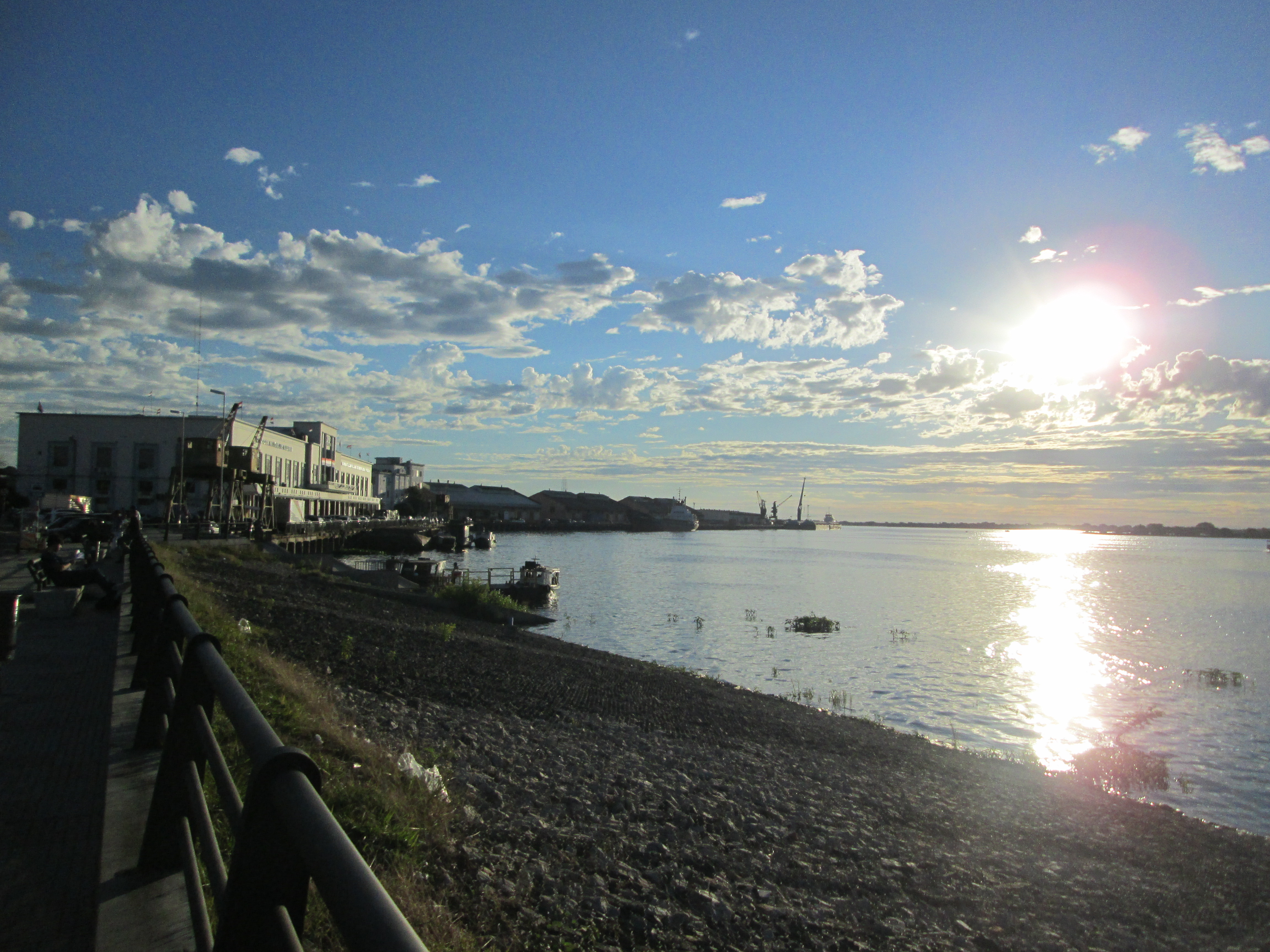
President's Palace, Asunción“Vergüenza” means “shame” in Spanish. In the everyday application of the word, “vergüenza” means shyness and someone without “vergüenza” isn’t ashamed to do whatever it is they want to do. This little word summarizes whether you will sink or swim as a volunteer. Why?

There is no room for being shy (having vergüenza) in the life of a PC volunteer. I and all other volunteers are weird and foreign to our communities, but our job is to get to know the people as best we can and make a life in Paraguay…as quickly as possible.

To get to know people we end up making a lot of “cold calls”—just walking up to houses to visit. We invite ourselves to any event we hear about:  Funerals, birthdays, soccer games, Bible study; the list goes on and on.

To make a life in Paraguay we (the volunteers) have to ask endless questions. In a country where there aren’t really even road signs, the only way to figure out where things are and who can help us is to ask. For example, there’s no directory of electricians that could help me when my power goes out. But, there are at least three electricians who live within a ten-minute walk from my house.  We can’t Yelp or Google maps stores and restaurants (except, maybe, in Asunción) because most of them are off the Internet grid and the only way to know they exist is to ask or stumble upon them.

But, it’s not just that we don’t know where anything is. It’s also that things are done differently here. This is the land of house-front stores and handy men and women. Because of this, we have to learn how to navigate a world of informal, personal business interactions. It’s a world that the organization, digitalization, and formalization of the US has pushed to a back burner, but in Paraguay it’s very much front and center.

Volunteering is an exercise in losing vergüenza. To stay afloat you simply must be bold.

Staying Busy With Small Business

Paraguayan fieldI am often impressed how people in my community have so many side jobs. Women in my community make woven sunhats, bake things to sell, make clothes, and collect medical herbs—the list goes on. Men often have skills they’ll sell—like being an electrician. One woman I work with put herself through college selling medical herbs and she makes extra money now selling ice cream at the soccer games (every Sunday). People are very crafty and not shy about selling things door-to-door, on buses, or on the side of the street.

Making things to sell is something people in my community are raised doing. Children, as young as 8, will go around selling things.

Sometimes, whole families will work together, in their free time, on side jobs. Like leading up to Palm Sunday, my family made woven palms. Sometimes people will weave hats or work on other projects while visiting.

Paraguayans never stop noticing products and services that could be sold. But, making some side money is often the limit of the vision. Few Paraguayans I’ve met, even the hardest working, see their side jobs as something that could be grown into a larger business.

In my community people almost exclusively do activities that relate to making money. The three exceptions to this are playing and watching soccer, participating in religious activities, and keeping the house clean. It’s really hard to explain to Paraguayans in my community why you would do something just for the sake of doing it—like volunteering in the Peace Corps, for example.

Let’s Talk About Stereos

Río ParaguayIn the States we joke men get big trucks to make up for things they lack. If I were to adapt the joke to fit Paraguay, I’d say men here get stereos.

Most people here don’t have cars. Dirt bikes and motorcycles are the more common family transportation. But, everyone has their stereo, and you’d be amazed how many families have giant stereos.

And they use their stereos. All day, starting between 6 and 8 in the morning and ending between 7 and 10 at night. There’s no way to avoid the joyous notes of cumbia and polka, sometimes competing between houses, everywhere you go.

We aren’t talking boom boxes. We are talking huge, 3 or 4, piece stereos with speakers for treble and for bass. They play radio and CDs or you can connect your pen drive or computer or phone.

We are talking club sound for a simple house party. Get ready to dance.

Chisme (aka Gossip)

Río ParaguayIf you’re from a small town or went to high school you’re already familiar with the idea of gossip, called “chisme” in Spanish.  Gossip is when people talk about what other people are doing, sometimes what they say is true and sometimes it is false, but they usually pass judgment. Here in Paraguay, well, at least in rural Paraguay, gossip is very important. In fact, it’s so important that Peace Corps has several sessions related to dealing with gossip during our training.

The brutal truth is life in a small town or rural Paraguay is pretty slow. Yep, the highlights are celebrations of saints, birthday parties, and soccer games. Many Paraguayans prefer to stay home and spend time with their families to going out. This leaves a lot of time to talk about what people are doing but not a lot being done about which to talk.

Anything that falls under the popular topics of sex, fights, and money is likely to catch people’s interest. The fun thing about it is even if you aren’t doing anything, someone might see something that makes them think you are doing something, and lo and behold you have a completely fictitious story about you flying around town.

Gossips will be gossips, so who cares? Well, the challenge isn’t really the gossip itself, but the fact that people often use gossip to form their opinions of others. It’s the judgmental side of gossip that’s particularly interesting when you are a Peace Corps volunteer.

As one of the only, if not the only, foreigner in your community you are stranger than your average person. Gossip about you is unavoidable. The trick, however, is preventing gossip that will harm your reputation or people’s respect for you. Because you don’t have history or family in your community, so reputation and respect is all you got.

A Neighborhood of Family

Mural in AsunciónWhen I talk to other volunteers about their sites we often joke that we are related to almost everyone (through our host families) in our sites. In Paraguay, everyone in one family tends to live in the same town, on the same street. The street will have generations of one family, and the family members will likely live their entire lives there. One common exception comes because of marriage: If two people from different parts of Paraguay marry, most often the woman moves to the man’s neighborhood.

Another thing that makes families so massive to someone from the US is that the average woman has more children than in the US. Many nuclear families, especially families where the mother does not have a professional job, have more than 3 children and 5, 6, or more is not uncommon. It is also interesting to note that children frequently live with their parents until they marry. For example, I have 5 siblings in my current host family: 26, 24, 15, 12, and 8 years old and all of them live in the house with their mother and father.

What does living so close to your family mean?

It means, as a kid, you are guaranteed a huge band of cousins (friends) with whom you can play. It means when you host a party you have tons of hands to help cook. It means, to visit with family, you don’t need to leave your neighborhood.

As someone who grew up far away from branches of my family, I find it neat that Paraguayans have their aunts, uncles, and cousins so close. But, the closeness doesn’t prevent divisions and arguments. For example, in my site, my host family is related to most people on one side of the street through my mother and the other side of the street through my father. But, family members from the two sides of the street visit infrequently, even though they live only a ten-minute walk apart.

How does this relate to daily life as a volunteer?

For me a key aspect to doing my job is knowing who talks to who. Why? In a small town, gossip flies around and is a key pastime for many people. As a foreigner trying to maintain a positive image, it’s helpful to know how individual’s opinions of me might get around and affect my relationships with other members of the community. Knowing who gossips together is also helpful in terms of meeting people and understanding safety warnings. Like anywhere, people only hang out with the people they like, so they can only introduce you to that circle. Often, people don’t trust or don’t like the people who are not in their circle so they’ll advise you to avoid those people. As someone who is still trying to learn about the entire community, it is important to know when warnings to avoid someone are for a good reason or just because the person you’re talking to doesn’t like that person.

A Land Where Fruit Grows on Trees

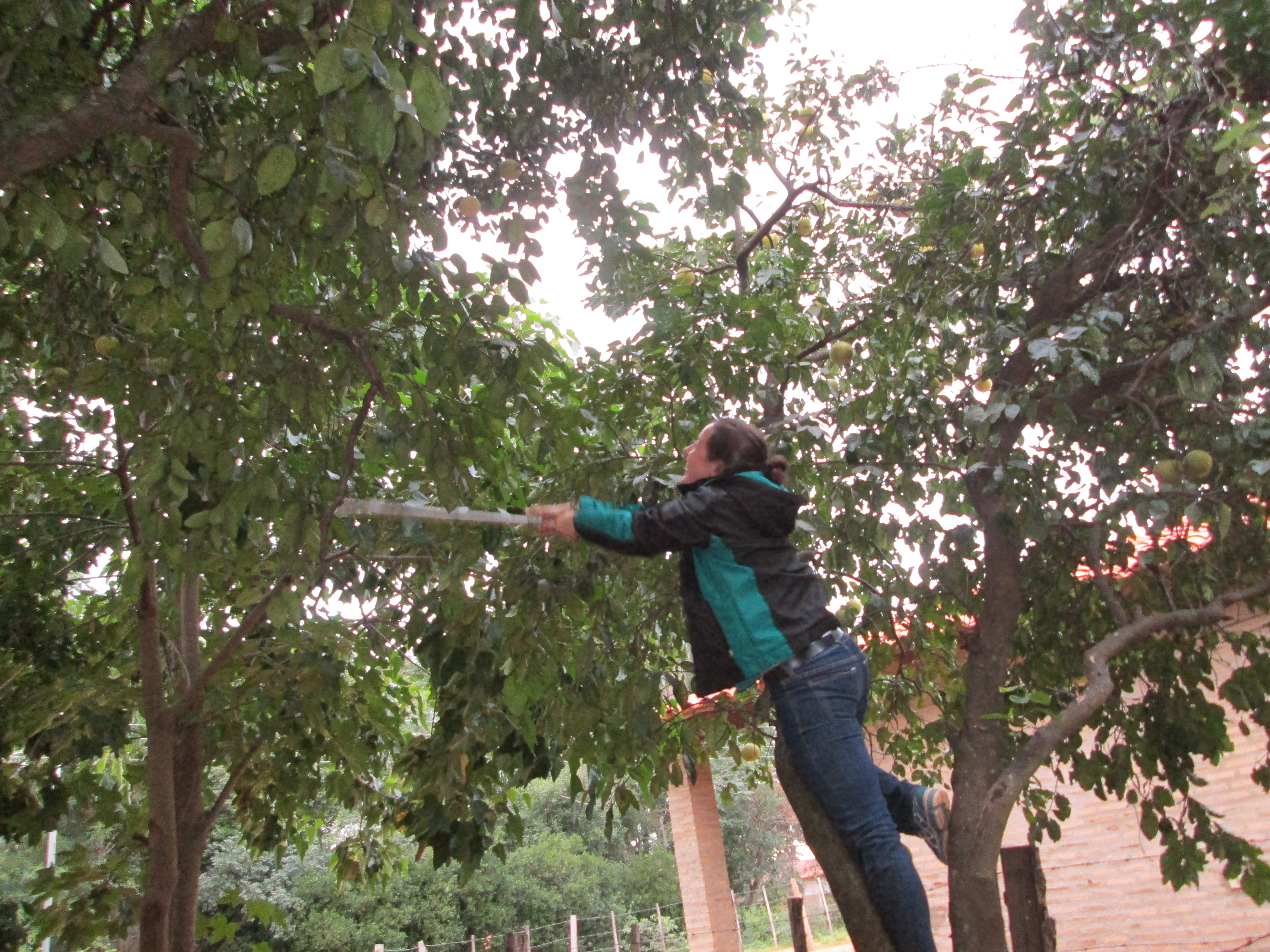
Me Hunting for GrapefruitIn the States I used to go grocery shopping for fruit—you know: grapefruits, mangos, and passion fruit—but in Paraguay you go acquaintance shopping instead. As far as I can tell, Paraguay grows just about every fruit except apples—the trick is to know what’s in season. Once you know the seasons the next step is finding someone who has that particular fruit at her house. From there, a pleasant ask or a afternoon of terere will likely do the trick.

Citrus are in season right now, and they are delicious. The trees are heavy with little globes. There’s something completely lovely about whacking down grapefruits and mandarins, high above your head, with a stick. They thud to the ground. They are juicy and fresh. The peels are not some pretty color like they are in the grocery store—usually they’re more patchy yellow-orange and green.

Before citrus it was guavas and avocados and before that it was mangos. Passion fruit are also coming in right now—so tart and mouth wateringly tasty. I think papayas are coming up. And there are different bananas throughout the year, though I’m not sure exactly when…just yet.

It’s fall quickly turning to winter right now. I’m not sure if that means we’ll have a fruit break or if the trees will just keep chugging along.

Darn Cold…at 60 Degrees Fahrenheit

Storm CloudsI didn’t bring winter clothes to Paraguay. It was partly a, “I want to pack light” thing and partly a, “it’s a sub-tropical country so it doesn’t get cold, right?” thing. Well, I learned my lesson. It gets bone-breaking cold in Paraguay…starting at 60 degrees Fahrenheit.

When it dips below 80 it’s likely to be windy, but the real killer is the rain. I know, I know, it sounds crazy. I, too, grew up in a land that dipped below zero during the winter so let me explain.

The houses in Paraguay have windows but they don’t have glass. The houses have walls, one brick thick, but they don’t have insulation. The houses have roofs but, there is no ceiling, so you can see right to the tiles or metal that is blocking the rain. The doors are thin and often have cracks. There is no heat source in the house. What does this all mean?

It means that it’s about the same temperature inside and outside. The house protects you from wind and rain and holds a little heat, but basically there is no escape. When the cold settles, it seeps into every room.

In my house, the shower and toilet are in stalls outside the house, with just curtains as doors. We have hot water, but it seldom is hot but rather just not cold. When the rain pounds down, the wind rustles the trees, and the coolness engulfs the house—it is frigid. The trick is to stay warm, because once you start feeling cold it’s hard to heat up again. I wasn’t prepared for the first cold spell. I ended up spending an afternoon in my sleeping bag, fighting a fever, because I got cold in the morning. But a trip to Marcado 4 fixed me up for the next time the temperature dips.

Mercado 4

Narrow paths, dirt outside and shiny tile inside, are tapered further by the crowd. Clothes line the paths – sweaters, sweatshirts, jackets, pants, leggings, socks, underwear, and hats – bright white and vibrant colors and crisp new shoes. Each stall with a different mix of things neatly organized in folded stacks. Salesmen and women invite you to ask about the prices. Suddenly the clothes fade away and its heaps of red tomatoes, oranges, and onions. Herbs green and brown are laid out and tied in bundles with palm leaves.

The sales women yell to each other across their mountains and hills of produce, sipping terere and jeering at the young men straining to push their wooden wheelbarrow-carts up the inclined walkway and between shoppers. The carts are stacked high with bursting plastic, burlap bags.

Kittens, scrawny and ownerless, gallop around the crates and between feet—gray, striped, orange, and black. Their fizzy ears and whiskers make them cuter than rats.

I look to the right and see hunks of meat and stacks of fish—the smell of flesh clashes with the earthy aroma of the vegetables next to me. I hurry on. I walked in a meat section once. The sent of death was thick, and I promised myself I wouldn’t go back there.

A basket made of chicken wire holds live chicks, chipping and jostling each other, and rabbits with their noses twitching.

I dart between to stalls to pass from the outside part of the market to the warehouse part of the market. I go up the stairs to find a bench. I sit on a bench in the middle of the room and look around at the racks of shoes around me…shoes in every direction: snazzy sneakers and sexy heals, clunky work boots and shiny men’s dress shoes.

I go back down into the fray and ask the smoothie-empanada lady where I can find a guitar. I cross the street—dashing through a just-big-enough-gap between the buses, cars, and motorcycles that roar and hum on the muddy street. I find myself in a new mix: Stands stacked high with shiny new cellphones. People ask if I’m looking to sell my phone. I hurry on. There are stereos and TVs. And there is kitchenware. Finally, I find the guitar store.

The last and final mission—find a bus home. I catch the bus on the corner-ish, hailing it like you do a taxi in the United States. I climb on. Luckily there is a seat. I sit with my new purchases piled on top of me.

I didn’t realize how big the market was. It stretches for blocks—crossing streets and alleys. The stores and stalls weave in and out of buildings. You get stuck going in circles. They tell me you can get just about anything there, and the prices can be cheaper than the mall, but to find a product you must navigate a labyrinth. (At least I have two years to master the whole thing.)

I made it! I finished my first solo mission to Asunción’s Mercado 4. I’m proud of myself, but there isn’t time to relax on the bus. Clanking and coughing my bus sputters down the cobbled streets of the city—there is too much to see and the air is spoiled by diesel smog. School children get on the bus, their uniform sweat pants and polos in some shade of gray or blue. Candy, cookie, and fruit venders hop on and off the bus holding their wares for all to see—their sales pitches are more like songs in rhythm and tonality than spoken word.

The little streets with the stacked and crunched houses wiz-by, and I just glimpse them through the dust-encrusted bus window. I am not inclined to call Asunción pretty; it isn’t. But it’s a city where you feel like things are happening and progress is pushing forward—to what end and to where is unclear, but Asunción in a word would be “movement.”

Cats and Dogs in Paraguay

JasyDogs and cats in Paraguay are usually approached in the same way that farm animals are—they serve a purpose and people are not emotionally attached to them. One common exception is puppies, which children tend to play with and adults tend to pet.

Dogs guard houses. They aren’t trained, spayed, or neutered. Sometimes female dogs are given a birth control shot, but several Paraguayans have told me that if you spay a dog before she has at least one litter she will die early. Dogs tend to have fleas and are dirty. They generally don’t come in the house and are often fed leftovers instead of special dog food.

There are dogs everywhere and you have to be aware when walking around at dawn, dust, and dark because dogs won’t hesitate to attack you. Luckily, however, a stick or pretending to pick up a rock will scare them away.

Cats are for killing rats and mice. They tend not to be welcome in the house and aren’t fed. Most cats I’ve met don’t really have owners and don’t really have names. Paraguayans call all cats “Michî,” which means “little” in Guaraní.

Paraguay’s Commuter Buses

RoadThe bus groans, heaving up the hill. The driver slams the bus into another gear. Someone pulls the cord, there’s a buzz, and then the bus lurches to a stop. Everyone is thrown back—even the people sitting hold on tight. In Paraguay, you can catch the bus anywhere along its route and get off anywhere along the way. You just buzz to stop and put out your hand (like you would hail a taxi) to get the bus to stop.

The bus starts again and the person who got on pushes through the metal turnstiles at the front of the bus and takes a seat. At the back of the bus are maybe five plastic burlap bags with produce. If you can lift it onto the bus you can take it on. The wind whips through the open windows; a welcome coolness to offset the penetrating sun. I should have sat on the shady side.

We jolt to another stop. Some school children get on. They duck under the turnstile because they didn’t pay. A woman next to the seat where I’m sitting presses against my shoulder and the bus roars up the road again. The bus swerves back onto the street from the curve where it had been driving for the past kilometer. The bus puffs black smoke as we pass someone on a dirt bike.

We stop and someone selling apples and someone selling donuts gets on. They make their rounds and get off at the next stop. They carry their goods in baskets and plastic bags.

I wonder how many people on the bus are going to my community. I watch the palm trees wiz by, surrounded by tall grass. There are cows tied up along the edges of the road. The bus driver drinks terere. His windshield is decorated with stickers of Jesus’ face and fringe. When the bus isn’t full, I love the ride.