An Encounter With Jesus

“Let’s go for a drive,” the mother of the family said. Her two daughters, a 3-year-old nephew, and his brother got ready to pile into the car. Going for a drive can mean many things in Paraguay. It could be a few-minute trip to the house-front store down the street or it could involve an hours-long journey to another town.

I hurried to the bathroom, the key is to always go before leaving, and asked what we were going to do. “Get the saint,” the mother said. She said it as though it was both obvious and I should have known what she meant. But, of course, I had no clue what “getting the saint” involved. Questions raced through my mind: What saint? Are we going somewhere to pray? Is it okay if I go in the athletic shorts and tank top I’m wearing? Are we bringing a statue of a saint somewhere? Where? How long are we going for? I climbed into the car, and we were off. I decided my attire was acceptable because one of the daughters was wearing a house dress.

“What are we doing?” I asked again.

“Getting the saint,” the daughter in the house dress said.

We stopped at a little store and picked up bread, sugar, and several pastries. I wondered, “Are we going to be gone so long we need food? Is the food going to be some kind of offering?”

We drove down a road on which I used to live. The road wound into a forgotten part of Paraguay and connected my town to another town. It was lined with pink and gold grasslands. We slowed down to let free-range cattle cross the road. Dusk was falling and its heavy light washed over the tiny school and houses we passed. It was strange to journey to no where as night shadows came. Paraguayans tend to stay home after dark.

The mother told me, almost in passing, that the little girl who had lived with them for about a year was gone. The little girl’s mom came with police and a judge and took the girl without warning. The reason the girl was living with them in the first place was because her mother was neglecting her.

We stopped. There were no houses close to the road. There was no visible reason for stopping at that point. The mother and the daughter in the house dress got out of the car, the others didn’t move. The mother said I could stay in the car if I didn’t want to walk. My curiosity was burning. Why so much mystery?

We started to walk on a little footpath. I asked the mother, “What is the saint? Why is it here? What is it for? Where are we bringing it?”

As we wove between the brush and grass the mother finally explained. We were getting a cross with Jesus on it. The mother said that this cross was a special one, a specific one, that was hard to find. A single man was the keeper of the cross and it was passed down to him from his mother. When something bad happens in my friend’s family they come and get the cross and bring it home for a night to pray.

We got to the keeper of the saint’s house after a short walk. He was an old, thin man. He had two teeth and his clothes were faded. His house was one room, with space for a bed and a table where the saint and its alter sat. The house was made of wood slats. Off to the side was a shower and toilet; the painted metal wall around them was starkly modern compared to the rest of the homestead. Two basins with dirty dishes were sitting on wooden planks. The beige sand around the house was swept like a Japanese garden. There was an ax with a new tree-limb handle. The daughter reminded me that the man lived all alone. She commented that he needed someone to break the solitude. Giant trees, like those that inspire poems, stood at the edge of his swept space. They created a canopy. His house stood on a ridge, and below spread the grasslands. It was perfectly silent.

The mother handed the man the bag of food. He pulled together the assorted chairs he had so we could sit. He was a chair short. The mother began to chat. The daughter chimed in at appropriate times. They spoke Guarani. They smiled and laughed. The mother followed the man to the alter to get the saint.

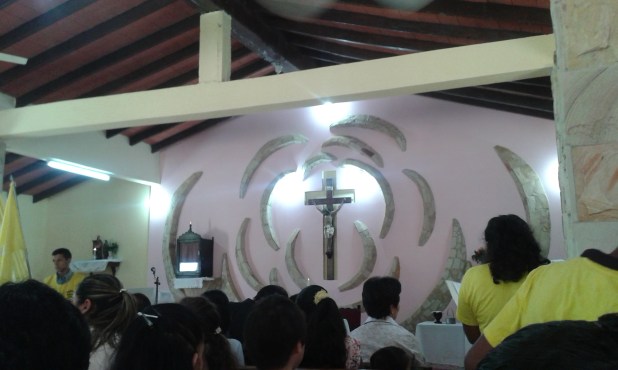
Anyone who has been in a Paraguayan Catholic place of worship knows what I mean by the Jesus cross. The cross is carved out of wood and has a bleeding Jesus nailed to it. He is wearing a crown of thorns. The one we were getting was about one and a half feet tall. It was painted blue and there was a little angel that attached to Jesus’ chest. I thought of vampires, but imagined the angel was supposed to be healing him.

The mother walked slowly as she carried the cross. We returned to the car and went back the family’ home. When we arrived the grandmother came over, she lives across the street. I couldn’t tell if the grandmother was crying, but she kissed the Jesus on the face. “Welcome to our home,” the grandmother said to the saint.
The Bosses

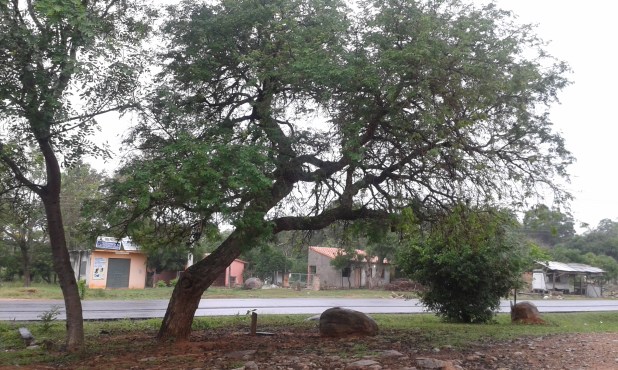
One knows when elections in Paraguay are on their way because public works, so long neglected, magically get finished in record time. The muddy street next to my school got cobblestones and it took less than a month. In a few weeks the highway by my house got repaved. The candidates also advertise themselves with signs plastered on every power pole and billboards propped above faithful business fronts. Conversations about what needs to happen in the community become more pointed, people of the same party meet to discuss politics, and candidates start visiting their supporters.

In other words, when elections are around the corner in Paraguay it’s not so different from September of a US election year. But, it is different when the elections are over and everyone is settled into their winning posts.

Paraguay is still a land with a mark of political corruption and political bosses —I guess you can argue the same for the States in some areas. Corruption by nature is often hard to see, especially from my view as an outsider, but Paraguayans grumble about it. The mayor a few towns over from my site was found guilty of taking large sums of money from the town coffers, yet I think someone told me he might run again. While I will leave the judgement of how much corruption there is among politicians in Paraguay to someone who has quantifiable data, political bosses are hard to miss for even someone like me who tries to steer clear of all Paraguayan politics.

Like most places, or at least the limited list of places I know, the best way to get a job in Paraguay is to know someone who has an “in” and who can help one by-pass the black pit of faceless applications. This is particularly important in a high context culture like Paraguay, where who one knows or is related to is often more important than what one achieved. Relationships in Paraguay are built over long conversations that develop slowly. Time saving and directness are not part of the traditional culture. But, in Paraguay there is often a deeper level of connectedness that will win one a good job, not just an okay job, and that is the political boss. If you’re like me and know US history by way of the different immigration movements and development of labor unions, you will know that politicians in the States had a long history of giving out jobs to win votes and saving the best posts for their most fervent supporters. And that is Paraguay today in a nutshell.

I don’t mean to say that without a political connection it is impossible to work in Paraguay, because that is not true, and I can’t speak for all Paraguayan towns when it comes to politics and work. But, this is what I can say. I’ve talked to a mother about her visiting the mayor so her daughter doesn’t have to…and the daughter ends up with a job in the city government. I know families that tow the party line and get side jobs in the local government, to supplement the money they already earn. I have seen families take steps to ensure that someone from their family is always at the political meetings and that the candidates they support pay them a visit to hear the family’s ideas. I don’t yet know first hand what will come of the political meetings and candidate visits, but if unemployed members of those families get work when their candidate wins, that will make me think a political boss had something to do with it.


Conversations With My 2-Year-Old Neighbor

Sometimes my 2-year-old neighbor decides to pop over for a visit. She’s in that wonderful stage where she asks questions about everything…usually more than many times.

Our conversations usually start with my bed. I live in a one-room apartment and my bed takes up more space than any other thing I own. It also has a mosquito net, thanks to Peace Corps’ effort to limit my chance of getting dengue.

Here’s one particularly memorable visit, boiled down:

“Is this your bed?” the little girl asked.

“Yes,” I said.

“Do you sleep here?” she asked.

“Yes,” I said. She then asked about the mosquito net, which we’d talked about close to 10 times before, and I answered.

“Do you sleep here alone?” she asked.

“Yes,” I said, starting to smile because I know what the next question will be.

“Why?” the little girl asked.

I don’t really answer. She asked about where my father and mother are…Where do they live? Why aren’t they here?

We then move on to the things on my table. She asked about a chap stick, the pens, some jars. After I explain each thing she exclaimed, “How pretty!”

On that visit I was in the middle of making lunch, which was salad and beet juice. I already knew from previous conversations that she doesn’t like veggies and most fruit. I knew she wouldn’t want my food, so I didn’t offer to share. I pulled out my dejected blender. My blender is held together by duck tape because there are huge cracks in the plastic. Surprisingly (wink), despite my half-hearted washing of the blender after every use, the base is grubby. It takes a special trick to make the top click into the base. I like to think it only works for people who love it.

“My mother has a blender like that,” my little neighbor said.

“Really? That’s great,” I said. I started to make juice.

“How pretty!” she said about the blender.

I look at her with fake surprise. I glance at the blender. “It’s a little ugly, isn’t it?” I asked.

A smirk like those kids wear after doing something they were told not to do in front of the person who told them not to spread across my neighbor’s face. Her little baby cheeks bulged and her eyes sparkled. “Yes,” she said and giggled.

The conversation ended there; she started repeating questions and then her mother called her for lunch. Now, every time I use or look at my blender I see her little smirk and it makes me smile. I learned that even an old, rundown kitchen appliance can add a little happiness to life if you let it.

Breaking the Mold

Origin: Ponderings on a rainy day in Paraguay.

Subject:  A limited attempt to justify my actions.

You know how when you put water in an ice tray, bag, or anything and then freeze it the water expands? If you’re not careful, the ice will break the container as it freezes or you end up with not-so-aesthetic ice cubes.

I feel like freezing water—the mold trying to keep me in shape will not hold up. I’m already overflowing, just imagine what’s going to happen when I solidify. Living and working abroad is the freezer, I’m the water molecule, and the molds are who I think I am and who I try to be. I often view myself as a homebody, but a homebody that tends to try to live more like a cosmopolite. Thinking about ice cubes made me realize, however, that I don’t fit nicely into the homebody or cosmopolite types.

Familiar. Routine. Known. Planned. Those are all things that I’ve always thought were important, and without which I’m usually harried, uncomfortable, and general miserable. But, at the same time, my fondest memories archive events that arose from spontaneity and going beyond my routine. And, I often do things to leave my routine behind: studying abroad for a time in high school, leaving Vermont to study in Washington, DC for college, and joining the Peace Corps. This juxtaposition in my personality—being comfortable only with the familiar but wanting and taking action to explore the unknown—started to make me wonder if I’m a masochist.

Don’t worry, after a thoroughgoing investigation I can say with certain confidence I am not a masochist. I just misjudged my character. I will explain.

When I left for a semester in Spain my junior year of high school people said it would change my life, and that I’d have amazing memories forever. When I left for college, people said to cherish my time studying because those years would be my best. When I left for the Peace Corps, people justified my leaving by reassuring me that the experience would be profound and the pinnacle in my life. I believed them, and now I think those thoughts were based at least partially on flawed assumptions.

All those times add up to more or less 6 years of my life. I am 25 and I want to live for a while yet. Were people telling me that my best years are now almost over? That might be the greatest tragedy that fate’s devised. I won’t accept that my life is a tragedy. What people meant to say, I think, was that studying abroad, college, and Peace Corps would be awesome because they would change up my routine and make life a fresh adventure.

“A fresh adventure”, that is the point of this rant. I like routine and familiar because they are easy. I periodically leave behind most everything that fits into the known not because I want to torture myself, but because comfort isn’t enough for me. I am on the trail of something else, and if I have to be uncomfortable sometimes to get there, it is a worthy sacrifice.

I do not think I could handle the life of a nomad; I’m just not that flexible. Nor do I think a fresh adventure is based entirely on changing location. However, I am reminded of the quote that pops into my mind more than any other as I go about my doings, “You have more power over your life than you think you do.”

In my heart I know I can not be happy just talking about the old times. Trying to accept the ordinary makes me restless. I am not a great adventurer or the bravest person, but I’m not scared to expand. I don’t want to just remember glory days, I want to be ever on the path of times worth retelling. That’s what I realized. Changing things up is scary, if it were easy everyone would do it. There’s always a chance for a real flop. But, since I can remember my favorite stories have always been those of people who took a leap. There is a beautiful, quaint simplicity to the stories of people who have spent all of their lives in the same place. But, there is something exciting and fantastic about those who can call more than one place home and who can say they’ve dabbled in many things. Molds are a way of setting a baseline. They’re a suggestion. As all expectations, molds are something to be surpassed.


Discovering Children

There are kids EVERYWHERE in Paraguay. It might be comical, but that is strange to me. I come from a part of the world were people tend to have few kids, later in life. Further, where I grew up it was rural so families were spread out. The distance between houses limited child congregation. When I moved out of my parents house, I lived on a college campus and then in a “young professionals” neighborhood—so basically no kids.

You might already be aware, but kids are hilarious. They’re always laughing and screaming and running. They get excited over the strangest things and distracted at the drop of a leaf. Did you know that 2-year-olds say the silliest things? Did you know 4-year-olds pronounce words wrong…and it’s hysterical?

Kids are so easy to please. One candy and they’re on top of the world. Kids are grumpy when they’re tired. Paraguayan children look at me and laugh—I’m not sure if that’s because I’m foreign, weird-looking, or just funny.

I think I’m going to miss all the kids around when I move back the States (though my position on having some of my own hasn’t change…um, no…maybe later, but probably not). I still haven’t figured out how to explain to Paraguayans that where I come from kids aren’t as profuse. I don’t know how to explain that I wasn’t raised having to take care of other people’s kids like all (maybe not all, but it seems that way) girls in Paraguay. In Paraguay, “woman” basically means “child bearer and nurturer.” I haven’t exactly figured out how to explain that I see myself as a woman, but I don’t think my main duty is life is to have children.

Culture: It’s the little things that get me…every…single…time.

Perspective Warp

At the beginning of June, I had my mid-service training—the last training with my group of volunteers until the close of service training. (Ten months to go in Paraguay.) We had a session during mid-service training in which we talked about how our perspectives on life and our work have changed throughout our time in Paraguay.

The idea is that everyone’s perspectively is constantly evolving as we experience new things. This evolution is accelerated for Peace Corps volunteers because we face so many new ideas, people, and places. As volunteers, everything (just about) we ever believed in or thought to be true is questioned and undergoes a thoroughgoing examination. You don’t have to be a particularly meditative person for Peace Corps to change you—actually, no matter who you are it will change you. Change is inevitable.

Change is neutral, so when I talk about changing perspective I’m not saying that one perspective is better or worse. The truth is that ranking perspectives is useless, and comparing them is only useful in the sense of 1) following one’s own progression and 2) understanding others more deeply so that living with them is easier.

I won’t try to explain my perspective on life; it’s too complex for a blogpost and likely to change tomorrow. What I find more interesting and tangible is how my perspective on perspective has changed since I arrived in Paraguay. Honestly, before coming here I didn’t think much about perspective outside of the arena of politics. In US politics we talk about policies and what the Constitution means. We talk about freedom and justice. Some people think abortion is just and an inalienable right and some people think it is sin and murder. Some people see love as love and some people see it as something that should and can only happen between certain individuals. Some people think everyone should have access to healthcare and some people don’t. The list goes on and on. And, I’ve only listed the black and white perspectives, there are infinite gray perspective in between white and black.

Perspective is more than politics. Actually, perspective is everything. That’s the first lesson I’ve learned. Perspective is the lens through which we see the world. We only see things within the scope of our lens and as our lens allows us to see them. Think of it this way: If your lens is sepia, nothing is pink or green.

Second lesson: One can’t force a perspective on others. Why? Well, first it’s impossible. Second, there is no justification for demeaning someone’s perspective. There are no ranks, just differences. People will change their own perspective, and the more smooth you are about your interaction with them the greater your impression can be. No one likes to be attacked, beaten over the head, and threatened with new ideas. Everyone can be trapped into exploring their beliefs. And sometimes that exploring leads to reflection and evolution.

Lesson number three: Perspective is interesting. Remember opinions, beliefs, and thoughts are different than perspective. Perspective is the bigger picture—the whole—while everything else is a pixel in the image. It comes back to a classic question: Is the blue that I see the same as the blue you see? Answer: No. Of course not. But, it’s okay that you and I don’t see eye-to-eye on blue, or yellow, or the meaning of beautiful, or…on anything. It’s okay because it makes things more exciting. A good storybook quote: “If every flower looked just the same, “Flower” would have to be each flower’s name.” Do you know the book?

What I’ve learned about perspective from Paraguay is that life is perspective and because we all have different perspectives life is fun. We won’t follow the same arc of perspectives in our lives. We won’t always agree or understand each other. But, we can certainly amuse ourselves trying.

Rainy Season

Ever lived in the tropics? Even been there during the rainy season?

Well, it’s not the rain that gets me (I live on a mountain so flooding isn’t a problem). It’s the inescapable dampness that permeates everything.

There are parts of my cement floor that haven’t looked dry since the first rain. I had to put my opened pack of gum in a ziplock bag…because the air turns the sticks of gum into a sticky, mushing goo. Every leather item in my house—wallet, belt, bracelet—I regulated to a ziplock bag. Even though I stored those items well off the floor and in the driest places in my house, a nice blue-green film grew on them. My wooden cooking utensil are now spotted with mold from just waiting to be used.

Washing clothes is a bear because the clothes won’t dry on the line. And despite my diligence, a small crop of mold started to form in my wardrobe. I had to wash about three quarters of my clothes as salvation from the infectious growth and certain squalor.

It’s between 60 and 75 degrees Fahrenheit and it feels like the pits of winter (and technically is here). It’s partly the breeze that cuts through my uninsulated house without shame that makes mild temperatures seem frigid, but it’s mostly because in the shade the dankness is finger-numbing.

Of course, winter only lasts a couple months. I have grapefruits, oranges, and mandarines sitting on trees, ripe and ready for picking, whenever I need a vitamin C boost. The sweatpants, knitted socks, sleeping bag, and heavy comforter that seem outlandish in the thick of summer are my key to survival when bedtimes comes these days. Bedtime comes hours early and wake up time comes hours late. It’s just too dark or too cold to function at optimal rates.

What would you say?

Celebrating Teachers' Day

Celebrating Teachers’ Day

Community member: Do you have a boyfriend?

Me: No.

Community member: But you’re pretty.

Me: …

~

Community member: When are you going to have kids?

Me: I don’t want to have kids.

Community member: You’re bad.

Me: …

~

Community member: Give me your eyes.

Me: What?

Community member: I want your eyes.

Me: …

~

Community member: Have you gained weight?

Me: No, I’m the same as I was.

Community member: You’ve gained weight.

Me: …

~

Community member: Do you have a boyfriend?

Me: No.

Community member: In your country?

Me: No.

Community member: How about a Paraguayan?

Me: No.

Community member: Why not?

Me: …

~

Community member: What is your religion?

Me: I don’t practice religion.

Community member: But you’re Christian, right?

Me: I don’t have a religion.

Community member: God exists.

Me: …

Introvert

Typical girl birthday party table center pieces/guest gifts.

Typical girl birthday party table center pieces/guest gifts.

Why don’t you just ask?

Pause, frozen, unable to move:

They could look at me funny.

Maybe they won’t understand me.

Maybe they’ll be mean…they could lie.

What if they think I’m stupid?

I don’t want to inconvenience them.

I wouldn’t want to make them uncomfortable.

What should I say? How should I start?

~

Why don’t you just go and buy it?

Oh, it’s not the money. I’m good at saving.

So exhausting, the thought of shopping.

How many people will I have to talk to?

Are the prices on the items? What…I have to ask?

Is the salesperson going to follow me around?

Will I be able to try it on? Privately.

What are the dressing rooms like?

The store might be packed or it might be empty,

but I’m not sure which is worse.

How do I say I don’t want to buy it?

Is it weird that I need time to think?

~

Don’t be lame, parties are fun.

Yes, but where to begin.

Who should I talk to first?

How many people do I have to talk to?

Should I say “hi” to everyone?

And if I don’t know the people there…

Will they talk to me?

So, when someone ends the conversation,

Does that mean they were bored?

Or is that just the normal sequence of things…

At a party?

Fun, yes, but exhausting. Every word, enervating.

~

It’s all about who you know. Your network.

What does “know” mean exactly?

So, like, do I invite them out to coffee?

Schedules are complicated.

Do I just follow up with a note?

What should I say?

How often should I talk to them?

It’s so painful to think that

I might annoy them…

Or that they thought I was boring.

If they don’t remember me, does that mean I’m forgettable?

But I don’t want to know them JUST

So I can ask them for something…

No, I can’t do that.

So how can I get to know them…

As something more than an acquaintance?

They are so busy. They’ve made that clear.

~

Why didn’t you come?

Truth: I don’t know. I guess…

I was worried I wouldn’t have time to recover.

I wanted to see all of you, but didn’t know

What to say or if you wanted me there.

I was worried it was just a polite invite.

But, not a heartfelt one. I should be more confidant.

The travel. So many hours with people

I don’t know.

Then there’s all the smiling.

The catching up because

I didn’t know that was happening in your life.

~

What’s the problem exactly?

We’re in a sea of social bonds

Instead of hydrogen bonds

Extroverts are buoyant

Introverts are dissolved

It’s science. A hard truth. Reality.

Roots

Villa Florida, Misiones, Paraguay

Villa Florida, Misiones, Paraguay

The day I felt most successful in Paraguay was the day I fixed my sink, fixed my toilet, taught 5 hours, and then tutored someone in English. But, it wasn’t the teaching or tutoring that made me feel like a champion. There is something incomparably gratifying about fixing things all on my own.

A simple joy derived from working with my hands on tangible things stems from my roots. My father is a carpenter, furniture maker, set builder, scenic designer, and general jack-of-all-trades when it comes to buildings things (petty much any medium). My mother is an artist (painter and sculptor) whose dabbles (and dives) into costume design, house building, furniture making, and set design. My stepfather is a furniture maker who also builds houses, fixes just about anything, goes logging with his horse, and changes his truck’s oil on his own. My stepmother, she’ll try to tell you she’s not crafty, but she knits, draws, and knows more about remodelling than she lets on.

A lot of what I do in the Peace Corps is intangible. I teach life skills. I teach English. I talk about health theoretically and US culture. I try to set an example for all the young women who cross my path. But, aside from the occasional breakthrough—like when one of my youth answers a question with an answer so profound it makes me pause or one of my students strings together a good sentence or two in English—I don’t see results.

On the flip side, when I fixed my sink and toilet I instantly saw my success. One minute my sink was clogged—so obviously I took it apart and in doing so discovered a critical screw was stripped (from years of abuse) and I couldn’t put it back together—hours later it was functioning better than it had before I tampered with it. As for my toilet, the connection between the pipe that brings clean water into the toilet every time I flush and the toilet itself was demolished. Every time I flushed there was a jet of water. The water was only clean, which was nice. A trip to the hardware stone, lots of explaining and acting out what I needed, and I came home with all I needed to fix everything. Whoop! Done. Master carpenter right here, in the middle of Paraguay! Take that Mr. Machismo.

I can get all fancy with my talk of and work in social marketing, behavior change, and capacity building, but it will always come back to the same thing. The day I changed the lock on my door with just a knife I was ecstatic. The day I fixed my sink and toilet, I could have taken on anything. I can fly as far away as I want, but I won’t forget my roots. Not for nothing.