Life’s Soundtrack

At first it was strange to throw toilet paper in the toilet rather than the wastebasket and be in a comfortable climate rather than melting of heat. Those contrasts caught my attention first and in a jarring way when I arrived back in the US several days ago, after living as a Peace Corps volunteer in Paraguay for 27 months. But, where one puts toilet paper and how the weather is have always been minor details of life to which one easily adjusts.

My Peace Corps service ended on April 8, 2016. And, I’m still journeying to where I’ll live next. I’m visiting family, not seen for over 2 years, before I settle into what I imagine will be a hectic lifestyle. And as the visiting continues, I’m taking my time to adjust to this new world called the U.S. of A. It was both out of urgency and strategic planning that my first stops in America were to visit my grandparents. I spent so many hours sitting, chatting, and talking about old times with Paraguayans, doing the same in English with family has been a treat.

But, even in the bubble of my grandparents’ homes and neighborhoods my time in Paraguay seems to fade like a dream. As one person commented on Facebook, “It happened and now it is over.” Or, as my grandmother said, “that place you visited.” I had to laugh at the choice of the word “visited.” Can anywhere one stays for over two years count as a visit? “Visit” seems like such a trival word to describe a place I consider home and from which I emerged a new person. Words. That brings me to the point of this ramble.

There are many details that are different about living in Paraguay and living in the US. For example, I can talk to a guy my age in the US without anyone jumping directly to the conclusion I have a fling with him, where as in Paraguay people would most likely think there was something going on between he and I. But, for now, the diverging details are not overwhelming. The harshest changes I currently feel are the different life sounds between the US and Paraguay and that I have lost the key words and phrases I’ve been using for two years to express my thoughts and feelings.

On one hand, it is nice to once again understand what everyone is saying around me. On the other hand, it is so distracting to know every blasted word the people in line in front and behind me are saying. Who should I listen to? How can I think of my own words when there are so many words flying around me that I effortlessly understand? It was a lot easier to tune out in Paraguay where I did not understand every thing people said.

I am joyful to hear so many people speak my native tongue, but my goodness how the sounds that make those words sound like gravel against a shovel or nails on a chalkboard. I never realized how ugly and harsh English can sound. The twang, whine, and nasal of English words is almost painful to my ears. I miss the round vowels of Spanish and the flow of Guarani–two languages that are melodic compared to the clanking nature of English.

It’s not just the sound of the language that is dissonant to my Paraguay-tuned ears. It’s the music, or more accurately lack of music. Where is my cumbia? My bachata? Paraguayan polka? Why are the houses and buses and streets silent? What is this new phenomena of silent nights? I used to have to wear earplugs to escape from Spanish-language love songs, and now I can sleep without earplugs because there is not even the roar of dirt bikes and heaving old trucks to disturb my slumber. Am I in the land of perfect sleep?

The soundtrack is different in my country from that of my Paraguay. But, that is not all. The words and phrases I can use to express myself are different too. It is obvious that speaking in different languages means using different words. However it is not the language, but the phrasing that is tripping me. Even when I translate, or try to translate, the words and phrases I used in Paraguay to English, it doesn’t work. Why? Well, a lot of the words don’t have an English equivalent. How the heck am I supposed to say “tranquilo” or “no más” or “opama” or “kaigue” or “hi’que” in this blasted native language of mine? I can’t.

“Tranquilo” could be translated to “tranquil,” “no problem,” and “life’s good,” but it means all those things and more. The same goes for the others. “No más” literally means “no more,” but it can actually mean “that’s all,” “no problem,” and “It’s not a big deal.” “Opama” literally means “It’s over already,” but that’s hardly a good suggestion of all the things “opama” can mean in context. Both “kaigue” and “hi’que” don’t even have English translations…so there’s that.

Sounds. Words. Music. Language. They dictate who we are and how we explain ourselves to others. When I first got to Paraguay, and for all my time there, one of the biggest challenges I had was feeling like I could not completely express myself in Spanish and Guarani. Ironically, I now feel the same way in my homeland. I’m at a loss for words and homesick for the familiar sounds of my community in Paraguay. The language. The music. The spitting of frying oil and roaring of dirt bike motors. I know the sounds of my American environment will soon become just background noise. But right now, my new life’s soundtrack is bombarding my conscious mind.

Land of Plenty and Unemployment

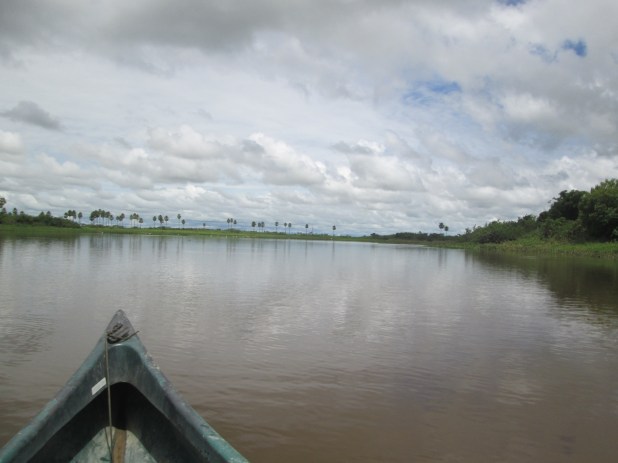
I went for a walk in the evening the other day. My walk took me along the main road and down to a river that was swollen beyonds its banks with rain. We’ve had a wet year and the rainy season is beginning. All along the flood banks men and women were fishing with their bamboo poles. Here fishing most often involves a string tied to a piece of bamboo, no reel, no bells and whistles. There are two primary kinds of fish, super bony and bony. The average fish is about the size of my hand.

Most people weren’t fishing just because they think it’s fun. As dusk was falling, two men on a dirt bike passed me, they were laden with silver, hand-sized fish. People here eat fish and even the small ones. One day the mother of the family I’m closest to was telling me about a woman in the community who has eight children. That’s a lot of mouths to feed with only the father working, and in Paraguay there are few jobs that pay enough to easily support a family of ten. I asked how the woman fed all her children.

“Well, they fish…” the woman I was talking to said.

Paraguay is fertile and has a climate designed for growing things. Fruit of all kinds, except apples and berries, is all over–bananas, all the citrus, papaya, passion fruit, pineapple, mangos, and the list goes on and on. There are several kinds of fruit in season at all times, and bananas are always available. With a little effort one can grow vegetables year-round and harvest most crops more than once every twelve months. In addition to fruits and vegetable, animals are part of most Paraguayan families’ lives. People who don’t live in cities can raise chickens and pigs on their plots, and even if they don’t own grazing land they can graze cows on public land and land that isn’t in use.

With some effort starving can be avoided in Paraguay even if money is tight. Further, the temperature is moderate. Unlike Vermont where winter exposure is deadly, in Paraguay, a roof to protect from the rain is enough to survive. Simple, rustic living spaces where families depend on their own crops to eat may not be a dream, but are realistic ways to live in Paraguay.

The point is that Paraguayan climate and geography are friendly toward life. People who are creative and willing to work can survive on almost no money. But, as hospitable as the earth and rivers are in Paraguay, job opportunities are limited. It is not uncommon for one person in a family of many to work, even if several people in that family are working age. The common example of a father supporting his wife, adult children before they marry, and his young children is traditional but not what most families would choose. It is a reality here because jobs are scarce and opportunities for professional employment lag far behind the number of people who are educated and trained.

As I watched the sun set over the river and bordering marshland, I thought about the juxtaposition of existence in Paraguay. I like to think Paraguayan society is moving toward providing its people as many career options as the land of the Guarani offers food choices to the hungry. I believe it is. The students I worked with want more than just a roof and bananas with fish. They want to travel and have cars and cell phones. Paraguay must change to provide what its future leaders demand or it will lose them.

Lice

Once when we were children my sister got lice from school. I remember it was a big, embarrassing ordeal. We all–my mom, my sister, and I–used lice shampoo right away. This memory makes me smile often, as I go about life in Paraguay. Things are so different here.

Most kids have lice in Paraguay…that might be an exaggeration, but not a terribly erroneous one. The difference is, however, that lice are not considered to be the end of the world in Paraguay, as they seem to be in the States. People I know here don’t use shampoo to kill the little buggers either.

Lice control in Paraguay involves a child sitting in her mom’s, aunt’s, couscin’s, or sister’s lap while the older woman combs through the girl’s hair with her fingers and kills the lice she finds between her finger nails. This is a ritual that is neither hidden or done with shame. It is undertaken out in the open and in front of visitors without hesitation.

Grooming in Paraguay is more communal than I experienced in the States. The lice picking used to remind of apes and the other habits between women (mostly) like cutting each other’s toe nails and cleaning each others feet made me a bit queasy. Feet are for walking, not for touching in my book. But, nowadays I find these behaviors normal, though I still don’t actively participate–I guess we all have our limits.

The easy-to-maintain sterile world many people in the States live in allows us to forget that germs and bugs and dirt are just part of life. I think many of us could benefit from remembering creatures like lice aren’t usually the result of negligence but are just part of this little world in which we live. I’m not exactly saying that we should all go out and get lice, but I’m suggesting that their appearance shouldn’t be a catastrophe.

5 Confessions of a Paraguay Peace Corps Volunteer

When I was preparing to leave for Peace Corps, returned volunteers told me that the experience would change me. Of course they were right. Most of the changes I’ve experienced are internal, feelings more than anything else, and can’t be summarized easily in a few words. However, there a some things I now do that are amusing to me. These new habits aren’t particularly profound, but they offer a glimps into my life in Paraguay.

5 Confessions

1) I automatically prepare a 2-liter thermos of ice cold water in the morning regardless of whether or not I have imminent plans of drinking terere. I know I’ll finish the 2 liters by the end of the day one way or another. Before Paraguay, there was nothing I drank every day (other than water of course), not tea and not coffee.

2) If it’s raining in the morning I sleep in, make mate, and decide it’s a “me” day. Only “big” commitments have a chance of breaking that routine. I used to be an “A” type who could not sit without work for even two seconds.

3) I plan the amount of groceries I buy based on how many families I think I’m going to visit that week. No matter what I do, every Paraguayan family I visit will insist on feeding me and giving me food to take home. This country is a land of super-hosts. I’m not a moocher and I don’t like to accept any kind of gift without a clear way to repay it, but Paraguayans have shown me a generosity so profound they’ve eased my “repay” obsession and given me the chance to just enjoy their company.

4) I have so many humorous, invented reasons for why I don’t have a boyfriend and why I don’t want do date whoever is asking me about my relationship status, I don’t remember the real reason for my singleness. In Paraguay, it’s just as common for people to ask me if I have a boyfriend as it is for them to ask me my name (well, almost). I don’t enjoy the prodding so common here in Paraguay, but having to think about what is up with my romantic situation so often has given me the chance to be creative. I do hope I keep the humor when I return to the States, but I won’t miss the prevalence of questions about my love life.

5) I know all the tricks to get out of eating a second piece of meat. Everything from what I finish first on my plate to where I look while eating is calculated for best results. Paraguayans eat a lot of meat and they are aggressively generous with sharing their food. I appreciate my hosts’ invites to eat, but I just can’t consume as much beef and pork as they can. When left on my own, I hardly eat meat of any kind.

Guardian Angel

My life can be divided into periods marked by which woman took me under their wing during that time. No span is without the support of at least one helping hand, and my time in Peace Corps is not an exception. My Paraguayan guide is Herminia. She is 60-something-years-old and I think of her as the guardian of my spirit. Not my spirit in a religious sense, but more as Merriam-Webster defines it, “the force within a person that is believed to give the body life, energy, and power.”

Herminia was once beautiful. She tells stories of her long hair and running away to Brazil when she was young. The traces of beauty remain, but I know her better for ignoring the obsession of perfect appearances most Paraguayan women have. Herminia’s hair is always twisted up in a nice clip. Her legs are bowed in, highlighted by the faded tights she most often wears. Her threadbare shirts are filled with holes. As much as her daughter tries to get her to wear a bra she usually doesn’t, finding them to be nothing but torture. She is clean and her nails show the remnants of paint. Her most defining feature is the lines in her face, which are caught between telling the story of a life filled with laughter and a life of nervous outbreaks.

Herminia did not go to school after second grade. She is the mother of 3, and the main caretaker of one of her grandsons. These days, Herminia lives with her aging mother, so her mother will not be alone. Herminia is 1 of 9, but the only daughter. Herminia cooks the tastiest food over wood and charcoal fires. Sometimes she has all the ingredients for what she intends to make and sometimes not, but her food always turns out yummy. She has a cow whose milk she sells. She is a talker. She talks to all people. She was raised in Asuncion, so her Spanish is as ferocious as her Guarani. She knows the medicinal plants and she believes in God.

Paraguayans are the most welcoming people I have ever met. But, most of my Paraguayan friends and neighbors don’t seek me out. I am part of their lives when I show up at their houses, and I am on a different planet the rest of the time. Herminia is different. She comes looking for me. On those days when I hide in my house, having spent the pervious day there too, she charges across the street. I see her coming with her head high and a determined expression. “Where have you been, my daughter? I thought you were mad at me. Come over and we will make some rich food,” she says.

And I go to her house. We drink terere. We cook. We chat. We watch TV. And, the unexplainable gloom that comes to one unpredictably when she lives abroad is lifted. My energy is restored, and after I leave her house I am once again ready to face the Paraguay that hardly ever looks for me. I cross my threshold on my own, until the gloom returns. And the cycle repeats.

Herminia is the most open-minded Paraguayan I know in my community. I do not believe there is any conversation we can not have, or that there is any position on any topic to which she will not at least listen. I learned how to do the rosary in Spanish, I don’t know it in English, because she taught me. I learned it because it made her so proud that she could teach me. She shares her faith in her Catholic God, even though she does not expect me to believe. She tells me about the people of the community, if they are good or bad. She is a gossip, but I have yet to see her judge of character miss the mark. She tells anyone who asks about me, and most people do, that I am the daughter of the community. She says that all the mothers here are my mothers because I am far from home.

Herminia dances on chairs with liter beer bottles balanced on her head. She is my favorite dance partner. Once, we danced until 2 am, and she made me spend the night, sleeping with her and her grandson in one bed, so I wouldn’t have to walk home. At that time, she lived farther away than she does now. Herminia defends my sobriety as she sips beer she puts in metal cups so people on the street don’t know what she is drinking. She has a sweet tooth. She forgets where she put her glasses, her wallet…her grandson and I keep track of her belongings.

I can go to her house and talk a lot or say hardly a word. I can go read while they watch TV. I go to work, but sometimes Herminia does all the cooking. We move the table from shade patch to shade patch until lunch time. Then, we eat in the living room, plates on our laps, because Herminia’s mother can no longer lift her arms to eat at the table.

When I travel, Herminia watches my house from her yard across the street. She does not know my every move or try to tell me what to do, but she keeps track enough to know everything is going along without trouble. Paraguay knows when I am down. And usually, Paraguay sends in Herminia to bring me up again. I can not think of a better agent of change.

Blogging Abroad's Boot Camp Blog Challenge: Starting January 2015

Humanity

I spend hours on the bus in a month, and, perhaps, as many waiting for buses. It’s normal now. I’m not allowed to drive any vehicle or ride a motorcycle (thanks Peace Corps rules). Cars are scarce. I walk a lot, but walking has limits. However, despite the hours of sitting and the crowded rides, I like the bus. The bus is a perfect window into humanity. All kinds of people ride the bus–rich and poor, old and young, educated and uninformed, friendly and grumpy…just about everyone.

On many bus rides in Paraguay I have been reminded that chivalry and kindness are not only part of nostalgia and history. They are alive and well. A good illustration of their perseverance occured on a recent bus ride to the grocery store. It is a half hour trip to relatively urban center.

I was sitting on the bus looking at nothing in particular and thinking about something that has since been forgotten. A passenger stood. Bus stops are not a thing in most of Paraguay; one can get on and off the bus just about anywhere. To get on one flags the bus driver down much like one might a taxi. To get off one pulls a string that sounds a bell up by the driver. The passenger who stood was a particularly petite, young woman. I noticed her because of her slightness and because she was holding a fine, fat baby. Buses in Paraguay jolt and rattle, such that it is almost always necessary to hold on to something at all times or risk toppling over. The unsteady footing is even more likely to fling a child down the bus isle than an adult. The woman carrying the baby in one arm and holding a handrail in the other charged quickly to the back of the bus to pull the string and to get off. As she moved away from her seat a toddler, perhaps three, started to follow her. Toddlers are goners on the bus if someone doesn’t hold their hand. They forget to steady themselves and they move like rag dolls.

My gaze, and those of all the passengers between the open seat and the back door of the bus, moved from the woman to the child about to embark on a rocky road. I worried for a moment, but hardly a moment. A man across from the boy reached out his hand, grabbed the boy’s arm, and steadied him as he teetered along. When the man’s reach was exhausted, a woman took hold of the boy. The boy continued walking, passing onto the guiding hand of a third person. The boy made it upright and not phased to the door and got off after his mother.

Three strangers stepped in to help a child without a word or pause. They were not asked and they were not thanked. If that is not humanity, I do not know what is.

Blogging Abroad's Boot Camp Blog Challenge: Starting January 2015

Building Blocks

There is no such thing as an average day in the Peace Corps. Each day is filled with the mundane of living (cleaning, cooking, waiting…) and spiced with unexpected adventures. My projects and routines change with the seasons. During the school year I taught classes and during the vacations I visited friends and explored new places. This current period stands out because it is comprised of my final months as a volunteer in Paraguay and summer vacation. Despite the disparity in my activities, it is not completely futile to attempt to explain what a day in my life is like. There are two fundamental occupations that fill my time: fostering relationships and growing personally.

Fostering relationships

Peace Corps volunteers have three goals–to help people in their country of service gain new knowledge and skills, to share about American culture, and to learn about the culture of their host country. Those goals are a long-winded way of saying we volunteers are here to share all we know with whoever wants to listen and absorb as much as we can.

Most of the time outside of my house I spend with people in their homes. We sit. We drink terere. We talk. We cook. We eat. We stare into space. During my almost 2 years in Paraguay, I have already spent more hours visiting my dearest Paraguayan friends than I have spent with most of my grandparents, aunts, uncles, and cousins in the States during my life to date. Those hours of sharing with Paraguayans created the exciting events of my service: going to birthdays, being in a wedding, dancing all night, sharing Christmas dinner, going on road trips, and participating in religious activities like mass and patron saint’s day celebrations.

Even in the classroom, the relationships I developed with my students are what made me successful. By our second year together, my students were comfortable enough to ask questions about sex in my class–a feat in a country where the topic is usually only joked about in formal settings and invokes shame in most other contexts.

In summary, most of my energy in Paraguay is dedicated to visiting. You might ask, is visiting your job? Can visiting be a job? And my answer is a shrug. It’s not a 9-to-5 no matter how you look at it. But, this place is one where who, not what, one knows profiles and opens doors. I could not have taught English or youth development if my community members didn’t know me. They would not have trusted me with their children. I could not have thrived here without spending hours with my foreign friends. I would not have learned who I am. My friendships here gave me a professional and personal identity.

Growing Personally

When I am not sharing time with people, informally at events and in homes or formally as a teacher, my energy is mostly dedicated to either doing personal projects or cleaning my house. I will spare you the details of housekeeping except to say that you should take a moment to imagine a life where the power and water do not always work and there is no trash pick up or dump, vacuum, dishwasher, or laundry machine. I promise, speaking from experience, that such a life is quite different from one with those luxuries. Personal growth is inescapable in the Peace Corps, especially in Paraguay where some hours of most days are too hot to do anything other than think. Amusement falls soundly on my own shoulders. I live alone. I am the only American in my community. To visit the nearest volunteer, though not far away, requires a bus odyssey. I can not spend every waking hour with Paraguayans. I do not have a TV. I can not stream videos. My technology prevents me from watching many videos. I can only read so much. I write. I play the guitar. I think….there is so much time to think about hopes, dreams, and wishes.

Summary

I typical day for me in Paraguay is a spread of eating, cleaning, chatting, writing, thinking, navigating, and enjoying what and who is around me.

Blogging Abroad's Boot Camp Blog Challenge: Starting January 2015

Blurred Lines: Outside or Inside?

Everyone living in Paraguay struggles to stay cool in the almost constant heat. Sometimes there is a breeze. Sometimes it rains. But, with the regularity one should expect from a tropical region, Paraguay swelters in a humid heat. Because of this, the way people live here, in terms of housing, is very different from what I knew in the northeastern United States. Mainly, the lines between the indoors and the outdoors are blurred.

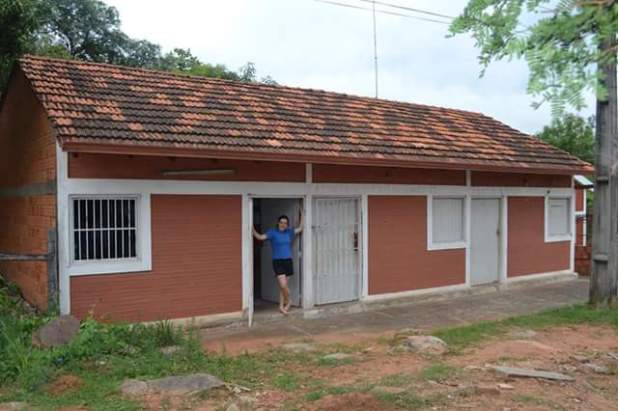
Most families with any wealth live in houses built of bricks and with tile roofs. The bricks are hollow terracotta and about half the size of a cinder block. Families with less money live in wooden houses with thatch or metal roofs. There is no insulation and most people do not have AC or a heating system in their home… fans are a staple.

Many families cook outside using either wood or charcoal fires. Some of these outdoor cooking spaces have a roof, but not always. Smaller houses, perhaps the norm in Paraguay, do not always have a living room or a dining room. Those rooms are not necessary because relaxation takes place outside. Paraguayans use their patios as the main living space. They sit out there to drink terere and to hang out. Some families even eat outside and will move their TV so they can sit in the shade of a tree to watch their favorite show or the soccer game.

The challenge of beating the heat does not only dictate where people spend most of their time but, also, influences how Paraguayans construct their homes. Paraguayan architects and home builders erect houses with doors and windows positioned carefully to create a cross breeze. Homes may have few windows, because the sun coming in is too hot, but the openings in a house maximize air flow. Further, Paraguayans leave all their doors and windows wide open until they go to bed.

I never thought about how much time I spent locked away from fresh air, but since coming to Paraguay it has been hard to ignore how much of my time in the States was passed in buildings. It is rejuvenating to see the sky, feel the wind, and sit among plants.

Blogging Abroad's Boot Camp Blog Challenge: Starting January 2015

When the Wind Comes From the South

My señora friend and I sat behind her house in a shady patch amongst the trees and not so far from the fire where she was cooking beans for lunch. We were sitting there because everywhere else was too hot. It was a suffocating heat that leaves one misted even if she lies down or sits like a statue. We talked about the heat, perhaps the most important topic of conversation except when it’s raining, and drank terere.

“At least there is a strong wind,” she said.

“Yes. That means it’s going to rain for sure, but maybe not because it is coming from the North,” I said. Paraguay has taught me how to feel the rain before it arrives. Life changes when it rains. It is critical to know when a storm is coming.

“That doesn’t matter, the wind can come from whatever direction,” the señora said. She smiled.

“When the wind comes from the South even the girls’ faces are ugly.”

“What?” I asked.

“We say here that when the wind comes from the North girls smile and there are flowers, but when it comes from the South even the girls are ugly. You know that everything unpleasant, the cold and rain, come from the South,” the señora said.

She got up to check on her beans. She was making a dish that when done would have beans, vegetables cut too small to see, noodles, cheese, milk, animal fat to get it started, and potatoes. It was one of the yummiest dishes I have had in Paraguay. While she cooked, I stayed to nurse the terere. I am not from here. The señora knows I can’t handle the fire smoke, it makes me cry and hack.

The thunder started that night. I hurried to fill every empty container with water. I did my dishes right away. The water went out as soon as I was rinsing my laundry. I would have liked to rinse it one more time and fill the basin, but one can’t have everything.

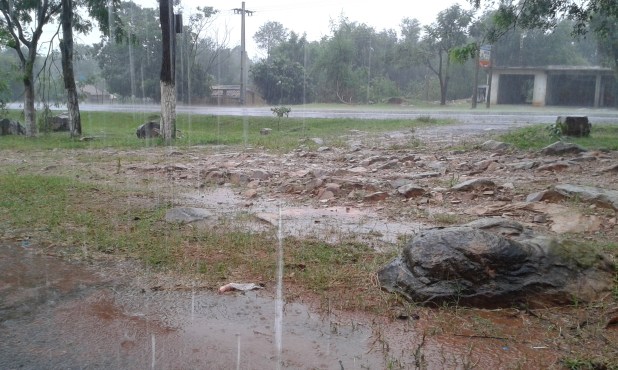
The rain started just before 11 pm. It poured so hard that it was still going at dawn. When the first drops pelted my roof I sprung out of bed. My ceiling leaks in a couple of places. It’s not a huge problem because most of the leaks are over nothing important and I have a cement floor that soaks up the water. I put out pots. The tat-tat-tat of the drips beat like a drum. A new leak started last rain storm, so I had to move one of the chairs I use as a bookshelf. To be safe I put a plastic bag over the fan motor. It was raining so hard the water blew in the peak at the crest of my roof. I slid my bed as far to one side as I could without getting too close to the window that even though closed was letting in a small stream. I was thankful the power didn’t go out. Last storm, I was surprised by the wind and caught by 27 hours without power.

The thunder made our community sound like a war zone. I have never heard thunder or seen lightening as dramatic as Paraguay. I doubt there is a sky more beautiful than Paraguay’s, and though I decided this long before my first Paraguayan lightening show, the electricity in the air confirms my judgement every storm.

The morning after the conversation with the señora and the following storm, I carefully observed the few girls who passed my house in the rain. They looked as they did the day before, however the plants around them were a brighter shade of green. Maybe the North wind didn’t change the girls or bring flowers, but it did highlight the best side of the foliage.

The Paraguay I Know Is Catholic

It is not necessary for me to say, but it is worth sharing two facts. First, the Paraguayans I know understand the world as Catholics. They may not go to church all the time, but they think about Jesus often and use God to explain most things. Social lives are largely centered around the church. Many of the biggest parties and drinking events spring from patron saint celebrations. Second, I am not Catholic. But, my beliefs do not prevent me from participating in Catholic religious activities if and when I want.

I traveled to Paraguay with the desire to help make the world better, but I came here as a student. My openness and curiosity to experience and to understand how Paraguayans practice Catholicism has given me great insight, despite putting me in the occasional uncomfortable situation. “Catholic” has come to represent, in my mind, the life philosophy of some of my closet Paraguayan friends. These days, when I go to a church function it’s not only to learn what issues my community thinks are important enough to bring before their God, but also because a friend invited me. For example, I know it means a lot to my señora friend when I do the rosary with her, and her happiness is enough to dedicate 60 minutes of my day to her God every so often.

It is impossible to escape Catholicism in Paraguay if one lives here and talks to Paraguayans. If one mentions an event in the future or tries to make plans to do something Paraguayans say it will happen “if God and the Virgin Mary permit it.” If one talks about marriage, it involves the church. If someone is sick or something is bad one prays. Families are divided by the Catholic Bible study to which they send their children. Public buses have Jesus painted on them and tout slogans like, “My path is guided by Jesus.” Passengers on buses cross themselves when they pass churches and cemeteries. Churches host parties and cookouts. People wear crosses and have saints’ cards in their wallets, religious photos as their profile pictures, and Jesus images hanging on their bedroom walls.

The way I see it, Jesus and Mary are Paraguay’s way of setting a moral code and giving meaning to life. In the end, it doesn’t matter that my Paraguayan friends and I have different reasons for why we think it is right to be honest or to treat people with dignity. What is important is that we share the values of truthfulness and respect.

I never needed to think about what “tolerance” meant before coming to Paraguay. But, Paraguayan tolerance is how my community embraced me and my tolerance is why I have learned and done so much since coming here. Paraguay has taught me that tolerance is not just letting people practice their customs in peace. It is being open to learning how people’s cultural practices relate to their lives in general and, more profoundly, what their beliefs boil down to in their simplest form. We all have a lot to learn from people who see the world differently from us. And, we all have more values in common than it might seem at first glance.