
Roots

Villa Florida, Misiones, Paraguay

Villa Florida, Misiones, Paraguay

The day I felt most successful in Paraguay was the day I fixed my sink, fixed my toilet, taught 5 hours, and then tutored someone in English. But, it wasn’t the teaching or tutoring that made me feel like a champion. There is something incomparably gratifying about fixing things all on my own.

A simple joy derived from working with my hands on tangible things stems from my roots. My father is a carpenter, furniture maker, set builder, scenic designer, and general jack-of-all-trades when it comes to buildings things (petty much any medium). My mother is an artist (painter and sculptor) whose dabbles (and dives) into costume design, house building, furniture making, and set design. My stepfather is a furniture maker who also builds houses, fixes just about anything, goes logging with his horse, and changes his truck’s oil on his own. My stepmother, she’ll try to tell you she’s not crafty, but she knits, draws, and knows more about remodelling than she lets on.

A lot of what I do in the Peace Corps is intangible. I teach life skills. I teach English. I talk about health theoretically and US culture. I try to set an example for all the young women who cross my path. But, aside from the occasional breakthrough—like when one of my youth answers a question with an answer so profound it makes me pause or one of my students strings together a good sentence or two in English—I don’t see results.

On the flip side, when I fixed my sink and toilet I instantly saw my success. One minute my sink was clogged—so obviously I took it apart and in doing so discovered a critical screw was stripped (from years of abuse) and I couldn’t put it back together—hours later it was functioning better than it had before I tampered with it. As for my toilet, the connection between the pipe that brings clean water into the toilet every time I flush and the toilet itself was demolished. Every time I flushed there was a jet of water. The water was only clean, which was nice. A trip to the hardware stone, lots of explaining and acting out what I needed, and I came home with all I needed to fix everything. Whoop! Done. Master carpenter right here, in the middle of Paraguay! Take that Mr. Machismo.

I can get all fancy with my talk of and work in social marketing, behavior change, and capacity building, but it will always come back to the same thing. The day I changed the lock on my door with just a knife I was ecstatic. The day I fixed my sink and toilet, I could have taken on anything. I can fly as far away as I want, but I won’t forget my roots. Not for nothing.
Oh, I Couldn’t Because…

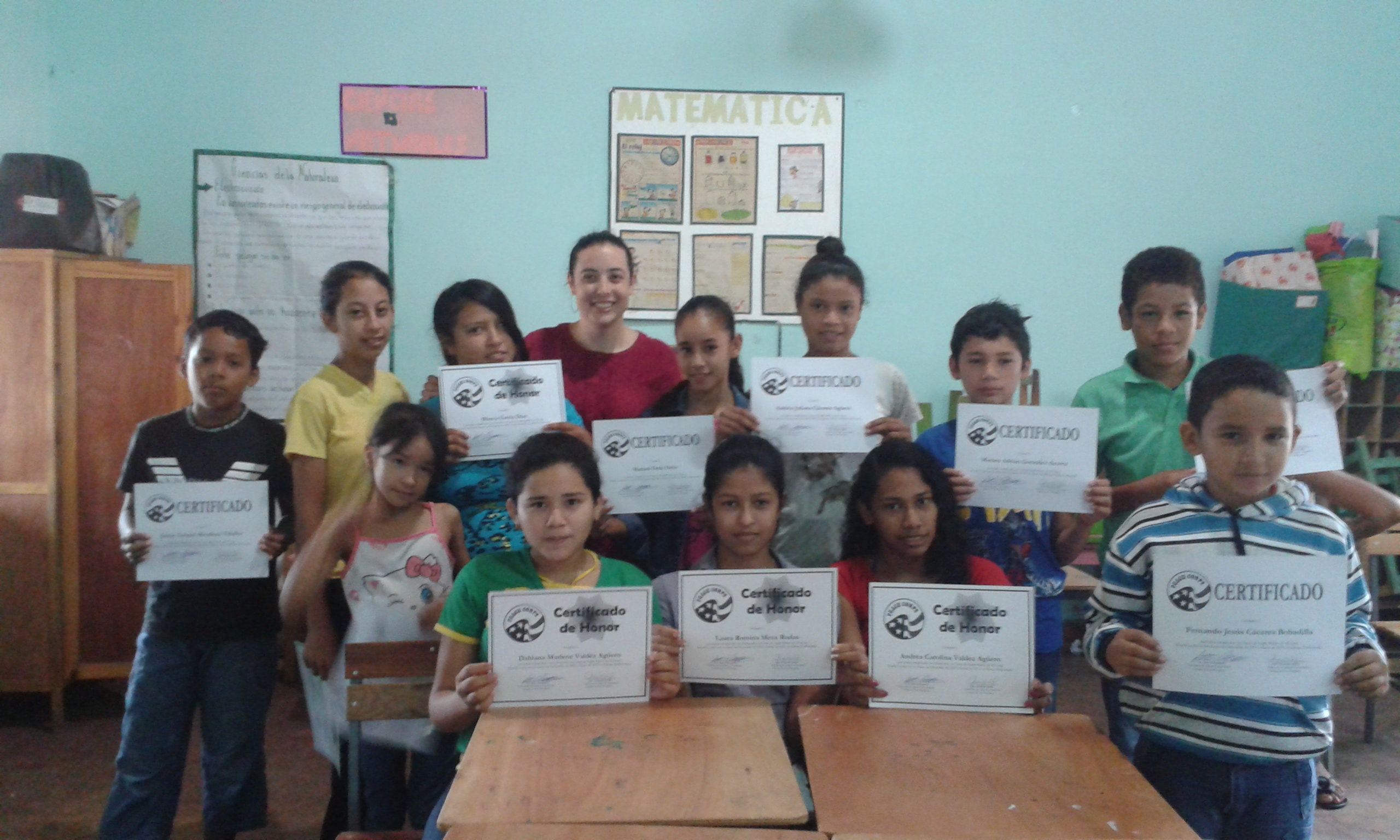
Summer English Class Champions

Summer English Class Champions

Because I had to wash my clothes. Because I had to clean my house. Because I didn’t have the energy. Those excuses would NOT fly in my US world, but in Paraguay they aren’t only legit excuses but won’t be questioned.

It’s amazing. I can come up with an excuse that would be completely understandable to my friends in the US. Like, “I had a ton of work for the next day and I needed to study.” If I try that excuse in my community people give the half nod that means something like, “Right, you just didn’t want to come. Lame.” Conversely, I can simply say, “I needed to wash my clothes. It’s been raining lately, so it’s been hard to wash them.” People will nod understandingly. No questions asked. Done. I didn’t come because I had to wash my clothes. Obviously. I had to take advantage of the sun.

As for cleaning the house. I’m a woman, after all. I couldn’t let my house be dirty, right? What would that say about my womanhood? Done. I didn’t visit because my house had to be cleaned that instant.

The excuse that I didn’t go because I didn’t have the energy is the hardest for me. I get the clothes washing. I wash clothes by hand. It’s a chore, and if it rains clothes don’t dry well. The sun is a valid concern. I also get the house cleaning bit. I might not agree with it, but the house is the women’s domain in Paraguay. Women in Paraguay are very proud of how they keep their homes, and to fail on that front would make people judge me. I do what I can to keep my house almost up to Paraguayan standards. However, I do fail on the lawn sweeping and spider web reduction parts of the job. But, what exactly does it mean to not have energy to do something? Isn’t that the same as just being lazy and lame?

No, it is not, according to Paraguay. It’s a polite reason not to go. Sometimes it has nothing to do with being lazy. Maybe it was raining. Maybe it was too hot. Maybe the terere I was drinking was simply too good to leave.

Culture. It permeates everything. Even the excuses we use to get out of things.

From the Same Country But Lightyears Apart

The View from My HouseCulture shock and disparities between host country and US culture are popular topics in Peace Corps training and volunteer stories. But, less talked about, is the diversity of Peace Corps volunteers themselves.

We volunteers come from all parts of the US. We have unique life experiences, reasons for joining Peace Corps, and life goals. We are in no sense homogeneous after you discount the fact that we are all US citizens. Our diversity is often overlooked, and by more parties that you might expect.

It’s not surprising that host country nationals might think all Americans are the same. As volunteers, we might be the first person from the US our community members have met. It’s also not entirely shocking that people in the US tend to stereotype volunteers. Most people in the US only know several returned volunteers personally. More surprising, however, is that Peace Corps staff and volunteers also often make the assumption that because all volunteers are from the States we have a lot in common.

Let me give an example. In Paraguay, one common topic in Peace Corps training and subsequent conversations with volunteers is catcalling. Street harassment is something that happens in Paraguay and, depending on where you are, it can be frequent and daily.

What I’ve found fascinating about the numerous powwows to discuss street harassment I’ve experienced with volunteers is how it is discussed as though it is something that does not happen in the States. Catcalling often is brought up as one of those unsavory parts of Paraguayan culture with which one has to deal.

I find this a mystery. Catcalling is not unique to Paraguay or foreign places. It is alive and well in the US too—from boys whistling to men who follow you down the street offering undesired commentary. My sister and I sometimes talked about our street harassment experiences when I still lived in the States: She lives in New York City and I lived in Washington, DC.

Catcalling is something new to many volunteers in Paraguay, and they find it very upsetting. But, for others, like me, who experienced catcalling in the States it is not new and we had strategies to deal with it before coming to Paraguay.

Experience with street harassment is one example of how volunteers are disimilar, but there are many examples. Our variance highlights the vastness and diversity of the US and reminds me that nationality isn’t what makes us similar or different. Nationality is one of many fragments that make up a person; it is not the summary of a person.

A Centralized Country

CaterpillarAsunción, the capital city, is the center of Paraguay in almost every sense of the word “center.” Imagine if Washington, DC was the only city in the entire USA with everything you might need. Picture a USA where NYC, Los Angeles, Houston, Chicago, Philadelphia, Boston…all the big cities didn’t exist, or Washington, DC alone filled each’s role.

My Point:

Paraguay is a centralized country in the sense that as you get farther from Asunción you have less access to resources like consumer goods, government services, and employment opportunities. For example, you might be able to buy sneakers in any urban center, but not the brand you want. You might be able to see a doctor to get your cough checked out, but you might not be able to get tested for HIV or see a dermatologist. You might be able to work for a nonprofit, but not an international NGO. You might be able to join a gym, but not a cross-fit gym.

Snapshot:

Let’s say I want to buy a tent, Asics running shoes, peanut butter, a violin, and a good bicycle. Let’s also say I want to go to the movies, go to a sit down restaurant that serves non-Paraguayan cosine, and sleep in a room with air conditioning. I want to withdraw money from an ATM, use wifi, make some calls with my cell phone, and get my Mac computer fixed. On top of that, I need to go see a specialist and get a new government ID. I also want to work for a big company, volunteer at a nonprofit that focuses on girls’ empowerment, and be part of a young professionals’ group. I want do karate and join a book club. Lastly, I like to travel so I want to have access to an airport with flights to other continents and a bus terminal with buses to other parts of Paraguay and to neighboring countries. The only place in Paraguay where ALL those things exist is Asunción.

Summary:

In Paraguay, it’s not just a question of city versus countryside. It’s a question of Asunción versus anywhere else in Paraguay.

One Year In Site

SunriseI’ve made it halfway. One year down, one year to go. But, don’t think of it as a countdown. When the day comes to leave Paraguay my feelings will be ambiguous at best.

April 11 was the midpoint of my Peace Corps service. I feel accomplished; like I did the hour I escaped high school, the minute I graduated college, and the instant I finished my first marathon.

We do a lot of things in life. Some of those things are pretty kick-ass and some are down right boring. But, we all have landmark moments. Those moments when we feel like we’re getting somewhere. That our lives might have meaning. That what we are doing is good. That we are moving in the right direction. That we are capable.

That’s how I feel, still in the glow of my one-year mark. I’m in a good spot. I’ve had successes and I still have work to do. I’ve taken the bull by the horns, so to speak, in tackling Paraguay, my Peace Corps work, and myself. I’d say, of all those projects, self-improvement has been the most extensive, difficult, and rewarding of all. I give myself a lot of pep talks. I think a lot about who I am—my strengths and weaknesses. The Peace Corps makes you confront yourself. Plopping down to work in another country shoves your shortcomings in your face. You lack language. Relationships take unexpected forms. Work is different. Getting around is hard. There are hours alone. It’s challenging to talk to friends and family still in the States. You have to build a completely new life—activities, friends, places…foods.

Not everyone is given the opportunity to take 2 years to cultivate the best person she can be. The rat race, the hyperactive, the go-getter, the conquer-all-be-“successful”-ASAP-don’t-think-just-do-it realities don’t leave much time for reflection. It’s hard to ponder when you’re always on the run. When there’s hardly time to sleep. I came from the rate race, and I’ll probably return to it when all is said and done. But, I like to think that after Paraguay I’ll never completely get lost in the scramble. I’ll always be type A, but I now know there’s many ways to be one.

One year in site. What a trip. I’ve learned so much. I’m happy to muddle through the low points and soar through the high ones. I know in a blink it will all be over. Like a dream. Paraguay. Shit, that’s a place I call home.

A Sure-Fire Way to Spur Education Reform

Stick everyone who could make education reform happen, who is blocking education reform, or who isn’t interested in improving education in a classroom with 30 or more eighth graders. It would make waves. Of course this idea came to me as I started teaching again this school year. I have two classes with more than 30 students, and one happens to be eighth grade.

I’ve been thinking a lot about learning environments recently, and specifically how learning is significantly imperiled by each additional student you add to a class after 15. In my experience, 15 students is a golden number. Fifteen students is just enough to create some diversity of opinion, but not so big that students can easily hide from participating.

Before I started teaching in Paraguay, I was aware of the class-size discussion. Student to teacher ratio was something my parents sometimes discussed. It was something I was told to look at when picking a university. A low ratio of students to faculty members was something I touted when I helped recruit for my college. But, now that I’ve taught myself, I have a better understanding of why it is important to keep a balance between teachers and students.

Here are some of the differences between my classes that have around 15 students and my classes of around 30 students:

Around 15 Students

Around 30 Students

We finished all the planned activities in the allotted time.

We finish about three-quarters of the planned activities and go over time.

Students listen to the directions and ask questions when the don’t understand.

Students chat in groups and don’t bother to say if they understood the directions or not.

There is time to talk to each student individually and answer their questions, offer encouragement, and provide feedback.

Time is spent trying to maintain a semi-focused work environment and only very disruptive students and students who approach the teacher get a fair allotment of the teacher’s attention.

There are a lot of elements that go into making an environment optimal for learning. There are a lot of factors that make a teacher effective or ineffective. But, the short and long of it is that if the structure of the classroom itself is set up to falter, even the greatest teachers and the most studious students are at a disadvantage. I’m not saying that all students who are part of a large class aren’t learning. I’m saying that they deserve better. Ensuring that classes are an optimal size shouldn’t be debated. It should be an integral part of education infrastructure no matter where a kid goes to school.

Chipa Time: Semana Santa

Semana Santa is what Paraguayans call the week leading up to Easter. School stops on Tuesday, and most people get off work before mid-day on Wednesday. Families share a last supper on Thursday and every night there is a religious celebration of some kind—not everyone goes. The TV is filled with depictions of Jesus’ death and resurrection. The gory details are not spared.

After the last super, you aren’t supposed to eat anything but chipa until Easter Sunday, or at the least, you aren’t supposed to eat meat. Chipa is a kind of cheesy biscuit, that promptly gets stale.

The chipa tradition is neat because it is unique to Paraguay. The idea is that every family makes their own chipa, and as families visit each other on Friday and Saturday they exchange chipa. As I got ready for Semana Santa, my friends explained that people take chipa less seriously than they once did. Many people buy chipa these days, and most people eat other things (though they do avoid meat).

I made around 500 hundred chipa on the Tuesday and Wednesday of Semana Santa. Several of the señoras I visit most are part of a baking cooperative. I helped them make chipa for their clients, and also helped various community members who used the cooperative oven make their chipa.

Making chipa is a strenuous process. First, you whip raw animal fat, vegetable fat, or maybe butter with your hands until it is smooth, then you mix in all the other ingredients. You mix everything with your hands, and by the end the dough is crumbly. From that point, you knead the dough until it is the consistency of putty. From there, you shape each individual chipa.

I like chipa making, especially for Semana Santa, because it brings the women of the community together.

Road Kill

I live on a road with more traffic than perhaps the average road in Paraguay. So, I imagine I encounter more road kill than I might elsewhere. Road kill is a fact of roads. In the States I’m from the countryside, so deer, raccoons, possums, and frogs are the common victims. In Paraguay, it’s a little different. We still have the squashed frogs, toads actually—Paraguay has an interesting toad that is very large and numerous that comes out at night. We call them “sapos.”

In Paraguay, the main road kill victims are…dogs. Yes, domesticated dogs. Now, before your heart breaks remember that dogs in Paraguay are usually kept as guard animals and NOT as pets. So, no child is weeping over the carcasses. Actually, it seems people don’t notice because no one removes the carcasses.

The leaving of dog carcasses on the side of the road is what inspired this post. Perhaps you’ve been unfortunate enough to get a whiff of rotting flesh driving around the States, or perhaps you’ve had a mouse die in your wall. Well, in Paraguay it’s hot so flesh begins to break down right away. The beating sun on the roadside is a special inferno.

Have you ever wondered how long it takes a carcass to disappear? Have you ever wondered if the rate of decomposition is different in different places and climates? Well, I hadn’t until a recent run with two dog carcasses en route.

The answer, at least about the rate of decomposition in my community, is two weeks, more or less. In Paraguay, the sun is cruel. So, it takes care of things. What’s more, in addition to the animal scavengers and bugs you might know about that help with breaking down dead bodies, Paraguay has armies of ants. So many ants. Within two weeks, an average-sized dog carcass will be reduced to a dark patch, maybe with some bones, on the pavement.

The Route aka the Ruta

I live on a “ruta,” which is to say I live on one of the biggest roads in Paraguay—don’t let your imagination get away from you…it’s two lanes. What makes it a big deal is that it’s paved. Most roads are dirt or cobblestone.

My ruta has a steady stream of traffic. Where I live, a distance for any major urban area, the traffic never backs up. Vehicles are always on the horizon, but crossing isn’t difficult. You might be interested to learn that Paraguay has a robust trucking industry. The most commonly moved things (according to my observation) are cattle, yucca, whatever fruit is in season, and construction materials like bricks.

A note about cattle. I’m not talking about moving a couple of cattle and nor am I talking about already dead cattle already cut into nice little stakes. I’m talking about diesel-billowing trucks with two carts behind them each with maybe ten or twenty cattle. The cattle aren’t tied in or in individual stalls, they’re jammed into the carts side-by-side. The only reason they don’t fall over is because they’re packed in there only a little less cozy than sardines. They are not your dainty Jerseys or your stubby Angus. They’re a breed that ranges from white to light brown with large ears and skin dangling from their necks. They’re large, taller than many breeds, more like Holsteins than Herefords. Here cattle always have their horns, and they can sometimes be over a foot long, though usually they’re closer to six inches.

The ruta makes my community more prosperous than many communities that is hidden on some dirt road out in the boonies of Paraguay. Why? Because we have buses that allow us to leave more than once or twice a day. I have a bus out every 20 minutes from 4 o’clock in the morning to 7-ish in the evening. Buses come back to my community as late as 10 pm. That means people can work in other towns and cities if they want to commute.

But, like most things in life, the ruta brings a little bit of bad with the good. It is noisy. That’s one. It brings “extranjeros,” which is a term for anyone not born in the community and in Paraguay is the catch-all scapegoat. Extranjeros are the perpetrators of all bad things. But, more subtlety and interestingly, the ruta divides the community in half. The people who live on one side talk to the other side infrequently. This communication divide is good when trying to avoid gossip, but not ideal for fostering cooperation among all members of the community.

The ruta plays an important role in my community, and it’s a new role. It was only about five or so years ago that the government built it. Before that, my community was secluded and hardly known. The ruta opened up a world of economic opportunity and reduced the time it takes to get to Asunción, the capital of Paraguay, by something like 50, 60 percent.

Maybe it’s the newness of the ruta, but the people view it with wariness. Even young women, not just children and parents, often hold hands when crossing the ruta. Rightfully, mothers worry about their children when they cross the road. You might too. We have the trucks and cars speeding along, passing whenever they want. On top of that, we have dirk bikes flying along the curb, sometimes in the right direction and sometimes in the wrong direction. Sometimes dirk bikes use lights at night, sometimes they don’t. At least they’re deafening so I know when they’re coming.

The chickens, which run free, don’t cross the road…probably wise.

The Life of a Bus Vendor

In Paraguay, the bus system is extensive and the main form of transportation. Many people don’t own cars, so unless something is walking distance or within your town’s limits (close enough to ride to on a dirt bike) you take the bus. Even if you’re used to riding buses in the States, you would be surprised by the bus vendor culture in Paraguay.

As you pass through almost any town, a chipa vendor will hop on the bus, calling “chipa, chipa, chipa” in a voice similar to that used at baseball games by the vendors who walk up and down the stands. Those chipa ladies will work their way down the entire length of the bus, no matter how packed it is. During rush hour, the bus aisle is so full there’s no room to turn and nothing left onto you can hold. How the chipa vendors get through that crowd is a mystery.

In more urban areas, or where there are a lot of people getting on and off buses, vendors sell things like gum, soda, cell phone chargers, fruit, dish towels, lottery tickets…really anything. These vendors sweat to earn their keep. They hop on and off the bus while it’s still moving, how? I don’t know. They jump the bus turnstiles and can spot interested buyers before those buyers seem to know they want to buy. They carry heavy baskets. They work during the hottest time of the day. They start early. They end late.

They make their money twenty, thirty, fifty cents at a time. Everyday, whenever the buses are running, is a workday for them.