White

Jesus RuinsI thought I looked like a lot of Paraguayans—I have brown hair and I’ve tanned to be several shades darker than I was in the northlands. I sort of thought I’d done a good job blending. Nope.

I’m mostly German and Irish with a mix of other groups is my heritage. Before coming to Paraguay I didn’t stick out with my freckles and greens eyes, actually I was so nondescript in the States that I figured if I needed someone who had never seen me to pick me out in a crowd I’d just wear something interesting.

Paraguayans compliment me on my light skin. Recently, I was feeling very integrated at a birthday party. Then, several of my students who were at the party looked at me funny as I walked across what would later become the dance floor. I asked them why they looked at me that way and they told me my legs were pretty…because they are so white. I’ve never before been in the minority. It’s weird having a physical trait that people use to judge you—especially one over which you have no control.

It’s not uncomfortable when Paraguayans comment on my skin—they tend to ask if I’m German (in their minds all light-skinned people are German, just like all dark-skinned people are Brazilian)—because in Paraguay any physical aspect of your body can and is a topic of conversations. The number of times I’ve been told I’ve gained weight (or lost it) in Paraguay is mind-boggling.

It’s not something I think about all the time, but comments about my skin remind me that I’m not from Paraguay. They make me feel like an outsider. Usually the skin-color conversation concludes when Paraguayans tell me that white skin is pretty and I say that their skin is beautiful too and that I think I’ll be their color when my freckles blend together. They laugh. I don’t think Paraguayans would understand if I told them that tons of people in the State pay to go to tanning salons so that they can be the color of the average Paraguayan.

Why is light skin considered the ideal, even in regions where it marks an outsider? When we don’t look like the people around us, why do we have moments of doubt about whether or not we belong?

Changed

Campo RoadChange (to become different, transform) is such a simple word and such a complicated reality. It is said that each of us is constantly changing and that the world is in a continual state of transformation. Sometimes those processes of becoming different are quick and sometimes they are slow. Being in the Peace Corps makes your process of changing fall close to lightening speed on that scale.

When we have a set routine—an American style routine where every minute is assigned to a specific activity—we choke our opportunities for personal evolutions. It’s not so much the routine, but when we are too busy to break out of our normal daily activities to try new things and overcome unchartered challenges the metamorphosis of life is slowed.

People who excel in experiences like volunteering for the Peace Corps, are people who embrace change. By becoming volunteers, my peers and I threw everything we had and knew to the wind to try something that we had never done and could not understand until we landed in Paraguay. (And to be honest, we are still figuring out what it means to be a volunteer in Paraguay. For example, something that would NEVER happen in the States occurs every single day).

I’m 10 months in Paraguay and counting. Ten months is also known as: 2 college semesters, one high school year, and the time a baby is in the womb (remember babies should be in the oven for at least 39 weeks). In the grand scheme of things, 10 months is a snippet of time. But, I’ve changed as much in these 10 months as I did during college (maybe more depending on what aspect of my life at which you’re looking).

Peace Corps is fertile ground for self-growth. Some of the fertilizers are:

  • We have many hours by ourselves during which self-reflection and contemplation of the meaning of life is inescapable.
  • Every day we have an experience that is quite unlike any prior experience.
  • Living in a culture that isn’t ours blows our mind. Things we took for granted before are no longer granted.
  • We have to change our beliefs to encompass the new reality through which we are muddling.

Why am I telling you all this? Do you remember that first time you visited your hometown after being away for a while—like after your first year of college? Do you remember how your parents’ and childhood friends’ interactions with you operated on the assumption that you were the same person you were before you moved out? Do you remember how wrong they were?

Peace Corps volunteers change, and our rate of change is faster than most of our loved ones back home. This difference in rate is not good or bad; it’s just a fact. And it’s true because our lives, serving in another country, require us to be flexible. We must be willing to breakdown assumptions we held and rise to new challenges—if we can’t do that we can’t do our job. When you talk to us, don’t be surprised if our interests are different than they were before we departed; don’t be surprised if our opinions, stereotypes, worldviews, concepts of good and bad, passions, and general attitude were mutated by Paraguay. Don’t worry, we still love you, but we aren’t the person who accepted our Peace Corps invitation. The person who opened that Peace Corps invitation some months ago no longer exists.

A Little Kindness Works Magic

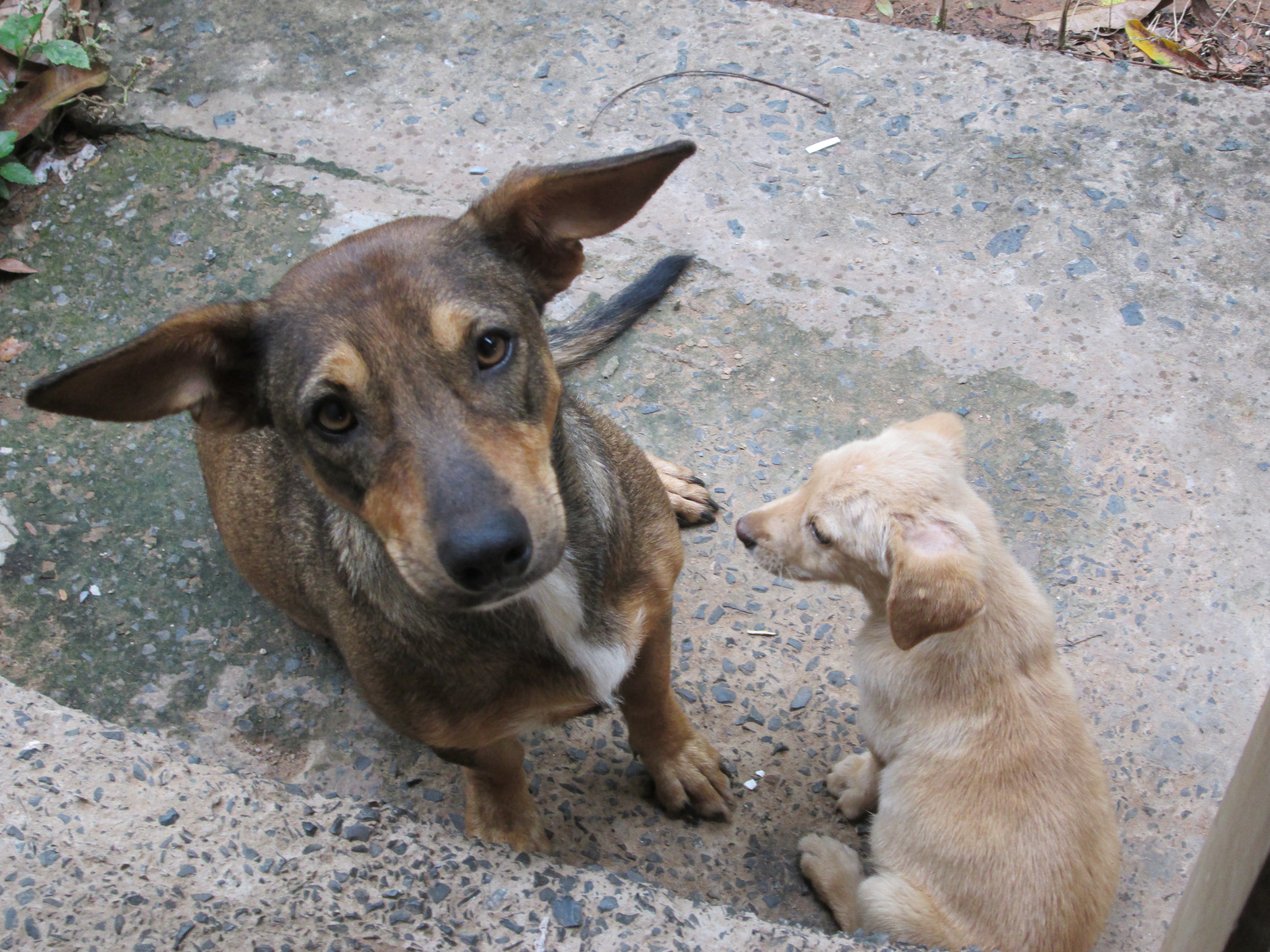
Cutest NeighborI don’t have my own pet in Paraguay. I travel too much and it’s not exactly practical to fall in love with a fuzzy friend and then spend a mountain of money to ship it to the States at the end of my service. But, there is a dog that owns me in the community. She’s my neighbor’s dog.

My neighbor has a house in Asunción so she is not always in the apartment next to me. Because of this, her dog ranges free for the majority of the week. I don’t know who feeds that dog, but someone does and it’s not me. But, I do pet that dog and talk to her and if I make too many pancakes I give her a few—she’s amazingly picky about what she eats and I don’t cook meat so beside pancakes we are somewhat at an impasse when it comes to food.

Sometimes I let my neighbor’s dog into my house—she’s allowed to sleep in the bathroom when it is unbearably hot and she is allowed to sleep in one corner of my house when it is pouring outside. She has fleas and smells, which is why she is regulated to certain regions of the house: dogs and cats are not seen here the same way as they are in the States.

Despite my minimal love the dog bounds to meet me when I come home and whines until I pet her. She often follows me around the community. She will wait for four hours at the house of someone I’m visiting so she can walk me home. She’ll brave crossing into other dogs’ turf, which could cause a fight, to go on long walks with me.

She’s a perfect example of what so many doctrines tell us we should be: giving, forgiving, unconditionally kind, and low-maintenance. We should all strive to be more like her.

Nothing Is More Important Than Here

People my age in Paraguay and people my age in the States have a number of things in common, but one that sticks out is that their cell phones are lifelines. We just can’t seem to put them down, no matter the occasion. And so, I find myself having the same reaction here that I used to have in the States when my friends whipped out their phones in the middle of a conversation.

Yeah, I’ve already head this: Internet, social media, and cell phones allow you to expand your reach far beyond your physical location and the number of people you can talk to personally in a day. These connecting tools, message-sharing tools sell things, allow you to plan with your friends, and help you keep in touch with friends and family who are far away. They are powerful.

But, nothing you post on Facebook about our friendship will ever be as powerful as that conversation we had yesterday. Nothing is more important than here, the space you are occupying at the moment, and the people who are here with you. When you bury your nose in your phone during our conversation you only send me one message: Whatever is on that little screen is more important than whatever we have between us.

When you go to an event and spend your whole time instagraming, tweeting, and facebooking, you will miss the event. Do you have to text every one of your friends to see when they’re arriving? Yes, social media and texting is important. But living life—doing real things and connecting to people in person—comes first.

Sure, I am curmudgeonly when it comes to cell phones and social media. But, it’s not because I don’t use them or think they aren’t useful; I find them essential. But don’t make me fight What’sApp when I’m talking to you. Don’t make me give up telling my story because you are clearly more interested in scrolling through newsfeeds than listening. Give me the time of day for a conversation, a meal, or an afternoon. You just might have fun and, maybe, you’ll even have something that’s genuinely interesting to say on Facebook afterwards.

The Paraguayan Woman: The Expert Event Planner

In the US, we often leave event planning to the professionals. Event planners are those people who don’t overlook a single detail, are able to hound countless vendors to get the best price and invitations delivered on time, and make sure all the ducks are in a row when the church bells chime. They make your dreams come true.

Well, many Paraguayan women should consider work in event planning if they move to they States. These women are experts. (I’m going to use birthday parties as an example, but there are many events from weddings to funerals that Paraguayan women organized without hiccup.)

Paraguayan women start planning by discussing the menu, decorations, and party favors months in advance. They’ll think about their budget and take countless trips to different towns and cities to scout out the best prices. They will discuss options and prices with all their friends and female relations until they develop the perfect plan. The planning drills down to what each member of the family hosting the event will wear. By the hour of the event, not a corner of the house will have cobwebs and not a wrinkle can be found on the t-shirts of the children.

Birthday parties are a big deal in Paraguay. We’re talking parties that cost a couple months salary for one-year-old birthdays and perhaps as much as a year’s salary for quinceñearas. The guest list for these birthdays can range from thirty people to hundreds.

Birthdays in Paraguay have a list of essential elements:

  • Invitations, addressed to each invitee, printed, and hand delivered by the hostess.
  • Theme, it might be princess or Winnie the Pooh, but all parties have a theme.
  • Agenda, depending on the age of the birthday person, there is a set order of events.
  • Sound system, to blast music, of course.
  • Tables with tablecloths and chairs, rented because no one has that many tables and chairs.
  • Food, you can’t have a party without food.
  • Cake, it’s a birthday after all.
  • Party gifts and treats, if it’s a kid’s party every kid gets a toy and some candy and every mother gets a trinket and candy. If it’s an adult party everyone gets at least a pocket full of candy.
  • Table centerpieces, every table needs a centerpiece that the people at the table will take home with them.
  • Display for the cake and photos, this usually takes the form of a backdrop stylized for the party theme and a table with decorations and the cake.
  • Gift receptacle, a decorated basket set up near the cake table.
  • Photographer, who takes posed photos, films key events during the party, and also takes action photos.
  • Other things that set ambiance, for a kid’s birthday there is always a bouncy house. There might also be face painting and the Paraguayan version of a piñata. For other birthdays it might be a decorated, large frame to take photos or fabric garlands (in theme colors) to decorate the event space.

Walks: Success Strategy

I never have trouble getting out the door to go on a walk. And when I walk, I’m usually out half an hour to an hour (though I’ve been known to disappear for several-hour walks if the occasion is right). I think best when I’m walking. Because of this passion, I was filled with delight when I learned that taking walks in site could help me integrate.

When I walk around my community people see me. That’s the key thing—they can’t see me when I’m sitting at home—which means they are notified of my existence or reminded that I live in their community.

When I’m walking, I have the opportunity to say “hi” to each person I pass. Greeting people is a chance to connect with them and show my community how friendly I am. During the school year, I would time my walks with the hour that school let out. That way, I would be able to chat briefly with the majority of my students outside of the classroom.

I try to walk daily. People sometimes joke that they want to join me on my walks, I always welcome them, but to-date I still walk alone. I like to think that seeing me walk most days might inspire others to start walking too, even if they don’t end up walking with me.

It’s true that my walks won’t make or break my service. But, the longer I’m a volunteer, the more I realize that all the little things matter. They add up and together each little thing I do to get to know my community better makes me a more effective and integrated volunteer.

Sacrifice and Hardship Mark the Path

Recently the volunteers in my region organized a career/college fair for high school students. During the event we had activities to help youth think about their future and set goals. We also had a wonderful group of Paraguayan professionals join us to share how they got to their current positions of success.

The Paraguayans that spoke with us had amazing stories.

  • The youngest woman on the panel, an accountant, talked about how difficult it was to leave the home of her parents to study. In Paraguay, it’s common for children to live with their parents until (or even after) they are married and leaving one’s community is uncommon. She talked about how hard it was to live with people who weren’t her family for the first time. She worked all day, attended class at night, and studied from evening until early in the morning.
  • One woman is the director of a university, has a doctorate, and is earning another degree. She’s achieved this despite losing her mother at 9-years-old and navigating a childhood with a less-than-loving stepmother.
  • The one man on the panel is the owner of a hostel in Asuncion that is popular among Peace Corps volunteers. He talked about how he’s always wanted to be his own boss. His love for travel inspired him to open a hostel. Before he was able to open the hostel he used to work 12-hour, sometimes 14-hour, days at other businesses. He is now successful enough to hire people to help him run the hostel, but when he started he was on call 24-hours, 7 days a week.
  • Another woman left her family, the countryside, and everything she knew to study to become a professor at what many call the best university in Paraguay. She worked from early morning to afternoon, went to class in the afternoon, and studied in the evening. She was forced to go against her beliefs and sham support for the dictator as part of her admittance into the university—she noted how this was one of the most difficult parts of her studies for her.

These Paraguayans had inspiring stories and they also had good advice. They all recommended that youth find work about which they are passionate because, “work doesn’t seem like work when you love it.” They talked about making goals and sticking with them—even if it takes years to finally achieve them. They talked about finding inner motivation and strength to push through any obstacle.

One thing struck me, however, as I listened to them. They talked a lot about sacrifice and hardship. The warning of sacrifice and hardship is a familiar yarn to me because that’s what first my high school teachers, then my college professors, and then my bosses talked about when giving me advice.

It’s not bitterness that made these Paraguayans and all of my mentors focus on the sacrifice and hardship that got them to where they are. They forewarned that the path to personal success is bumpy and hazardous because they wanted to help prepare youngsters for the journey. Listening to the tale of challenge being told to the next wave of aspiring youth I had doubts.

We all must make sacrifices and face hardship in life. As someone in my childhood used to say, “If life were easy, it would be pointless.” But now being the listener, not just the sapling trying to soak in every drop of wisdom, our emphasis on hardship gives me pause. I don’t think youth need warnings or cautionary tales. They already know life is perilous. They need inspiration and encouragement to find their strength. We can tell our stories without giving them a tragic edge.

The matter-of-fact stories of my great-grandmother come to mind. She was born in 1907 to parents only several years settled in the US, having come from Germany. She lived into her 90s—almost 100 years of history that spanned 2 world wars, the Great Depression, and countless other moments that made history. Her stories never talked about sacrifice or hardship, they talked about life. Things happened and she survived them, and by telling her stories she implied that us (the listeners) would survive life too. She suggested, with her smile, that we would probably not just survive, but we might also give life a good run for its money.

Life is sacrifice and hardship. Even the happiest children know about challenge and disappointment. But, what we (adults) know that maybe youth don’t know yet is how to survive, even when the hurdle is more than dropping your ice cream cone. We’ve had more years of trouble and yet we haven’t lost sight of happiness.

When we tell our stories we can’t just focus on the events. We should share our thoughts and emotions. We should tell the greens what we learned and what made us smile and laugh despite everything. Youth want to know how we found the light because they’re still in the tunnel. They don’t want to just hear our take on the tunnel.

The Clothes Paradox

You would think that red mud everywhere, 100 plus degree-days, hand washing all clothes, no clothes dryers, and crappy (or no) showers would be an acceptable excuse to be mildly dirty and slightly unkempt. Wrong.

I’ve never felt more pressure to make sure my clothes are without wrinkles or to wear accessories and high heels as I do in Paraguay. And that’s saying something because I worked in PR in Washington, DC before coming to Paraguay.

Paraguayans scrub their sneakers weekly. Women wear bows in their hair on the daily. After watching an almost two-hour soccer game in the blazing sun, I’m sweating like a river and have serious sweat stains while my Paraguayan friends still look fresh in their neon t-shirts and tank tops and their flesh-crushing, tight jeans. When I walk from my house to the school, I get mud on my shoes and/or feet. But, my students always have shiny-clean sneakers. How they manage to avoid the mud is something I’ll never know.

I struggle walking from my house to the church in my flip-flops because of the sand and the rocks while my Paraguayan friends walk delicately in their three-inch wedges.

I don’t care how much deodorant I put on, at some point the heat makes me smell lightly stale. I’ll let you know when I find a Paraguayan with BO.

It’s a paradox. It’s almost as though because it’s so easy to be clean in the States we don’t judge people if they decide to dress like the stereotypical hippie. As long as people don’t smell, usually American’s couldn’t care less what someone wears to a baseball game. Well, Paraguay is different. Watch out what you wear, people notice.

The New Patriotism

[Peace Corps volunteers wanted]


Not unlike the dove that gave the olive fame

With diligent wings glides from land to land

The volunteer’s hope-seeped, motives stand

A mighty force with a core, whose flame

Is the imprisoned compassion, and in the name

Of service and understanding. Opens her hand

To send world-wide welcome; her mission

Unite cultures by seeing what’s different and the same.

“Keep power struggle, you greedy pomp!” cries she.

In many languages. “Give me your dreamers, your hopeful,

Your flexible adventurers yearning to breathe free,

The unsatisfied refuse of your corporate cubicle.

Send these, the determined, resilient to me,

I know the secret to the world’s pull!”


“Give me your unafraid, your mentally indomitable,

Your quivering intellectuals yearning to see,

The soul-seeking refuse of your successful label.

Send these, the patient, tempest-ready to me,

I send my call to all those who are able!”


“Give me your creative, your quick thinkers

Your unwavering looking to redefine prosperity

The motley refuse of your first-world tinkers

Send these, the sponges, life-long learners to me

I open my door to those who can be linkers!”

Paraguay Is for Dance Lovers

Do you love to dance? I do. Actually, dancing is my favorite pastime, and it wins by a landslide.

In the US we talk about people who can dance and who can’t dance. We have an unfortunate situation where many women like to dance and many men refuse to dance or do so grudgingly. That doesn’t happen in Paraguay.

Just about everyone dances and though you can find people who don’t like dancing it’s not an easy task. What’s more, many parties are designed specifically to have a dance component.

And, in Paraguay, there are many more opportunities for parties than in the States. In addition to celebrating major national holidays, Paraguayans celebrate patron saints’ days and soccer teams’ founding anniversaries…every community has a patron saint and a soccer team.

We aren’t just talking humble little dance parties in your apartment. We are talking huge speakers, DJs, and bands. The average party doesn’t start until 11 or 12; the first band doesn’t come on until at least 1 in the morning, and the dancing can go on until 6 a.m. (or so).

Dancing also doesn’t only mean breaking it down free and wild. In Paraguay, everyone knows how to dance cumbia and cachata, which are couples’ dances. You have to have a dance partner.

Summary: Paraguay is a dancer’s paradise.