The Smiles of Children

Paraguay RiverIt’s the smiles and waves of the children in my community that remind me what I’m doing here is worthwhile. I’m still learning these kids’ names and I’ve been to their class maybe once, but they are already happy to see me. They yell “hello” across the street, wave and smile vigorously, and ask me when I’m coming back to the school. They may be little terrors when I’m actually in their classroom trying to teach, but their smiles give my work meaning.

It’s easy to wonder why I’m here. My work doesn’t have a clear product, or a clear direction for that matter. It’s not like I have sales that I can track to measure my success. I’m dabbling in diplomacy and public health—terms that don’t even have a clear definition. And to tell you the truth, up until recently I haven’t even been doing those things…I’ve been setting up to do those things.

The first 3 months in site—yep, I’ve been in my site 3 months already—are supposed to be about building relationships. For me, building relationships included going on walks, hanging out at the health post, visiting houses in my community, baking at the bakery, and helping my site mate teach in the school. I watched a lot of soccer. I’ve helped some people study English. I helped a child with his math and Spanish homework.

I tell myself time and time again that sitting for hours, drinking terere or watching the soccer game, is actually part of my job. Peace Corps service is like building a house—you need a good foundation before you can build the walls and roof. But, I’m the one building and evaluating the foundation. I guess I’ll know how I did somewhere down the road when my projects start falling into place. I start teaching at the school regularly at the end of July. I can’t wait to have a “set” schedule.

Germany Won, You Know

RoadI’m sure you’ve heard: Germany won the World Cup. Several people in my community pointed out Germany’s victory to me, which I found confusing. I mean, I watched the game, but Germany was never my team. The confusion evaporated as soon as one person asked me if Germany was a city in the US and another asked me if Germany was near the US.

A lack of geographic knowledge, which may have led to these confusions, isn’t what interested me in these interactions. Plenty of people in my home country don’t know where Paraguay is, so I call it even. What interested me was how people were making the connection. Mainly, Germany is foreign and so is the US. I’m from the US, so therefore I am foreign and must have a connection to Germany. (It’s also a race thing, but I’ll save assumptions about light-skinned people for another post).

Many people in the countryside of Paraguay never leave their communities, or only go as far as the nearest town or city. Vacations aren’t common, especially vacations abroad. Most people who emigrate for work go to Argentina (at least that’s what it seems from the stories I’ve heard). My site is comprised of two communities, and my house is about 1 kilometer (less than a mile) from one of the communities. Yet, people in the community I don’t live in often comment about how far away I live. It’s a fifteen-minute walk.

The idea of living all your life in a small fraction of the Earth isn’t uncommon. Even friends I have in the US who haven’t traveled much see the world as a giant, strange place beyond their country’s borders. But, for me the idea of “us and them” is even more exaggerated here because Paraguay is such a small country. And, many Paraguayans are only just discovering that they can explore the world.

It’s also a good reminder why I’m here: to clarify some basic facts about the US and try to dispel fears and assumptions about the US that come from not knowing. I guess as humans we are uneasy about the unknown and make things up to explain things we don’t understand. Living here has turned my life on end; it’s very interesting to be the proof that certain beliefs aren’t true. But, more than anything, it makes me wonder what things I assume or think are true but are really just fantasies I’ve invented to fill in the gaps of my knowledge.

Family Planning and Religion

HouseOne of the topics about which I will teach here is family planning. Before coming to site, I was concerned about the topic because of how polarizing it is in the US. I worried that there would be as much religious rhetoric against contraception and teaching sexual health in Paraguay as there is in the US. Paraguay is a Catholic country and I wondered if some of the same denial of basic health realities was present here as in the US. It is not.

Family planning and sexual health in Paraguay is not a subject cramped by religion. It is awkward and hard to talk about, just like in the US, but not because of religious beliefs. I find it awkward because of the power relationships between men and women here. And, well, because it’s just a hard subject to discuss eloquently.

In Paraguay, birth control pills and condom are free and offered at every public health clinic in the country. To get birth control pills a woman simply needs to go to the health clinic, request them, and present her ID. Sexual education is taught in many schools. I like to think Paraguay is transitioning to a family model that allows women to have the number of children they want when it makes sense for them. Paraguay isn’t there yet, but it’s on its way.

One thing I find particularly interesting about the relative ease of discussing family planning in Paraguay is that abortion is illegal. Period. Having one national set of laws in Paraguay that governs actions related to family planning makes it easier than in the US to know what can be said and can’t be said when teaching.

6 Unexpected Outcomes of Paraguay

  1. Paraguayan house, back viewMy best friends in site are all 2-3 times my age. The señoras are simply awesome.
  2. I go to Bible study. Sometimes you got to do things you’re not comfortable doing to integrate. And, with the stress I feel just living in Paraguay, it’s nice to have an hour to just reflect and be calm.
  3. I think babies are cute. I’ve never been a baby person. Here there are babies everywhere. And the babies are pretty darn cute.
  4. I’ve eaten tripe and other organ parts of animals. I just tell myself not to think about it.
  5. I drink coffee. Coffee is a common breakfast food, yep food.
  6. I pray for rain. Nothing happens in the rain, so it’s nice to have a justification to take time to recharge.

Hobnobbing With the Señoras

President's PalaceIn site, my friends are ladies somewhere between 2 and 3 times my age. They are grandmothers. They are wonderfully welcoming and fun. If you asked me anytime before Paraguay, I would never have imagined my social life (at least when I’m in site) centering on grandmothers.

Until I came to Paraguay, I tended to seek out the friendship of people close to my age. But, in my site people my age are complicated. The complication comes from the fact that we are going in different directions. There is a big focus on being in a relationship, so between women my age and me there’s a feeling of competition and between men my age and me there’s sexual tension—neither of which are feelings I want in my daily life.  Our dreams are different. Of course, young people here are fun, and I’m still hoping to find some Paraguayan best friends my age.

Everything that makes people my age difficult makes señoras (as one calls the older, married ladies) perfect friends. Señoras aren’t competitive, and the best ones don’t judge. Even if they think I’m strange, it doesn’t stop them. Most señoras are jokesters and enjoy hanging out. They’ve already raised kids and are the true rulers of the community. Many of them are homemakers, so they’re around more than the younger people who work outside of the home or are going to school.

Señoras have great stories and enjoy help cooking or reviewing their grandchildren’s homework. They are set in their ways, but they’ll listen to my ideas and observations even if they won’t act on them.

Being Single In Paraguay

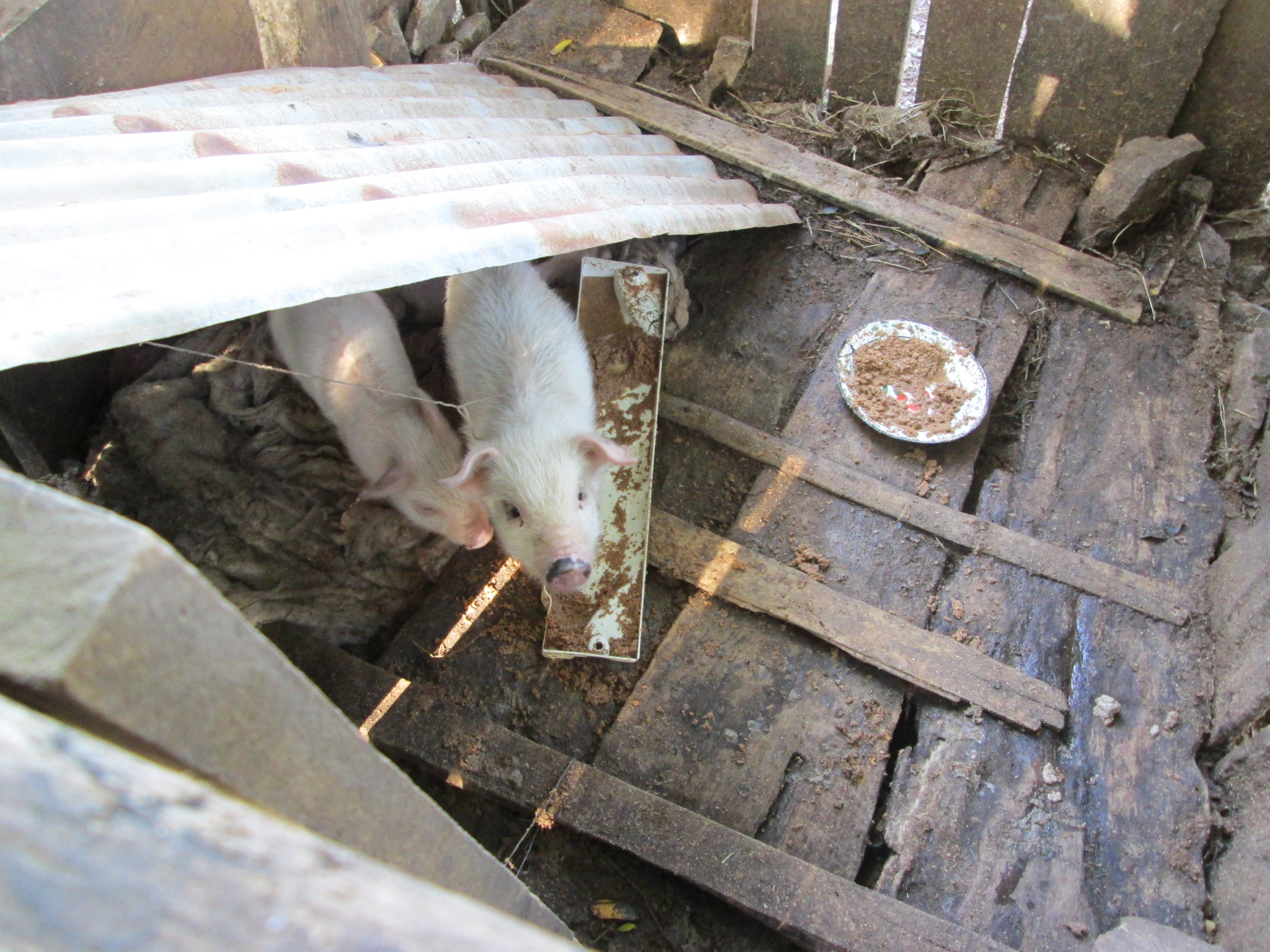
PigsIn Paraguay people aren’t single. They are either in a relationship, in a relationship with multiple relationships on the side, or about to be in a relationship. This relates partly to the importance and closeness of family and the role of women as mothers in Paraguayan culture.

In the US, most people hope to eventually end up with some kind of significant other, however there are things that come first, such as personal happiness and your career. That is not the case here. Having a boyfriend or girlfriend (husband or wife) seems to be the centerpiece of happiness. As for careers, at least in my community, most people are looking to pay the bills, not to develop a career.

When I tell people I’m single, I’m often asked, “why?” It’s almost as if my community members think I’ve specially calculated my singleness. I explain that I have things to do before I get married, and that I’m working on my career. But, the Paraguayans I explain this to continue to have a confused expression on their faces.

Often times, I want to throw my hands up and say, “I’m single because I’m here.” But I don’t because that’s rude and doesn’t teach anything.

A Dance Party and Some Inspiration

This past weekend I attended my first Ahendu—a Peace Corps Paraguay volunteer talent show and dance party that happens about every 4 months, whenever one group of volunteers swears out. The majority of the some 250 volunteers in Paraguay attended. This year the theme was Great Gatsby.

On a basic level the party brings out the crazy side of volunteers, as you might imagine after each of us has been pent-up and on our best professional behavior in our work communities for months. In-site, as we call our work communities, we are on 24/7 and everyone notices everything. Ahendu also highlights the talented musicians amongst us. But, for me, the party was more than just a time to dance like crazy.

It was a time to meet and to get to know many of the other volunteers in Paraguay. We are all so different, but we have something in common because we all decided to join the Peace Corps and are surviving in Paraguay. We have similar struggles—such as navigating a world without things we took for granted before like hot water, heated houses, and Internet.  And we have unique struggles—such as finding work or avoiding local sexual harassment.

We laughed a lot—at all the ridiculous situations we have found ourselves in since coming to Paraguay. The volunteers preparing to leave were sentimental but ready to go.

As a new volunteer I felt refreshed and inspired when Ahendu was over (and I’d finally caught up on sleep). Why? Despite the party atmosphere what struck me is the great projects on which all the volunteers are working. It was cool to see volunteers who can speak Guaraní and are as guapa as I will be.Yeah, sometimes we party hard, but in the end we’re all here because we hope to save the world in our own small way.

Greeting…Everyone

Look at the view!In my Paraguayan community I greet everyone. As I walk by people’s houses I wave and smile or call out a casual “adios.” As I pass people in the street I say “adios” and when I go to someone’s house I shake everyone’s hand or do a two-cheek air kiss.  If you don’t greet everyone, you’re liable to appear standoffish, and that’s not helpful at all.

As someone who lived in a bigger US city before coming to Paraguay, adjusting to saying “hi” to everyone took some time. I’m used to it now, but there are times when it’s still awkward; like when I’m walking past a group of guys who are staring at me the entire time I walk. Staring here is culturally acceptable, common, and unavoidable when a woman walks past any man.

Greetings here are social cues. For example, my host sister will say a guy likes a girl if he walks by her without greeting her. Or, when someone stops greeting another person it can be a sign that she is angry with him. Paraguayans avoid confrontation and are very indirect, so they’ll rarely tell a person if something that person did bothered them.

I hated having to remember to greet everyone when I first got to my site. But, now that I’m used to it, I kind of like it. It’s nice to acknowledge people, and it’s nice to be acknowledged.  It’s also easier to just put the greeting on autopilot—just always keep your eyes up, and say “hello” to everyone. Trying to decide who to greet and who not to greet is just too complicated.

Vergüenza: Sink or Swim

President's Palace, Asunción“Vergüenza” means “shame” in Spanish. In the everyday application of the word, “vergüenza” means shyness and someone without “vergüenza” isn’t ashamed to do whatever it is they want to do. This little word summarizes whether you will sink or swim as a volunteer. Why?

There is no room for being shy (having vergüenza) in the life of a PC volunteer. I and all other volunteers are weird and foreign to our communities, but our job is to get to know the people as best we can and make a life in Paraguay…as quickly as possible.

To get to know people we end up making a lot of “cold calls”—just walking up to houses to visit. We invite ourselves to any event we hear about:  Funerals, birthdays, soccer games, Bible study; the list goes on and on.

To make a life in Paraguay we (the volunteers) have to ask endless questions. In a country where there aren’t really even road signs, the only way to figure out where things are and who can help us is to ask. For example, there’s no directory of electricians that could help me when my power goes out. But, there are at least three electricians who live within a ten-minute walk from my house.  We can’t Yelp or Google maps stores and restaurants (except, maybe, in Asunción) because most of them are off the Internet grid and the only way to know they exist is to ask or stumble upon them.

But, it’s not just that we don’t know where anything is. It’s also that things are done differently here. This is the land of house-front stores and handy men and women. Because of this, we have to learn how to navigate a world of informal, personal business interactions. It’s a world that the organization, digitalization, and formalization of the US has pushed to a back burner, but in Paraguay it’s very much front and center.

Volunteering is an exercise in losing vergüenza. To stay afloat you simply must be bold.

Where’s the Big Dream?

The RoadFull disclosure: I’m a dreamer. I like to think about the future and make several, multifaceted plans about where I want to end up and how to get there. I like to make plans, but I’m always happy to change and revise them whenever I learn something new or gain new insight.

As you might imagine, as a dreamer, I like to talk to other people about their goals and aspirations.  Because of this, I often find myself struggling to connect to young Paraguayans. Many of the young people I talk to here don’t dream big.

During training we did this activity that is an interview with yourself in 10 years. The idea of the activity is that one person pretends to be a reporter and asks you about what your life will be like in 10 years. I modified that and started asking young people where they see their lives in 5 years. I thought it might be a fun conversation starter.

I was wrong. The 5-year question usually yields a very short answer. The youth I have ask say the following: 1) a house, 2) a stable job, 3) a boyfriend/girlfriend, 4) children, 5) a car. Now, any of those individual topics could be interesting, but the response is usually that brief and in list form.  When asked what kind of job, the respondent often shrugs. When asked about their house, boyfriend/girlfriend, or children the answer is equality nondescript. One interesting tidbit: Often the respondents think they will have children, but aren’t sure if they’ll be married. They sometimes have a plan for how they are going to get all the things on that list, but always.

I used to find myself sad that the people I talked to didn’t have big dreams, but then I wondered why I was sad because they were probably happy with what they were doing and where they were going.  It’s hard to not make assumptions and project your beliefs on others. Living in a different culture makes in unavoidably obvious how different each person sees the world.