Anything Goes

Señora: “I hate women’s work. It’s better that you don’t marry.”

Me: “That’s why whoever I do marry and I will split the chores evenly. We will both work and we will both keep house.”

Señora: She looks at me with a pitying expression. “Maybe there are men like that in your country, but not here.”

Me: “Yes, there are. That is why I haven’t married a Paraguayan. If I don’t find a man like that, I won’t marry.”

The señora nods, seemingly satisfied, and goes to check her pot of food, which she is cooking outside over charcoal. She always cooks with charcoal or wood. She has a gas stove, but I guess it is too expensive to use gas.

In Paraguay, the house is the women’s domain and everywhere else belongs to the men. When a woman leaves her home she dresses up, puts on her swagger, and forges into a land where men have all the cards–she has tricks but her male counterparts still have the upper hand.

For me the most surprising and challenging features of Paraguay are the rigidly defined and openly maintained gender roles. When you boil things down, Paraguayan culture and American culture are similar. But, while in much of the US the glass ceiling is the elephant in the room and women “accidently” end up working and doing the lion’s share of the housework and child raising, differences in gender roles are openly talked about and defended in Paraguay.

I’ve watched a brother sit on his ass while his sister washes his clothes by hand. Then, when the sister gives him the clothes, already ironed, to fold, the aunt makes the sister fold them. I’ve seen men sit at the table waiting to be served while their women cook and set the table. I’ve witnessed men sitting and drinking for hours while women clean and cook and deal with the kids.

I’ve seen a woman called a whore because her boyfriend, undenounced to her, filmed them having sex and published a video. (If I am not mistaken, she lost her job because of that). People said it was her fault for not anticipating what the man might do as a man. I’ve heard a 3-year-old boy scolded and teased for touching dolls, painting his nails, and riding a purple bike. His best friend is his 4-year-old girl cousin. The list goes on, but you get the point. That is the home.

Beyond the home, anything goes. In most places in Paraguay, catcalling women in the street is the norm. In my community catcalling is limited, score, but if I walk along the main road every couple vehicles honk at me…and I’m not even blond or ever dressed to impress. It’s normal for old men, married men, men with children, and youth to hit on women ages…well, age isn’t important if he thinks the lady or girl is pretty. Men will pester women in front of anyone and everyone except their girlfriend or wife. Women and men don’t usually mingle at social functions. The vast majority of Paraguayan men my age who show interest in me don’t do so as a friend. They have only one end goal in mind. Of course, these affronts are brushed off as joking. According to many Paraguayans, pointing out women, offering commentary on women, and trying to conquest (the literal translation for the word “woo” or “take to bed” in Spanish) are what men do. It’s not their fault, they are men. It is women’s job to protect themselves.

In Paraguay it is odd to be single, especially at my age. Women are supposed to settle down and have children. Paraguayans like to ask if I have a boyfriend. They like to ask why I don’t. Men often ask me if I have a boyfriend before they know my name. It is normal now. I expect it. I anticipate in before it happens. I have multiple funny responses.

Just because I have a gender role in Paraguay that I do not agree with, does not mean I accept it. However, I can’t crash the whole system. The Peace Corps isn’t about forcing host country culture to change. I’ve settled for small rebellions. I do exercise that isn’t dance. I wear t-shirts and loose athletic shorts. I climb trees and get sweaty. I watch movies with guns and fire and talk about fast cars. I discuss being a professional and working. I own things that are blue and green. These are small details. But, gender roles are mountains made of pebbles. Maybe I can’t move the mountain in my little Paraguayan town, but I can sure send some rocks flying.

Blogging Abroad's Boot Camp Blog Challenge: Starting January 2015

Humanity

I spend hours on the bus in a month, and, perhaps, as many waiting for buses. It’s normal now. I’m not allowed to drive any vehicle or ride a motorcycle (thanks Peace Corps rules). Cars are scarce. I walk a lot, but walking has limits. However, despite the hours of sitting and the crowded rides, I like the bus. The bus is a perfect window into humanity. All kinds of people ride the bus–rich and poor, old and young, educated and uninformed, friendly and grumpy…just about everyone.

On many bus rides in Paraguay I have been reminded that chivalry and kindness are not only part of nostalgia and history. They are alive and well. A good illustration of their perseverance occured on a recent bus ride to the grocery store. It is a half hour trip to relatively urban center.

I was sitting on the bus looking at nothing in particular and thinking about something that has since been forgotten. A passenger stood. Bus stops are not a thing in most of Paraguay; one can get on and off the bus just about anywhere. To get on one flags the bus driver down much like one might a taxi. To get off one pulls a string that sounds a bell up by the driver. The passenger who stood was a particularly petite, young woman. I noticed her because of her slightness and because she was holding a fine, fat baby. Buses in Paraguay jolt and rattle, such that it is almost always necessary to hold on to something at all times or risk toppling over. The unsteady footing is even more likely to fling a child down the bus isle than an adult. The woman carrying the baby in one arm and holding a handrail in the other charged quickly to the back of the bus to pull the string and to get off. As she moved away from her seat a toddler, perhaps three, started to follow her. Toddlers are goners on the bus if someone doesn’t hold their hand. They forget to steady themselves and they move like rag dolls.

My gaze, and those of all the passengers between the open seat and the back door of the bus, moved from the woman to the child about to embark on a rocky road. I worried for a moment, but hardly a moment. A man across from the boy reached out his hand, grabbed the boy’s arm, and steadied him as he teetered along. When the man’s reach was exhausted, a woman took hold of the boy. The boy continued walking, passing onto the guiding hand of a third person. The boy made it upright and not phased to the door and got off after his mother.

Three strangers stepped in to help a child without a word or pause. They were not asked and they were not thanked. If that is not humanity, I do not know what is.

Blogging Abroad's Boot Camp Blog Challenge: Starting January 2015

Building Blocks

There is no such thing as an average day in the Peace Corps. Each day is filled with the mundane of living (cleaning, cooking, waiting…) and spiced with unexpected adventures. My projects and routines change with the seasons. During the school year I taught classes and during the vacations I visited friends and explored new places. This current period stands out because it is comprised of my final months as a volunteer in Paraguay and summer vacation. Despite the disparity in my activities, it is not completely futile to attempt to explain what a day in my life is like. There are two fundamental occupations that fill my time: fostering relationships and growing personally.

Fostering relationships

Peace Corps volunteers have three goals–to help people in their country of service gain new knowledge and skills, to share about American culture, and to learn about the culture of their host country. Those goals are a long-winded way of saying we volunteers are here to share all we know with whoever wants to listen and absorb as much as we can.

Most of the time outside of my house I spend with people in their homes. We sit. We drink terere. We talk. We cook. We eat. We stare into space. During my almost 2 years in Paraguay, I have already spent more hours visiting my dearest Paraguayan friends than I have spent with most of my grandparents, aunts, uncles, and cousins in the States during my life to date. Those hours of sharing with Paraguayans created the exciting events of my service: going to birthdays, being in a wedding, dancing all night, sharing Christmas dinner, going on road trips, and participating in religious activities like mass and patron saint’s day celebrations.

Even in the classroom, the relationships I developed with my students are what made me successful. By our second year together, my students were comfortable enough to ask questions about sex in my class–a feat in a country where the topic is usually only joked about in formal settings and invokes shame in most other contexts.

In summary, most of my energy in Paraguay is dedicated to visiting. You might ask, is visiting your job? Can visiting be a job? And my answer is a shrug. It’s not a 9-to-5 no matter how you look at it. But, this place is one where who, not what, one knows profiles and opens doors. I could not have taught English or youth development if my community members didn’t know me. They would not have trusted me with their children. I could not have thrived here without spending hours with my foreign friends. I would not have learned who I am. My friendships here gave me a professional and personal identity.

Growing Personally

When I am not sharing time with people, informally at events and in homes or formally as a teacher, my energy is mostly dedicated to either doing personal projects or cleaning my house. I will spare you the details of housekeeping except to say that you should take a moment to imagine a life where the power and water do not always work and there is no trash pick up or dump, vacuum, dishwasher, or laundry machine. I promise, speaking from experience, that such a life is quite different from one with those luxuries. Personal growth is inescapable in the Peace Corps, especially in Paraguay where some hours of most days are too hot to do anything other than think. Amusement falls soundly on my own shoulders. I live alone. I am the only American in my community. To visit the nearest volunteer, though not far away, requires a bus odyssey. I can not spend every waking hour with Paraguayans. I do not have a TV. I can not stream videos. My technology prevents me from watching many videos. I can only read so much. I write. I play the guitar. I think….there is so much time to think about hopes, dreams, and wishes.

Summary

I typical day for me in Paraguay is a spread of eating, cleaning, chatting, writing, thinking, navigating, and enjoying what and who is around me.

Blogging Abroad's Boot Camp Blog Challenge: Starting January 2015

Blurred Lines: Outside or Inside?

Everyone living in Paraguay struggles to stay cool in the almost constant heat. Sometimes there is a breeze. Sometimes it rains. But, with the regularity one should expect from a tropical region, Paraguay swelters in a humid heat. Because of this, the way people live here, in terms of housing, is very different from what I knew in the northeastern United States. Mainly, the lines between the indoors and the outdoors are blurred.

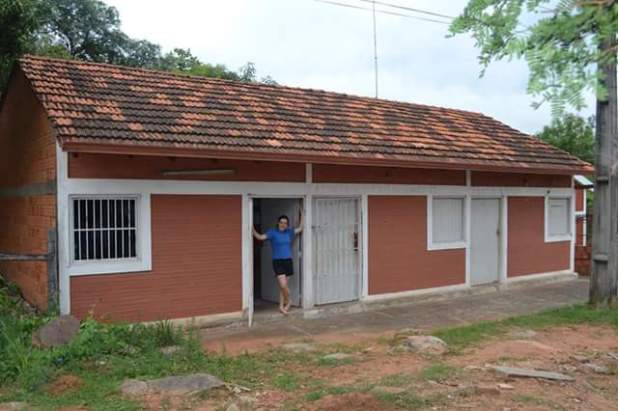
Most families with any wealth live in houses built of bricks and with tile roofs. The bricks are hollow terracotta and about half the size of a cinder block. Families with less money live in wooden houses with thatch or metal roofs. There is no insulation and most people do not have AC or a heating system in their home… fans are a staple.

Many families cook outside using either wood or charcoal fires. Some of these outdoor cooking spaces have a roof, but not always. Smaller houses, perhaps the norm in Paraguay, do not always have a living room or a dining room. Those rooms are not necessary because relaxation takes place outside. Paraguayans use their patios as the main living space. They sit out there to drink terere and to hang out. Some families even eat outside and will move their TV so they can sit in the shade of a tree to watch their favorite show or the soccer game.

The challenge of beating the heat does not only dictate where people spend most of their time but, also, influences how Paraguayans construct their homes. Paraguayan architects and home builders erect houses with doors and windows positioned carefully to create a cross breeze. Homes may have few windows, because the sun coming in is too hot, but the openings in a house maximize air flow. Further, Paraguayans leave all their doors and windows wide open until they go to bed.

I never thought about how much time I spent locked away from fresh air, but since coming to Paraguay it has been hard to ignore how much of my time in the States was passed in buildings. It is rejuvenating to see the sky, feel the wind, and sit among plants.

Blogging Abroad's Boot Camp Blog Challenge: Starting January 2015

Fewer Than 100 Days Left

The end of December marked 100 days left in my Peace Corps service. The mix of heart-break and joy I feel thinking about leaving Paraguay is beyond my power of words to describe. But, this moment is a good chance to think about why I came to Paraguay in the first place and where I could see myself in the future.

I came to Paraguay to grow. I came to help others, and myself, cultivate new skills and ideas by sharing—my dream is that Paraguayans have learned something from me over the past 2 years. Paraguayans have changed my way of being, from adding terere to my routine to warping how think about machismo. In the formal setting of my classes, I hope that some students grabbed something that they can use…whether it be how to put on a condom or a vague understanding that there are ways to see the world that are very different from their own. On a personal level, I look forward to life-long friendships with the amazing people I’ve met.

New Years 2014, I was getting ready to leave the USA for 2 years. I was excited and petrified. I wanted the adventure of living in another country for a chuck of time and I was eager to see what would come of my Peace Corps service. But, every single piece of service preparatory literature and every former and current volunteer I talked to said to try not to form expectations about Paraguay and what my service would be like because I could not know until I started. The fog about my future was chilling. I did my best to have a blank slate mind when I landed in Asuncion after an exhausting flight filled with raw nerves. I remember it was sunny and hot when I arrived in Paraguay. Everything here was new and exciting when I piled into the van that took me away from the airport and the world I’d known.

Since middles school, perhaps before but I don’t remember, the world beyond my itsy, bitsy town in rural Vermont held my interest. Places outside the borders—state, country, and continent—called to me. In 8th grade I began a love affair with Spanish, which continues to fester and prod me to evaluate every move as not only a personal or professional decision, but also a language choice. When I fell head-over-heals for Spanish, I knew that one way or another my path would meander beyond the land of the free and home of the brave to places whose values and virtues were unknown to me.

With fewer than 100 days left, I can say the hardest part is leaving. Leaving friends and loved ones. Leaving routines and places that are familiar. It is easy to float along doing what seems logical and secure. It is comforting to have a home-base, a set schedule, and a clear purpose. And, going abroad destroyed all those things for me. But, in their place equal, though different, pleasures germinated. I now know I can bend and sway and operate in foreign lands. I know that there are parts of myself that will always be true and strong; for example, I value honesty above all things and will never drink alcohol. And there are parts of me that will adapt to the environment, such as what I eat and how I spend time with people.

Volunteers like to ask each other, “If you knew what you know now about how your service would be, would you still have decided to do it?” My answer is a definitive “yes.” I would choose to come to Paraguay when I did in every alternate path of my life that could have been. This New Years, welcome 2016, I am not the lady I was 2 years ago. My biggest crop in the Paraguay season of my life has been me. I could not be who I am today without the laughs, frustrations, and pleasures Paraguay gave me. I am leaving Paraguay soon, I may only return for vacation (who knows), but Paraguay has a piece of my heart.

Am I achieving what I came here to do? Heck yeah, I just didn’t know in coming to Paraguay that my main accomplishment would be learning how to crack the hard shell of life and let happiness sprout wherever the wind takes me. We can not foretell the future, just as we can not guess the weather no matter what meteorologist try to make us believe, but Paraguay was the thunder before a storm. Bring it on 2016.

Blogging Abroad's Boot Camp Blog Challenge: Starting January 2015

When the Wind Comes From the South

My señora friend and I sat behind her house in a shady patch amongst the trees and not so far from the fire where she was cooking beans for lunch. We were sitting there because everywhere else was too hot. It was a suffocating heat that leaves one misted even if she lies down or sits like a statue. We talked about the heat, perhaps the most important topic of conversation except when it’s raining, and drank terere.

“At least there is a strong wind,” she said.

“Yes. That means it’s going to rain for sure, but maybe not because it is coming from the North,” I said. Paraguay has taught me how to feel the rain before it arrives. Life changes when it rains. It is critical to know when a storm is coming.

“That doesn’t matter, the wind can come from whatever direction,” the señora said. She smiled.

“When the wind comes from the South even the girls’ faces are ugly.”

“What?” I asked.

“We say here that when the wind comes from the North girls smile and there are flowers, but when it comes from the South even the girls are ugly. You know that everything unpleasant, the cold and rain, come from the South,” the señora said.

She got up to check on her beans. She was making a dish that when done would have beans, vegetables cut too small to see, noodles, cheese, milk, animal fat to get it started, and potatoes. It was one of the yummiest dishes I have had in Paraguay. While she cooked, I stayed to nurse the terere. I am not from here. The señora knows I can’t handle the fire smoke, it makes me cry and hack.

The thunder started that night. I hurried to fill every empty container with water. I did my dishes right away. The water went out as soon as I was rinsing my laundry. I would have liked to rinse it one more time and fill the basin, but one can’t have everything.

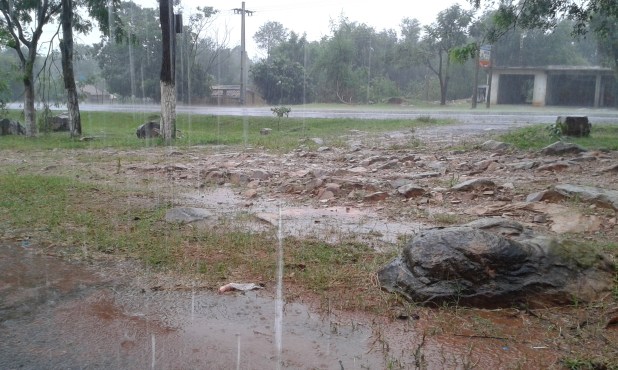
The rain started just before 11 pm. It poured so hard that it was still going at dawn. When the first drops pelted my roof I sprung out of bed. My ceiling leaks in a couple of places. It’s not a huge problem because most of the leaks are over nothing important and I have a cement floor that soaks up the water. I put out pots. The tat-tat-tat of the drips beat like a drum. A new leak started last rain storm, so I had to move one of the chairs I use as a bookshelf. To be safe I put a plastic bag over the fan motor. It was raining so hard the water blew in the peak at the crest of my roof. I slid my bed as far to one side as I could without getting too close to the window that even though closed was letting in a small stream. I was thankful the power didn’t go out. Last storm, I was surprised by the wind and caught by 27 hours without power.

The thunder made our community sound like a war zone. I have never heard thunder or seen lightening as dramatic as Paraguay. I doubt there is a sky more beautiful than Paraguay’s, and though I decided this long before my first Paraguayan lightening show, the electricity in the air confirms my judgement every storm.

The morning after the conversation with the señora and the following storm, I carefully observed the few girls who passed my house in the rain. They looked as they did the day before, however the plants around them were a brighter shade of green. Maybe the North wind didn’t change the girls or bring flowers, but it did highlight the best side of the foliage.

Time Passes Before We Know It

It’s been a while since I posted and not because there was nothing to write. The days pass slowly, but afternoon seems to fall before the morning begins. I wake up and it is already Friday. Where did the week go? I ask myself. December 8th marked exactly four months until my days in Paraguay end and a new adventure begins. The ghosts of my service past, service present, and service future have come knocking. They’ve taken me on dream walks to see what I accomplished, what I am doing, and what I will achieve. Unlike the ghosts of Christmas, the service ghosts aren’t here to make me repent. They came to remind me that time passes before we know it, and therefore I should live every second to the max.

People from America, land of the brave, often say that, “It’s the journey that counts” or some phrase that means the same thing. They say this and then grow angry that there is a line at the grocery story, show impatience because there is traffic, or become testy when there are no electronics to amuse them. They say it when they put in long hours on the job and then rush around to the bar, the gym, friends’ houses… And at such hectic times, they say another phrase, “Every moment counts.” And they say that phrase when they refuse to sit quietly, with friends or alone and without the simulation of media or a purpose.

Before my two years in Paraguay, I used those phrases just as “they” do. But now, to me, those sayings have a meaning caught between what the land of the brave believes and how I think Paraguay, the land of time, puts those phrases into practice.

The land of time is hazy and hot. Mangos grow in December, when the land of the brave is dreaming of a white Christmas. Paraguay’s infrastructure is speeding towards better days, but for now the water goes out often and the electricity falters when storms come or too many people use their fans. People have motorcycles and the number of families with cars has skyrocketed since I moved here. However, all personal transport beside, the main staple of commuting remains the buses. One can go almost anywhere on a bus in Paraguay, if one is patient. Some places have a bus only sometimes or on some days and bus schedules are at best a suggestion. Business is accomplished over long meetings that begin with the weather, ease into family, and, at long last, mention the job at hand. It is easy for those from the US to fixate on the inefficiencies of Paraguay. We see the millions of lost moments, moments that could have been spent “doing something productive.”

Time passes before we know it, but in the hours and minutes that have ticked away since I landed in Paraguay I have seen another side of time. On those hot afternoons when the mangos hang overhead, school is out for the summer and many people have vacation. Those days are spent following the shade as it moves across the patio. Families and friends sit and watch the bright sunshine sift through the trees and make patterns of light and dark on the red sand. As families and friends watch the sun move, they talk. They talk about the heat, times shared, what absurdities the neighbors are up to, and the next barbeque. They drink terere. They take siesta. Interspersed among the bouts of sitting are the daily chores. Sometimes an adventure to the river or a party breaks up the listlessness.

The thing about these lazy days of summer when nothing happens, is that my Paraguayan friends waited all year for them to arrive. They got up at four to catch the bus at five to go to work at seven, to work, to get home at seven-eight-nine, to clean and cook and tend the animals, to say “hi” to the children, to sleep, and to get up at four to shower…they did that so their children and grandchildren could have nice clothes and cell phones and study something better. The difference between the land of the brave and the land of time is that in Paraguay, one does not work to work. One works because one has a family. As long as the hours may be, it is not the job itself nor one’s own professional standing that give life meaning, but the people who inspired one to leave the shade of the patio and go forth.

In Paraguay most of time is burned during the journey. Traveling is time consuming. Washing clothes by hand is an afternoon. Cooking with charcoal or wood and also the gas or electric oven are skills that one learns over years of practice. Navigating without power and water when the sun beats down and a shower or a fan would be nice is a test. But every moment counts. In Paraguay the moments are counted not by what one did, but by with whom one was.

Time passes before we know it, and dear reader you might be appalled at the number of moments I spent sitting in the shade of mango trees. I was shocked when I first thought of those seconds given to history at no cost. But, what I have come to see is that quiet instants are not a waste. I will never have the endurance of my señoras. They have given the better part of most years to sitting. But, what I have learned from Paraguay is that there is joy in taking time to do nothing. Peace is found in letting one’s mind wander aimlessly. Of course, too much emptiness is terrible, but my land-of-the-brave upbringing would never let me take too much time for pause. The ghosts of my service have let me face my biggest fear as the reality that I will leave Paraguay comes into focus. I fear that once I leave Paraguay I will never again have time to just be. It is a real possibility that I will descend into the ant hill again, but I hope that I can always carry with me the calm I found here, no matter where I end up. Because, happiness is not found in running from place to place worried about the moments. It is found when one stops and smiles at where the journey has plopped her and takes a moment to laugh with the family and friends around her.

The Paraguay I Know Is Catholic

It is not necessary for me to say, but it is worth sharing two facts. First, the Paraguayans I know understand the world as Catholics. They may not go to church all the time, but they think about Jesus often and use God to explain most things. Social lives are largely centered around the church. Many of the biggest parties and drinking events spring from patron saint celebrations. Second, I am not Catholic. But, my beliefs do not prevent me from participating in Catholic religious activities if and when I want.

I traveled to Paraguay with the desire to help make the world better, but I came here as a student. My openness and curiosity to experience and to understand how Paraguayans practice Catholicism has given me great insight, despite putting me in the occasional uncomfortable situation. “Catholic” has come to represent, in my mind, the life philosophy of some of my closet Paraguayan friends. These days, when I go to a church function it’s not only to learn what issues my community thinks are important enough to bring before their God, but also because a friend invited me. For example, I know it means a lot to my señora friend when I do the rosary with her, and her happiness is enough to dedicate 60 minutes of my day to her God every so often.

It is impossible to escape Catholicism in Paraguay if one lives here and talks to Paraguayans. If one mentions an event in the future or tries to make plans to do something Paraguayans say it will happen “if God and the Virgin Mary permit it.” If one talks about marriage, it involves the church. If someone is sick or something is bad one prays. Families are divided by the Catholic Bible study to which they send their children. Public buses have Jesus painted on them and tout slogans like, “My path is guided by Jesus.” Passengers on buses cross themselves when they pass churches and cemeteries. Churches host parties and cookouts. People wear crosses and have saints’ cards in their wallets, religious photos as their profile pictures, and Jesus images hanging on their bedroom walls.

The way I see it, Jesus and Mary are Paraguay’s way of setting a moral code and giving meaning to life. In the end, it doesn’t matter that my Paraguayan friends and I have different reasons for why we think it is right to be honest or to treat people with dignity. What is important is that we share the values of truthfulness and respect.

I never needed to think about what “tolerance” meant before coming to Paraguay. But, Paraguayan tolerance is how my community embraced me and my tolerance is why I have learned and done so much since coming here. Paraguay has taught me that tolerance is not just letting people practice their customs in peace. It is being open to learning how people’s cultural practices relate to their lives in general and, more profoundly, what their beliefs boil down to in their simplest form. We all have a lot to learn from people who see the world differently from us. And, we all have more values in common than it might seem at first glance.

Overheard In Paraguay: Friendship

We sat in a half circle around the grill. The men were cooking large slabs of meat, ribs and some unidentifiable cut, for the mother of the family’s birthday dinner. The husband of one of the birthday mother’s daughters sat by the grill passing one can of beer among the men there. A nephew walked up to the daughter’s husband. The husband was around 30 and the nephew was about 11.

The husband hugged his nephew first with one arm and then the other, squeezing him. The nephew squirmed, and they both smiled. The husband held the nephew at arm’s length and put on an almost serious expression. “Will we always be friends?” the husband asked.

“Yes,” the nephew said.

“Even when I am old and you are my age?” the husband asked.

“Yes, even when you are old and I have kids,” the nephew said.

The husband smiled and pulled the nephew into another hug. The nephew pulled away again and they looked at each other, the husband still squeezed the nephew’s shoulder.

“Even when you are in Heaven and I am old we will still be friends,” the nephew said earnestly.

The husband laughed. “And I will look after you from Heaven.” They hugged again. “And, when you come to Heaven, we will be friends in Heaven. We will be friends forever.”

The boy nodded and ran off to find his playmates.

Incense

My house gets musty sometimes. I have a cement floor and my house has no foundation so the damp seeps in when it pleases. Scented candles are hard to find in Paraguay. I spray air freshener when I think of it. Most of the time my doors and window are open, so the smell is blown to the wild outside. But also, it is only sometimes that my house smells and one gets used to it quickly and forgets.

I’ve thought about incense before, but I haven’t found a smell I like. I’m also very sensitive to smoke, any and all kinds. I haven’t had the motivation to really look for a nice incense.

One day the señora friend who lives close to me stopped by on her way home and invited me over for lunch. She must have thought my house smelled because she gave me a stick of incense toward the end of my visit. I smelled it and found it to be surprisingly pleasant.

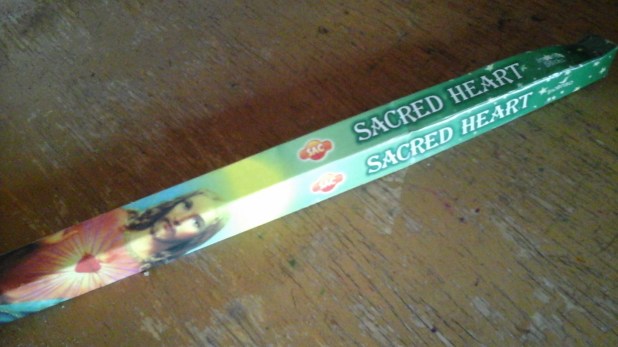
I told her that it smelled good and explained how it was hard to find good incense. She reached over and showed me the front of the incense box. The box was green with a drawing of Jesus and his heart with light rays radiating from it. “It says the sacred heart of Jesus, right?” she asked. She didn’t have her glasses.

“Yes,” I said.

“That’s why,” she said. ”Of course it smells good.”