When In Doubt, It’s An Energy Problem

I have a running joke about physics: When in doubt, it’s an energy problem. Before you stop reading, let me try to enlighten you with the humor. Picture yourself in your first semester of physics. You’ve tried solving one problem, yes one silly little problem, for over an hour. You’ve combined pages worth of equations and moved around variables like a wizard. No luck. You set it aside. Try again. And again. No luck. You go to your review session. A cunning smirk lifts the corners of your professor’s mouth when you ask, exasperated, if he can please review the problem. He completes the problem in two simple steps.

There’s this nifty law about nature—it’s called the conservation of energy—and it states that energy can’t be created or destroyed, only transformed. I know. You’re thinking, “By golly she’s turned into a real science nerd in a couple short months.” Sure, I’m guilty, but let me make my non-science point…

The quality that makes the law of conservation of energy so darn handy is that it allows you to ignore all the complicated transformations that occur during a journey and just focus on the beginning and end. By boiling a process down to two points, you’re able to paint a picture of what happened without seeing what occurred. And knowing without knowing is quite a powerful thing to be able to do.

Now, let’s bring energy out of the land of physics. In my world, energy means the chutzpah to get things done. I, like you, have a lot of things I want and need to do. I’m often not exactly sure how I’m going to shoulder the load. It’s exhausting to just think about all the little straws piling up on one’s back. In thinking about all my to-dos, a list of which can and does fill pages, I realized something. Tasks are not unlike equations. And, getting to the end of a to-do list is not unlike solving a physics problem.

What I’m saying is that conservation of energy is not only a physics thing but also a life thing. It’s a way to shift your perspective from being buried in the minutia of all the little details to being able to see the whole arc of your adventure. I find it exceptionally grand to think that even though I’ll take every step on the road between here and there, I don’t have to fixate on every single one. What matters are where I am now and where I’ll be then. As I forge ahead on the doctorhood quest, simplifying life to just energy is quite motivating. I don’t know every action and transformation that will occur between now and when I’m a doctor—nobody knows the future. But, I find it easy to be optimistic when I realize that I have a lot of good mojo now, and that wherever I am later that pizazz will still be with me in one shape or another.

Winter In Vermont

Winter is defined by suffocating darkness. The sun rises hours after me and sets long before my work is done. The haze of dawn seems barely brushed from the sky before the long shadows of dusk push back the sunlight. But, despite short days, Vermont winters are beautiful and perhaps one of its key features.

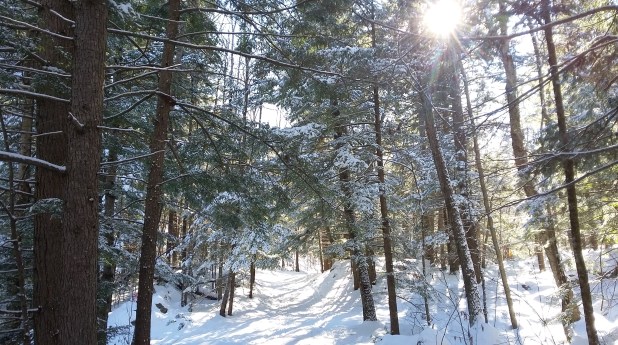
When you enter the woods they are silent, not like a tomb, but like someone holding her breath. Frozen until spring comes. The snow crunches under your feet and the trees crackle, almost frozen. Sometimes the trees freeze, and when that happens their limbs splinter as whole colonies of cells explode.

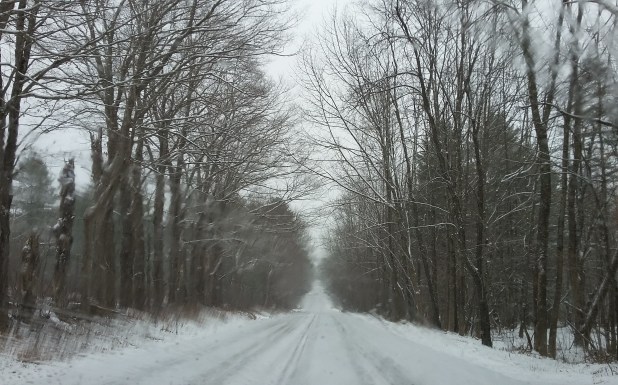
On days when it snows, the daylight softens to the gray of twilight. Sometimes the wind drives the snow sideways like pellets, and other times the air is so still you can hear the snowflakes alight on your coat. The mist of snowflakes spreads a feeling of sleepiness. The animals find cover under the evergreens, and I settle by the fire when my hat and boots are soaked through from walking in the snow.

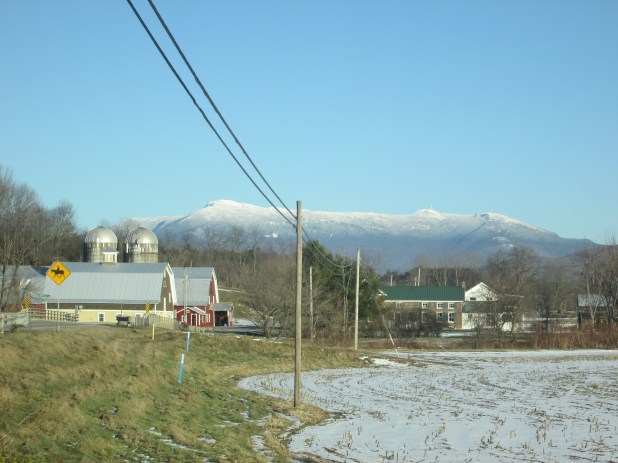
Sometimes it is too cold to snow. On those crystal days the air is so clear you can see the distant rounded mountaintops acutely, figures outlined harshly by the sky. The air freezes your nose hairs with each inhale. The wind gives you brain-freeze when it collides with the small patch of skin between your scarf and your hat. It is unbearable to take off your mittens because of the burning and numbness the air causes, so you simply learn how to navigate outdoor life with padded hands. On the coldest days, it’s a fight to stay warm. I must sleep under a pile of blankets. But, frozen days are good days.

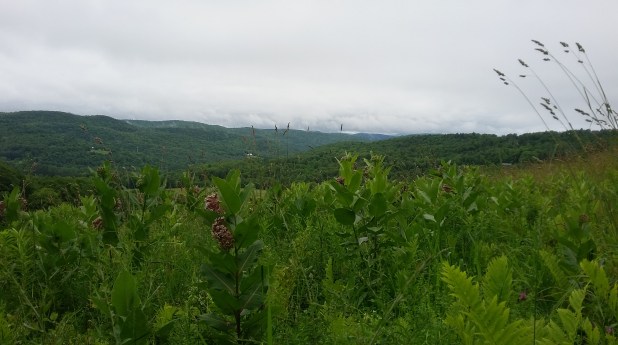
The cold protects and preserves Vermont. The threat of harsh winters prevents people from moving here and therefore it ensures there is space for the streams that meander through expansive forests. The heavy frost and ice storms keep the mossy hollows and fern-blanketed forests safe from bulldozers, houses, pavement, grass, and hoards of people and their pets.

Other places have launched themselves into a more modern era with blind enthusiasm and as if shot by a catapult. But the cold makes one lethargic. Vermont is undoubtedly part of the modern world. But, we Vermonters enjoy new technology without thinking it necessary to replace the woods. We are happy to embrace the innovations of lifestyle and thinking that come, and yet we hesitate. And I think our tendency to pause comes from having weathered so many winters. We know what true silence is—it’s the forest on the coldest day of the year when the gray of morning almost shakes hands with the gray of evening.

Once you’ve encountered a truly silent place it stays with you. Unforgettable. No matter where you go the vividness of the place where you found complete silence comes to mind from time to time. And you realize that silence is invaluable and scarce. And you find yourself taking a moment to stop because you know deep-down that anything that would destroy the places where there is silence is terrible.

The Doctorhood Quest

It seems timely to quote Carrie Fisher, who said:

Stay afraid, but do it anyway. What’s important is the action. You don’t have to wait to be confident. Just do it and eventually the confidence will follow.

That’s a decent summary of how I try to live. Going to Paraguay was a leap, but a longer jump is starting my quest to be a doctor. Becoming a doctor is a 7-year commitment at its least, and it’s looking more like 10 years for me. What a trip to start in my late 20s, don’t you think?

Can you imagine striving for 10 years even though there is a real possibility of losing your way at each turn?

I’m not sure if I can picture it. I’m not certain the path is clear to me, but I’m going for it anyway…because my end goal and vision are vivid. Fear and confidence. They go hand-in-hand. They balance each other. When one is strong, it is wise to foster the other.

I wonder every day if dedicating myself to becoming a doctor is what I should be doing right now. It’s not exactly doubt that makes me wonder, but more of a need for reflection. Ten years is a long time. It’s a little more than a third of my life so far. It might drive some people crazy constantly questioning themselves, but I’m comfortable with the uncertainty. You see, I’ve learned that doing things that initially make me uneasy usually yields the best outcomes.

It is easy to fall into a routine and a pattern. The path of least resistance is to continue along whatever path you’re on—Newton: an object in motion stays in motion along a straight line unless a force acts upon it. It is hard to stop and go and change direction. But, I like challenge. Sometimes I rest, but most often I act as my own force and alter my own direction.

I started the doctorhood quest back in May 2016. That’s when I took my first “real” science classes. But, I’ve known since 2014 that I’d be a doctor someday. Why such a delay? Life. The doctorhood quest is not about speed. It’s about endurance. I know I’ll reach the grail. I know that when I do, I will be happy to dedicate myself to medicine and improving the world in my small way. But the word for the doctorhood quest is “patience.” There are plenty of people who need healing today and there will be plenty tomorrow and the next day. Right now, I’m learning and doing the small things I can. When it’s my turn to heal, I’ll be ready.

Happy Holidays

Spend Thanksgiving, Christmas, and the New Year in another country and without your family for a few years and you’ll return with a whole new perspective about the holidays. I promise. I know. I did it.

You end up seeing clearly all the things you love about your holiday traditions. You also realize that the stress that often comes with the holidays is not required. The tension is something you add to the mix for a host of reasons, but is not inherent to the holidays.

Leaving the stress at the door is great, and I was only able to do it because I took a sabbatical. During my break, I had plenty of time to ponder all the things I love about the holidays, but especially Christmas with my family.

Top of the list was seeing everyone. This Christmas was special because I met my baby niece for the first time. She’s little and cute and the first of her generation in our family—needlessly to say she was the star. I also saw my brothers after over two years. Two years is a long time. The last time I saw them, one was in high school and the other was in college. They both graduated those occupations in May 2014. I left January 2014. Wow. Crazy, right? They both are taller than I remembered, and the younger is a giant. GIANT.

A close second is the food. I do Christmas Eve at my mom’s and Christmas Day as my dad’s. Both of my parents are fantastic cooks. We dine like the three kings. This year, my mom pulled out all the stops with the desserts—two types of pie, German chocolate cake, and chocolate mousse. On Christmas morning, we ate fruit cake and Christmas stollen. My dad served king crab, but this year I’m trying the vegetarian thing so I stuck to my favorite on the rainbow, orange. Specifically, squash orange. Some people get excited over steak and potatoes. I’ve always been a fan of squash and potatoes.

Next are the decorations. My family is full of artists—basically if you aren’t an artist you’re in the minority. What this means is that we have awesome Christmas trees and house décor. We aren’t one of those families that drapes their house in lights. But we have some great Christmas tree ornaments and we know how to place them just right on the tree. On Christmas Eve, my job is to decorate the table. I went for elegant this year—a garland and candles.

Christmas Eve we do fireworks and a bonfire. You should be jealous. It’s a perk of living in the middle of nowhere with snow all over—we can enjoy fires of all shapes and sizes with almost no risk of harm…this year one of the fireworks we set off did explode on the ground in many directions however.

Stockings. I love Christmas stockings, maybe more than presents. Why? Who knows, but it’s so fun to see all the little, silly things one can fit in a decorated sock. Tooth brushes, toothpaste, candy, tree ornaments, nail files…you never know what “Santa” will leave.

The morning. I’m a morning person. I usually get up early. On Christmas, I’m always the first up. I’ve overcome my childhood ways…meaning I don’t get up at 4 o’clock in the morning any more. This year I got up at 5ish. I love the quiet when everyone is sleeping and it’s just me, the Christmas tree, and the stockings. This year I finished embroidering a stocking that needed some love before anyone else got up. Victory.

My sister has changed and is now a morning person. Because she and I travel from our mom’s to our dad’s and split Christmas between them, the 26th is also part of Christmas at my dad’s house. This year, she and I finished making a pie before the parents got up. The crust had been in the fridge overnight and was rock-like. Luckily, my sister is buff—you should see her shoulder and arm muscles. She’s a professional fitness trainer—so she rolled out the crust like it was warm butter. I gave advice like, “If dirty dishes are in your way (when making pie) move them.”

It was nice to be home for Christmas. And, seeing as I was in Paraguay just before (and traveled 32 hours to get back in time for the 24th), it was even sweeter.

*Photo credit: Matisse, my brother.

Welcome 2017

You know, 2016 was a pretty awesome year. It was one of transition. My service in Paraguay ended and I returned to Vermont. As you may recall, I grew up in Vermont. I fled the state when I went to college. I swore I’d never return. But, minds and hearts change. Here I am. And, I’ll be in Vermont for a stint longer than I was in Paraguay.

So where does 2017 find me?

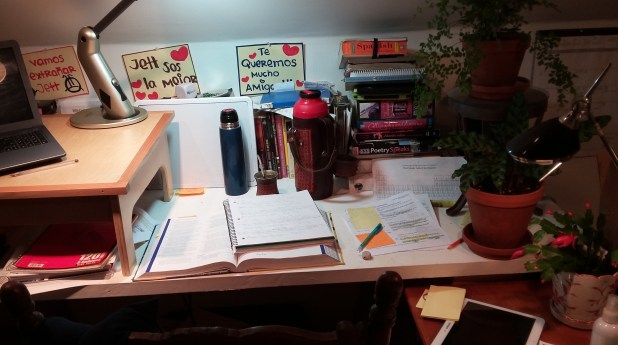
I’m in the midst of a post-baccalaureate, pre-med program. What does that mean? I’m taking the undergrad classes required to apply to medical school, which I didn’t take when I earned my BA in Public Relations.

The end goal? Becoming a medical doctor. But, one step at a time…

I guess we can say that 2017 officially marks the end of my Peace Corps journey and the beginning of my doctorhood quest. And it is a quest. A long, long adventure full of all kinds of tricky science and learning new things. Luckily, I gained some endurance and determination abilities while in Paraguay.

As always, I’m doing many things. I’m studying and working. I’m on the verge of becoming an EMT. Got my cert…now I just need a volunteer position. Further, I’m considering what other delights I can fit into my jammed schedule.

While I start 2017 as a busy bee, like every year I remember, this year isn’t about the work. Work is what I do, I’m just like that.

2017 is about attitude, not tasks.

We can’t know the future. Life is exciting because of tomorrow’s mystery. But, I have high hopes for 2017. And, despite some giant obstacles (not the least of which is a despicable human storming the Oval Office) I have some happy goals.

I’m expecting 2017 to be full of positive thinking and pep talks. That’s the nature of having hard professional and personal goals. But big goals aside, my main resolution for 2017 is to create moments of caring and sharing. What does that entail? Carving out time to spend with people I love. Smiling and seizing opportunities to discover new people to love. I know, it sounds wishy-washy. But it’s not. This year is simply about being happy as a human and sharing that happiness with others.

With that, let’s go 2017. I’m ready. Are you?

The Return

Ha! My Peace Corps service ended so long ago that I went back to visit. Eight months after journeying from Paraguay to the US, I traveled backward for a Paraguayan friend’s wedding.

I cried when I finished my service and left the land of the Guarani—mostly because I didn’t know when I would return. I told my Paraguay friends, many of whom are more family than friends, that I would come back. I wondered if I was lying.

Well, I was honest. I went back. Sooner than expected, but love has no timeline and I swore I’d go back for my friend’s wedding. I was a bridesmaid. The bride was a vision. If my friend’s married life is half as lovely as she was on her wedding day, she scored big time.

It takes more than a day to travel from Vermont to Paraguay. It’s a journey of planes and buses. But, it’s worth it. And, now that I’ve done it once, I know I can do it again.

I think one of the loveliest things about going back was how little things had changed. Sure, there’s some new paint here and there. Many of my students graduated high school this year. My friends continue their lives, making changes like tying the knot. But, the important things carry on the same—perhaps indefinitely. The heat engulfs you when you step out of the airport. The sun sparkles in the sky, making the colors of life dazzle. My friends laugh easily and every Paraguayan offers food or terere. The people. The people of Paraguay are so warm. That’s the best part. They are so generous. I hope they always will be.

I spent the days drinking terere and gossiping about town happenings. I took siestas when the sun was too strong. I visited. I prepared all the little things that make a party a party—the frame for taking selfies at the wedding. Packaging the guest wedding gifts.

My Paraguayan friends welcomed me like family. They made room for me. My Paraguayan sisters gave up their beds for the days I was there. I shared meals that my favorite señoras cooked.

I saw the sun shine through the mango trees. I realized that as long as my friends are there, Paraguay will be a second home. And while my soul continues to wander, it is reassuring to know that yet another place I love will always be home. They say home is where the heart is. The euphemism is a smoothing of the reality. The heart can be like an electron. More than one place at once. My heart is divided in two. I imagine that it will split more as I fall in love with other peoples and their lands. And, now that I’ve learned a bit more about the odd natures of electrons (thank you pre-med curriculum), I’m okay with the uncertainty of where my heart actually is—I, at least, know the path on which I’m most likely to find it.

Photo credit: Carolyn Enz Hack

Convenience

“How is being back in the States?” friends and family have been asking since I got back from Paraguay. Unfortunately, I don’t have a good answer…just as I couldn’t explain what is was like to live in Paraguay when I first moved there. However, despite my general inability to describe my transition back to the USA, there is one thing that stands out to me about living in America: life logistics are incredibly simple. What I mean to say by “life logistics” is all the things we do to make sure our lives function properly— such as bathing, traveling between activities, and controlling house temperature.

In my new US home, I make up reasons to stay in the hot shower longer. It’s such a treat compared to my Paraguayan bathing ritual. In Paraguay, I stored water in a basin because for hours, many days, we didn’t have running water. Even when I did have water the pressure usually wasn’t enough to push water out of the shower head. And, because of this annoying water-flow problem I did not invest in a shower head to make hot water. So, 95% of the time I bucket bathed in cold water—using an old, plastic pitcher to dump water over my head. If it was too cold, I boiled several liters of water to add to my basin and bathed quickly. In America, I turn on the shower and the water comes pouring out every single time. The water is as cold or as hot as I want it to be. I don’t need to worry when a storm comes that I won’t have bath water or hesitate before exercising because I forgot to hoard water. In the great land between Canada and Mexico, showers are a given.

When I’m trying to get somewhere new by bus in Vermont, I type point A and point B into my smartphone. Then, Google tells me where and when to wait for the bus. The bus comes when Google says it will, and the fare costs exactly what the bus website said it would. In Paraguay, when I traveled to a new place by bus I asked 1 to 5 Paraguayans which buses to take, where to wait, and how much the fare costs because none of that information is available online. I asked more than one person to check the information and make sure I had the best route and detailed instructions to help me know where to wait for and get off the bus because there aren’t marked bus stops (usually). If I messed up my transfer in Paraguay, I had to start the process of asking for directions all over again. In Vermont, I can’t really get lost because I can check my travel progress on my phone periodically and then ask someone if I need more help.

It is spring in Vermont. Sometimes it is pleasantly warm and sometimes it is cold. If it’s cold, I turn on the heat. My house is insulated. The windows and doors block the wind. My roof doesn’t leak. My floor is on a foundation so my feet are shielded from the ground’s temperature. When I listen to the beep the thermostat makes as I turn up the heat, I think of my little Paraguayan house. The wind came through the shutter and doors. The walls were made of one layer of hollow bricks. My floor was a cement slab on the good earth. My roof was tile and let in the rain in some places if it was windy. It was always windy when it rained. On cold days in Paraguay, I put on two pairs of pants and all my jackets. Then, fully clothed, I sat under my sleeping bag and drank mate. That was my heat, blankets and hot beverages.

What is it like to live in America? It is comfortable. It is efficient. It is easy. It is sterile. The challenges of life logistics have been replaced with intellectual and trivial quandaries. Should I take a more-than-five-minute shower? Would I be a better person to bike rather than ride the bus? When exactly is it cold enough to turn up the heat rather than putting on another sweater?

Life’s Soundtrack

At first it was strange to throw toilet paper in the toilet rather than the wastebasket and be in a comfortable climate rather than melting of heat. Those contrasts caught my attention first and in a jarring way when I arrived back in the US several days ago, after living as a Peace Corps volunteer in Paraguay for 27 months. But, where one puts toilet paper and how the weather is have always been minor details of life to which one easily adjusts.

My Peace Corps service ended on April 8, 2016. And, I’m still journeying to where I’ll live next. I’m visiting family, not seen for over 2 years, before I settle into what I imagine will be a hectic lifestyle. And as the visiting continues, I’m taking my time to adjust to this new world called the U.S. of A. It was both out of urgency and strategic planning that my first stops in America were to visit my grandparents. I spent so many hours sitting, chatting, and talking about old times with Paraguayans, doing the same in English with family has been a treat.

But, even in the bubble of my grandparents’ homes and neighborhoods my time in Paraguay seems to fade like a dream. As one person commented on Facebook, “It happened and now it is over.” Or, as my grandmother said, “that place you visited.” I had to laugh at the choice of the word “visited.” Can anywhere one stays for over two years count as a visit? “Visit” seems like such a trival word to describe a place I consider home and from which I emerged a new person. Words. That brings me to the point of this ramble.

There are many details that are different about living in Paraguay and living in the US. For example, I can talk to a guy my age in the US without anyone jumping directly to the conclusion I have a fling with him, where as in Paraguay people would most likely think there was something going on between he and I. But, for now, the diverging details are not overwhelming. The harshest changes I currently feel are the different life sounds between the US and Paraguay and that I have lost the key words and phrases I’ve been using for two years to express my thoughts and feelings.

On one hand, it is nice to once again understand what everyone is saying around me. On the other hand, it is so distracting to know every blasted word the people in line in front and behind me are saying. Who should I listen to? How can I think of my own words when there are so many words flying around me that I effortlessly understand? It was a lot easier to tune out in Paraguay where I did not understand every thing people said.

I am joyful to hear so many people speak my native tongue, but my goodness how the sounds that make those words sound like gravel against a shovel or nails on a chalkboard. I never realized how ugly and harsh English can sound. The twang, whine, and nasal of English words is almost painful to my ears. I miss the round vowels of Spanish and the flow of Guarani–two languages that are melodic compared to the clanking nature of English.

It’s not just the sound of the language that is dissonant to my Paraguay-tuned ears. It’s the music, or more accurately lack of music. Where is my cumbia? My bachata? Paraguayan polka? Why are the houses and buses and streets silent? What is this new phenomena of silent nights? I used to have to wear earplugs to escape from Spanish-language love songs, and now I can sleep without earplugs because there is not even the roar of dirt bikes and heaving old trucks to disturb my slumber. Am I in the land of perfect sleep?

The soundtrack is different in my country from that of my Paraguay. But, that is not all. The words and phrases I can use to express myself are different too. It is obvious that speaking in different languages means using different words. However it is not the language, but the phrasing that is tripping me. Even when I translate, or try to translate, the words and phrases I used in Paraguay to English, it doesn’t work. Why? Well, a lot of the words don’t have an English equivalent. How the heck am I supposed to say “tranquilo” or “no más” or “opama” or “kaigue” or “hi’que” in this blasted native language of mine? I can’t.

“Tranquilo” could be translated to “tranquil,” “no problem,” and “life’s good,” but it means all those things and more. The same goes for the others. “No más” literally means “no more,” but it can actually mean “that’s all,” “no problem,” and “It’s not a big deal.” “Opama” literally means “It’s over already,” but that’s hardly a good suggestion of all the things “opama” can mean in context. Both “kaigue” and “hi’que” don’t even have English translations…so there’s that.

Sounds. Words. Music. Language. They dictate who we are and how we explain ourselves to others. When I first got to Paraguay, and for all my time there, one of the biggest challenges I had was feeling like I could not completely express myself in Spanish and Guarani. Ironically, I now feel the same way in my homeland. I’m at a loss for words and homesick for the familiar sounds of my community in Paraguay. The language. The music. The spitting of frying oil and roaring of dirt bike motors. I know the sounds of my American environment will soon become just background noise. But right now, my new life’s soundtrack is bombarding my conscious mind.

Land of Plenty and Unemployment

I went for a walk in the evening the other day. My walk took me along the main road and down to a river that was swollen beyonds its banks with rain. We’ve had a wet year and the rainy season is beginning. All along the flood banks men and women were fishing with their bamboo poles. Here fishing most often involves a string tied to a piece of bamboo, no reel, no bells and whistles. There are two primary kinds of fish, super bony and bony. The average fish is about the size of my hand.

Most people weren’t fishing just because they think it’s fun. As dusk was falling, two men on a dirt bike passed me, they were laden with silver, hand-sized fish. People here eat fish and even the small ones. One day the mother of the family I’m closest to was telling me about a woman in the community who has eight children. That’s a lot of mouths to feed with only the father working, and in Paraguay there are few jobs that pay enough to easily support a family of ten. I asked how the woman fed all her children.

“Well, they fish…” the woman I was talking to said.

Paraguay is fertile and has a climate designed for growing things. Fruit of all kinds, except apples and berries, is all over–bananas, all the citrus, papaya, passion fruit, pineapple, mangos, and the list goes on and on. There are several kinds of fruit in season at all times, and bananas are always available. With a little effort one can grow vegetables year-round and harvest most crops more than once every twelve months. In addition to fruits and vegetable, animals are part of most Paraguayan families’ lives. People who don’t live in cities can raise chickens and pigs on their plots, and even if they don’t own grazing land they can graze cows on public land and land that isn’t in use.

With some effort starving can be avoided in Paraguay even if money is tight. Further, the temperature is moderate. Unlike Vermont where winter exposure is deadly, in Paraguay, a roof to protect from the rain is enough to survive. Simple, rustic living spaces where families depend on their own crops to eat may not be a dream, but are realistic ways to live in Paraguay.

The point is that Paraguayan climate and geography are friendly toward life. People who are creative and willing to work can survive on almost no money. But, as hospitable as the earth and rivers are in Paraguay, job opportunities are limited. It is not uncommon for one person in a family of many to work, even if several people in that family are working age. The common example of a father supporting his wife, adult children before they marry, and his young children is traditional but not what most families would choose. It is a reality here because jobs are scarce and opportunities for professional employment lag far behind the number of people who are educated and trained.

As I watched the sun set over the river and bordering marshland, I thought about the juxtaposition of existence in Paraguay. I like to think Paraguayan society is moving toward providing its people as many career options as the land of the Guarani offers food choices to the hungry. I believe it is. The students I worked with want more than just a roof and bananas with fish. They want to travel and have cars and cell phones. Paraguay must change to provide what its future leaders demand or it will lose them.

Lice

Once when we were children my sister got lice from school. I remember it was a big, embarrassing ordeal. We all–my mom, my sister, and I–used lice shampoo right away. This memory makes me smile often, as I go about life in Paraguay. Things are so different here.

Most kids have lice in Paraguay…that might be an exaggeration, but not a terribly erroneous one. The difference is, however, that lice are not considered to be the end of the world in Paraguay, as they seem to be in the States. People I know here don’t use shampoo to kill the little buggers either.

Lice control in Paraguay involves a child sitting in her mom’s, aunt’s, couscin’s, or sister’s lap while the older woman combs through the girl’s hair with her fingers and kills the lice she finds between her finger nails. This is a ritual that is neither hidden or done with shame. It is undertaken out in the open and in front of visitors without hesitation.

Grooming in Paraguay is more communal than I experienced in the States. The lice picking used to remind of apes and the other habits between women (mostly) like cutting each other’s toe nails and cleaning each others feet made me a bit queasy. Feet are for walking, not for touching in my book. But, nowadays I find these behaviors normal, though I still don’t actively participate–I guess we all have our limits.

The easy-to-maintain sterile world many people in the States live in allows us to forget that germs and bugs and dirt are just part of life. I think many of us could benefit from remembering creatures like lice aren’t usually the result of negligence but are just part of this little world in which we live. I’m not exactly saying that we should all go out and get lice, but I’m suggesting that their appearance shouldn’t be a catastrophe.