Work-Life Balance

Why do some people always seem to have time for vacation, camping trips, and concerts while others always seem to be working? How do some people function on what seems to be no sleep? What exactly is work-life balance? Is being a workaholic a problem or just one way of giving life meaning?

Some Case Studies

Hospitals

Health care is full of people who work almost around the clock—nights, weekends, and holidays are fair game. But, for example, the shift work of nursing can allow for many days off every 2 weeks. Plenty of nurses I know take advantage of 36-hour, full-time work weeks (broken into 3, 12-hour shifts). A sample biweekly work week is 3 days working, 1 day sleeping, 3 days working and 7 days off. Despite the exhaustingly long shifts, these nurses enjoy 4 more days off every 2 weeks than a person who works a job Monday through Friday.

My American Family

In my immediate family, there are many models of work. Several of my family members are self-employed. They may work every day but they might also take long stretches off. Some days are long; some days are short. My sister is a trainer and fitness queen. While she often works fewer than 40 hours per week, her hours are spread out across every day of the week and at different times of day such that taking even one day off requires scheduling magic. There’s my step-mom who has the stereotypical workaholic, business schedule which is based on an 8-hour slot Monday through Friday. Of course, a few hours are tacked onto each day and she works additional hours over the weekend. In the end, she works something like 80 hours a week even though she’s on paper for 40—and, stepping away for any stretch of time seems impossible.

Paraguay

In Paraguay, holidays are sacred, summers are lazy, and commutes are so long they seem unreal. Except for the man I knew in the Navy and some small business owners, no Paraguayan I met while living there worked during a national holiday. Perhaps that’s different in Asunción (the capital) and in major hospitals (of which there are few) but generally Paraguayans don’t work holidays. Additionally, few people work on Sundays. Almost nobody works past midnight. While many Paraguayans have long commutes to work and work long hours, the number of days off they have in a year dwarfs the number of days off many Americans choose to take.

Paraguay vs US

In Paraguay, family comes first for most people. Most people work to support their family and buy nice things. Most Paraguayans prioritize time off visiting, eating, celebrating, and watching soccer over working endless hours. Most Americans prioritize working. Many Americans bank hundreds of vacation hours that they cash out or lose entirely. Of course, these are stereotypes…but, during my experience living in both countries, the stereotypes of family-first for Paraguay and work-first for the US seemed justified. I’ve often asked myself, “Who has it right?”

The Perfect Balance

The balance between work and other activities isn’t static. The perfect balance, the one that yields the greatest happiness, is unique for each human. Neither the Paraguayan approach nor the American life approach is better, they are just different. Paraguay taught me the importance of downtime while the US emphasizes overtime and constant production. Regardless of who you are, there are times when work should come first and times when family, vacation, rest, or anything else must come first.

Winning the balance comes down to being willing to reflect on your life and to make changes. For example, when one of my friends frequently complains about working too much or is always exhausted, I often ask if it’s time to scale-back or change their work schedule, job, or approach to working. When another friend often talks about being bored at work or not making enough money, my thought is that it’s time for them to invest more effort in professional growth. Is it easy to change things up and move toward something different? No.

It’s hard to reflect on your life and make meaningful changes. What I do to face the challenge is break my life into chapters and then identify what made me happiest and saddest during each chapter. I use what I identified to inform my guesses about what I need to do today to tip the scale more towards happy going forward. I tend to be work-centered (mostly because I love learning and feeling productive). As a result, the life side of my balance always requires more attention and energy than the work side. Knowing this, I put extra effort into “life” to keep my scale level. My scale often dips one way or the other, but I try not to let the off-kilter stretches jar me. Rather, I make small adjustments until I waver around a mix of experience that feels right for the time.

Mansplaining Women’s Empowerment

I went to a training on managing aggressive patient behavior, mostly via verbal de-escalation. The class included a section on basic physical defense—such as getting out of a chokehold and escaping when someone grabs your arm. The skills were useful, but I found myself more frustrated than fulfilled by the class. What ruined the class was that one of the instructors preached for 20 minutes about how the young women in the class should feel empowered by the self-defense skills he just taught us. He told us some stories about women who were raped and killed because “they didn’t put up a fight.” He explained how we should be careful, avoid bad situations, and if attacked fight back.

Mansplaining: definition from the wiki article, “(of a man) to comment on or explain something to a woman in a condescending, overconfident, and often inaccurate or oversimplified manner.”

I was insulted by the lecture because as a woman I’ve been told countless times to be careful. When I told my family I was joining a night crew on an ambulance squad, almost before I was congratulated on finally starting as an EMT, I was asked if it would be safe for me to sleep at the station with my male crew members. Throughout my Peace Corps training, we had sessions on gender relations and how to avoid getting raped in our host country. In college, our advisers used to give us party-going strategies to avoid getting drugged. The list goes on.

It is NOT empowering to be told that you’re a victim and will always be a target. It is NOT empowering when people create boundaries (perceived or real) for you. It is empowering when others complement you on your success, offer intelligent advice as you work through challenges, and lend their support as you strive to reach lofty goals. Let me offer an example of what disempowering and empowering look like:

Disempowering: In a recent conversation with a male nurse, both the fact that I’m applying to medical school and my age (I’m almost 30) came up. The nurse didn’t comment on my age until I mentioned I’d applied to medical school. Upon hearing about my professional ambition, he “jokingly” asked why I wasn’t married and pregnant at my age. That is such a classic example of sexism it could be in a textbook. He never would have asked any man that question, even in jest, about applying to medical school.

Empowering: Upon telling one of my mentors about a test score I wished was higher, he said that he was sure I’d be just fine and turned to the other person with us to explain that “good” by my standards was quite different than “good” by most standards because I have high expectations.

Being an adventurous, single woman does clash with society’s view of women. How can I travel to foreign countries alone? It’s so dangerous. How can I go hiking or camping alone? It’s so dangerous. I’m not going to argue that those activities are safe. What I wish to suggest is that I have the intelligence to decide for myself what is safe and not safe, worth the risk and not worth it, and how to avoid unnecessary danger. I don’t need people to remind me how awful the world is. I need people to help me figure out how to overcome the challenges between me and reaching my goals.

What I wish that the instructor of the class about managing aggressive behavior knew is how many creepy men I’ve avoided in my life already, long before his class. I wish he understood that I don’t need him to tell me I should be careful and fight back. It is not empowering to be viewed as a potential victim of aggression, especially sexual aggression, even if you know how to fight back. It is empowering to be seen as a peer and fellow human with dreams, strengths, and weaknesses that transcend sex and gender. That is what women’s empowerment is all about; being viewed as an intelligent being and not an object or target or static lump.

Prayers

Trying to get into medical school is a bit of a slog at times. I’ve been lucky to have people support me during each leap through the hoops of fire. Recently, I’ve had a few folks tell me they’re praying for me, and then qualify their statement by saying they know not everyone believes in God. I was surprised that they felt the need to acknowledge I may not believe in their God.

In Paraguay, my adopted mothers prayed for me almost every time I left their house for mine (so almost daily). I am and was always thankful because of the sentiment. I believe it’s tremendously generous and kind when a person cares enough to think of me, to support me, and then to ask for help on my behalf—whether they communicate with their God or simply wish me luck.

In America, I think we publicize the extremes. I see politics radically divided. Political opinions are often based on extreme visions of how things should be or a rebellion against others’ interpretations of right and wrong. These hardline stances don’t allow for more than one opinion to thrive. To me, holding an unweaving “I’m right and they’re wrong” stance is limiting because it creates rigid definitions of aspects of life that neither the State nor another individual can interpret for me or you.

I attended church often in Paraguay because the church was the center of everything in my Paraguay community. I did not and still do not believe in the God of that church. But, I could feel how strongly my Paraguayan friends and family believed in their God. To them, their God was not only the source of life and reason for living but also the definition of love. Going to church allowed me to better understand how they saw the world. The Paraguayans who welcomed me into their lives knew our views of God were different, and they still embraced me as a dear friend. They included me in their secular and religious activities, answered my millions of questions that began with “Why?”, and they accepted it when I sat out from certain rituals because they were “too much for me.” What these shared experiences taught me was that we do not need to have the same definition of life and love to build friendships. We just need to be comfortable knowing that even though we see eye-to-eye on some things and share some history, we also hold very different views of certain aspects of life.

My hope is that someday the US won’t just be tolerant, but that each of us will be comfortable standing side-by-side with folks who are different from us, be strong enough to ask questions to learn more about how those different people see the world, and be proud enough of our belief system to follow it without expecting others to pledge allegiance to our view.

When I think of those who prayed for me before I took the MCAT, I’m thankful. Perhaps their prayers didn’t mean to me what they meant to them, but I think we share the knowledge that what I was doing was hard and whatever assistance they gave would be part of my success.

Christof

There’s a guy, Christof, in my neighborhood who collects returnable bottles from the recycling we put out on the corner for the city each Friday. One day when my father was visiting me, he struck up a conversation with Christof. One of Christof’s daughters went to college and the other didn’t–Christof joked that the daughter who finished college doesn’t have a job while the other one does. He collects bottles to help both of them.

I don’t often drink anything that comes in a redeemable bottle, but since chatting with Christof, my father started saving his seltzer bottles…he drinks a lot of seltzer. My father brings the bottles to my house (even though I live about 2 hours away) when he visits so I can give them to Christof.

I work nights, so it’s challenging to put out the recycling before Christof passes. One morning I saw him, though, collecting from the neighbors. As he walked by, I ran out and asked him to wait a moment. He paused, a smile lighting his face. I handed him 2 huge trash bags of bottles I’d squirreled in the garage for a few weeks. He thanked me a million times, wished me a blessed day, and was on his way.

At first, I thought my father was ridiculous for saving bottles for Christof. But, that morning when I saw Christof’s face after I handed him our bags of bottles, I realized that my father was right. We can get so caught up in all the big things we should do that we do nothing. Christof reminded me that it’s the small things that add up in the end. And, luckily, life is full of small things.

Framing: Beautiful Microbe, Beautiful Molecule

Before I started down the health science path I studied communications. In communications, there’s an idea called “framing.” Framing is a theory that’s often applied to the media and how it shapes public opinion about certain topics. The concept is that how you talk about a specific topic (ex. healthcare)—such as the tone you use and the details you include (or leave out)—can shape other people’s perceptions of the topic.

I’ve noticed that several of my science professors use framing as a teaching tactic. And, despite knowing exactly what they’re doing, I still fall for it.

I’m currently studying microbiology and organic chemistry. There’s a lot of new information to learn and for organic chemistry there are a few new thinking skills I’ve been practicing—such as being able to think about molecules in 3D. It’s an interesting challenge to train your brain to be able to rotate different molecular structures using only your imagination. I’m lucky enough to find microbiology and organic chemistry fascinating, but still it’s hard work. That’s where the framing comes in.

My organic chemistry professor introduces particularly complex or tricky molecules as “beautiful molecules.” “This is a beauuuutiful molecule,” he’ll say. He’ll also start a new chapter by saying “This is an important chapter. This is very cool…let me tell you why.” And, somewhere in that explanation of how awesome the challenging topic is, he’ll make a few comments about needing to practice the skills he’s about to show us. “But I will teach you how to…” he will conclude.

My microbiology professor does the same thing. I always know when he’s preparing to introduce a particularly complex metabolism, process, or cycle used by bacteria because he’ll pull up a picture of a microbe and say “This beautiful microbe…”

Those are current examples, but my general chemistry professor did the same thing. His word for hard concepts to learn was “interesting” rather than “beautiful.”

So what’s going on with this inappropriate use of descriptive words? Framing. Why? Because it works. As absurd as it sounds, it’s way easier to fight with a beautiful molecule than a molecule that’s “annoying” or “difficult” or “challenging” from the very start. I don’t think microbes are necessarily beautiful, but I approach them with much more interest and forgiveness when they are presented to me as “beautiful” rather than “ugly” or “evil” or “bad.” And, when trying to complete long chemical equations, it is a lot easier to complete the “interesting” problem than it is the “hard”, “tricky”, or “terrible” problem.

What’s my long-winded point? Before I dove into science I heard that it was “hard” and “confusing” and “dry” and “boring” and many other potentially negative adjectives. Sometimes I completely agree. But, most of the time, I do think it’s amazingly interesting. I think we’d do a lot of young people thinking about their future (and older people looking for something new) a service if we framed science as something wonderful. Sure, there is plenty about it that’s hard, and even monotonous, but most of it (all of it maybe) is not beyond most people’s reach. We’ve just conditioned our population to think science is either too complicated for them or not something they’d find interesting by describing it as scary, trying, and a thing that only geeks and brilliant people do. It’s worth a frame-shift around science. Why? What better way to find answers to medical questions, renewable energy questions, etc. than having more people researching and exploring those topics?

Are you lonely?

“Are you lonely?” is America’s version of the boyfriend question. I thought the coupling obsession was a Paraguayan thing. But, now that I’m back in the US, I realize I was mistaken. It’s also an American thing. Maybe it’s a human thing. Regardless, I’ve gotten a lot of practice justifying why I’m single. So, let me tell you…

…there is no reason why I’m single. I just am.

I know it’s hard to believe that a person can be happy just being. But, try to imagine it. Consider, for example, that I can go hiking on the fly and not wait for a soul. I could move anywhere and would only need to bargain with my future landlord and maybe the visa office. I can (and do) eat when, what, and where I want and don’t feel even a hint of obligation to coordinate with anyone.

Perhaps you’re thinking something like, “Fine, Jett, you’re busy and independent…but really you’re just waiting for the right guy. You’re lonely, but you forge on propelled by the dream of the prince who will sweep you off your feet one day.”

If something like that is on your mind, I must ask: Doesn’t that argument seem archaic? By now we should all know that princes only live in fairytales. They aren’t real, but metaphors for love and good fortune. I don’t need the metaphor. I’m not looking for someone to fend off the dragons. I do that just fine on my own.

Don’t despair, you’re partly right. I’m busy and I have great friends. But that’s the whole point. If I lived my whole life as I am—doing good work, engaging in hobbies, and enjoying friends—then I would have an awesome life. You see, my life’s not on hold. I’m not working toward finding that perfect man. I’m just living…and I also happen to be single. I’m not worried about love. Why should I? It’s spontaneous and stubborn. It will do whatever the heck it wants. Just like me.

I might one day stumble upon someone to be my partner in crime. I might uncover a person who makes me happier than I already am. If I do, I’ll marry him. I also might not find such a human. Either way, the trajectory is grand. I realize that many believe that singletons need to be saved. But let’s remember that when we, you and I, were taught about the American dream it was never said that it could only be dreamt by two.

Thanks for your concern about my emotional well-being. But, the better question is “What do you do?” I assure you the answer is interesting. I have a lot to say about me and my doings. And don’t worry, I’ll let you know if me becomes we.

Old Haunts

I stared at the metro station that had been my home stop for several years as the train doors binged open and closed. That day I had no reason to get off there. I tried to remember what I had thought about all those times after interning, working, volunteering, and adventuring when I got off on that platform and observed the name written in white on a brown pole, “Cleveland Park.” Too many different thoughts to remember. Feelings arose—that of being too hot or tired from a long day at the office, but those were more sensations than memories.

It had been over three years since I’d visited DC—three years, but a lifetime of learning. The trouble with my recollection wasn’t so much that I didn’t remember all the good and bad things that had happened while I was in our Nation’s capital. The marathon training runs through Rock Creek Park when the sun glistened through the trees as I padded along the winding creek dodging bikers and baby strollers. I remember the roly-poly red pandas who I visited many weekends. The tart and sweet of frozen yogurt and mango. The smell of coffee emanating from my clothes after a shift at Starbucks—you can’t escape that scent, and coffee smells different when it’s associated with work, rich and bitter at the same time. I remembered the night I drank my first energy drink, my only all-nighter of college, so I could walk down to Obama’s first inauguration. I had tickets! I remember the cherry blossoms and the autumn leaves reflecting in the pool at Jefferson’s feet. The flags on the Vietnam memorial stark against the black stone. The quiet white lines of tombs at Arlington—so many lost. The smelly humidity of the metro before a marathon. The chili fries at National’s stadium—Harper, Zimmerman, Gonzales…the presidents racing. The long night walks in the neighborhood when families strolled and the smells of different restaurants wafted across the sidewalk. The Greek deli where I got my college graduation lunch.

The trouble, though hardly that, was that the feelings of weariness and frustration that had laced my time in DC were gone. Completely gone and only the happy memories of my old haunts remained. The Kennedy Center at dusk. The strange winding of the canal through Georgetown. The roses. Roses in almost every garden. The long walks to the grocery store and the strolls past embassies. It was strange to think of embassies now. I’d been an expat. I knew what it was like to visit your country’s stronghold in a strange land. Oddly not comforting considering the comparison between American politics and the warmth of Paraguay.

I watched the people rushing out of the metro. I was sure not to esca-left—unforgiveable. I’d forgotten about all the fancy men’s shoes and checkered shirts, but seeing them I realized how unchanged cloud DC was. Suits of a cut only seen on the Hill and in old boys’ clubs abounded. I smiled. Funny to think those young men, dreaming of great titles and accomplishments, where not as unique as they imagined. As for the women, the boring shirts and sensible skirts. Even below the Mason-Dixon line so many folks lacked the flare that the south brings out if you let it. “Not far enough south,” I guessed. Of course, these folks were more complex than their clothes, but they’d lead you to believe their clothes were an expression of themselves. Hard to say, not knowing them.

Wandering the streets made me feel the freedmen of disengagement. This was not my home and could very well never be my home again. It was an easy thought. Whether the metro ran on time or late mattered little—it was no longer my metro. And besides, I’d waited hours in the hot sun for buses a fraction as nice as the dirtiest DC metro car.

Old haunts. They weren’t haunts at all, really. Just little snapshots into the past. But I no longer saw any of the scenes as I did then. No. They all had a different filter. And this time, the view was bright as the afternoon, January sun in Paraguayan. The vignette lens that had once allowed the shadows to creep in around the edges of my old stomping ground had been replace by a softening and brightening filter. I noticed the sidewalks, their cracks had been filled. The sidewalks were new just like my path. And the corners of my mouth creeped up all on their own. If my positive outlook, adopted from Paraguay, could endure the city where politicians were trying to put our country forty years behind in education, rights, and healthcare, then it was safe to say I’d come to visit just at the right time. The right time to prove that rain and sun are different sides of the same sky. I saw the sun.

When In Doubt, It’s An Energy Problem

I have a running joke about physics: When in doubt, it’s an energy problem. Before you stop reading, let me try to enlighten you with the humor. Picture yourself in your first semester of physics. You’ve tried solving one problem, yes one silly little problem, for over an hour. You’ve combined pages worth of equations and moved around variables like a wizard. No luck. You set it aside. Try again. And again. No luck. You go to your review session. A cunning smirk lifts the corners of your professor’s mouth when you ask, exasperated, if he can please review the problem. He completes the problem in two simple steps.

There’s this nifty law about nature—it’s called the conservation of energy—and it states that energy can’t be created or destroyed, only transformed. I know. You’re thinking, “By golly she’s turned into a real science nerd in a couple short months.” Sure, I’m guilty, but let me make my non-science point…

The quality that makes the law of conservation of energy so darn handy is that it allows you to ignore all the complicated transformations that occur during a journey and just focus on the beginning and end. By boiling a process down to two points, you’re able to paint a picture of what happened without seeing what occurred. And knowing without knowing is quite a powerful thing to be able to do.

Now, let’s bring energy out of the land of physics. In my world, energy means the chutzpah to get things done. I, like you, have a lot of things I want and need to do. I’m often not exactly sure how I’m going to shoulder the load. It’s exhausting to just think about all the little straws piling up on one’s back. In thinking about all my to-dos, a list of which can and does fill pages, I realized something. Tasks are not unlike equations. And, getting to the end of a to-do list is not unlike solving a physics problem.

What I’m saying is that conservation of energy is not only a physics thing but also a life thing. It’s a way to shift your perspective from being buried in the minutia of all the little details to being able to see the whole arc of your adventure. I find it exceptionally grand to think that even though I’ll take every step on the road between here and there, I don’t have to fixate on every single one. What matters are where I am now and where I’ll be then. As I forge ahead on the doctorhood quest, simplifying life to just energy is quite motivating. I don’t know every action and transformation that will occur between now and when I’m a doctor—nobody knows the future. But, I find it easy to be optimistic when I realize that I have a lot of good mojo now, and that wherever I am later that pizazz will still be with me in one shape or another.

Winter In Vermont

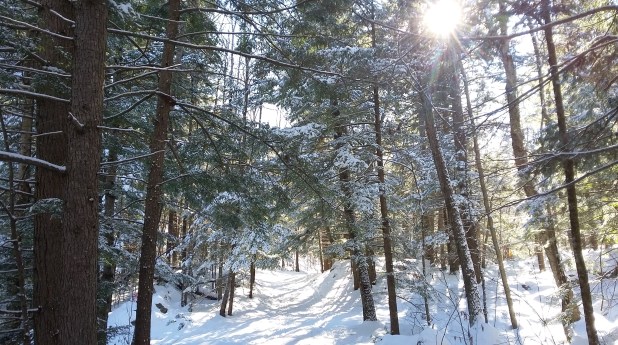
Winter is defined by suffocating darkness. The sun rises hours after me and sets long before my work is done. The haze of dawn seems barely brushed from the sky before the long shadows of dusk push back the sunlight. But, despite short days, Vermont winters are beautiful and perhaps one of its key features.

When you enter the woods they are silent, not like a tomb, but like someone holding her breath. Frozen until spring comes. The snow crunches under your feet and the trees crackle, almost frozen. Sometimes the trees freeze, and when that happens their limbs splinter as whole colonies of cells explode.

On days when it snows, the daylight softens to the gray of twilight. Sometimes the wind drives the snow sideways like pellets, and other times the air is so still you can hear the snowflakes alight on your coat. The mist of snowflakes spreads a feeling of sleepiness. The animals find cover under the evergreens, and I settle by the fire when my hat and boots are soaked through from walking in the snow.

Sometimes it is too cold to snow. On those crystal days the air is so clear you can see the distant rounded mountaintops acutely, figures outlined harshly by the sky. The air freezes your nose hairs with each inhale. The wind gives you brain-freeze when it collides with the small patch of skin between your scarf and your hat. It is unbearable to take off your mittens because of the burning and numbness the air causes, so you simply learn how to navigate outdoor life with padded hands. On the coldest days, it’s a fight to stay warm. I must sleep under a pile of blankets. But, frozen days are good days.

The cold protects and preserves Vermont. The threat of harsh winters prevents people from moving here and therefore it ensures there is space for the streams that meander through expansive forests. The heavy frost and ice storms keep the mossy hollows and fern-blanketed forests safe from bulldozers, houses, pavement, grass, and hoards of people and their pets.

Other places have launched themselves into a more modern era with blind enthusiasm and as if shot by a catapult. But the cold makes one lethargic. Vermont is undoubtedly part of the modern world. But, we Vermonters enjoy new technology without thinking it necessary to replace the woods. We are happy to embrace the innovations of lifestyle and thinking that come, and yet we hesitate. And I think our tendency to pause comes from having weathered so many winters. We know what true silence is—it’s the forest on the coldest day of the year when the gray of morning almost shakes hands with the gray of evening.

Once you’ve encountered a truly silent place it stays with you. Unforgettable. No matter where you go the vividness of the place where you found complete silence comes to mind from time to time. And you realize that silence is invaluable and scarce. And you find yourself taking a moment to stop because you know deep-down that anything that would destroy the places where there is silence is terrible.

Happy Holidays

Spend Thanksgiving, Christmas, and the New Year in another country and without your family for a few years and you’ll return with a whole new perspective about the holidays. I promise. I know. I did it.

You end up seeing clearly all the things you love about your holiday traditions. You also realize that the stress that often comes with the holidays is not required. The tension is something you add to the mix for a host of reasons, but is not inherent to the holidays.

Leaving the stress at the door is great, and I was only able to do it because I took a sabbatical. During my break, I had plenty of time to ponder all the things I love about the holidays, but especially Christmas with my family.

Top of the list was seeing everyone. This Christmas was special because I met my baby niece for the first time. She’s little and cute and the first of her generation in our family—needlessly to say she was the star. I also saw my brothers after over two years. Two years is a long time. The last time I saw them, one was in high school and the other was in college. They both graduated those occupations in May 2014. I left January 2014. Wow. Crazy, right? They both are taller than I remembered, and the younger is a giant. GIANT.

A close second is the food. I do Christmas Eve at my mom’s and Christmas Day as my dad’s. Both of my parents are fantastic cooks. We dine like the three kings. This year, my mom pulled out all the stops with the desserts—two types of pie, German chocolate cake, and chocolate mousse. On Christmas morning, we ate fruit cake and Christmas stollen. My dad served king crab, but this year I’m trying the vegetarian thing so I stuck to my favorite on the rainbow, orange. Specifically, squash orange. Some people get excited over steak and potatoes. I’ve always been a fan of squash and potatoes.

Next are the decorations. My family is full of artists—basically if you aren’t an artist you’re in the minority. What this means is that we have awesome Christmas trees and house décor. We aren’t one of those families that drapes their house in lights. But we have some great Christmas tree ornaments and we know how to place them just right on the tree. On Christmas Eve, my job is to decorate the table. I went for elegant this year—a garland and candles.

Christmas Eve we do fireworks and a bonfire. You should be jealous. It’s a perk of living in the middle of nowhere with snow all over—we can enjoy fires of all shapes and sizes with almost no risk of harm…this year one of the fireworks we set off did explode on the ground in many directions however.

Stockings. I love Christmas stockings, maybe more than presents. Why? Who knows, but it’s so fun to see all the little, silly things one can fit in a decorated sock. Tooth brushes, toothpaste, candy, tree ornaments, nail files…you never know what “Santa” will leave.

The morning. I’m a morning person. I usually get up early. On Christmas, I’m always the first up. I’ve overcome my childhood ways…meaning I don’t get up at 4 o’clock in the morning any more. This year I got up at 5ish. I love the quiet when everyone is sleeping and it’s just me, the Christmas tree, and the stockings. This year I finished embroidering a stocking that needed some love before anyone else got up. Victory.

My sister has changed and is now a morning person. Because she and I travel from our mom’s to our dad’s and split Christmas between them, the 26th is also part of Christmas at my dad’s house. This year, she and I finished making a pie before the parents got up. The crust had been in the fridge overnight and was rock-like. Luckily, my sister is buff—you should see her shoulder and arm muscles. She’s a professional fitness trainer—so she rolled out the crust like it was warm butter. I gave advice like, “If dirty dishes are in your way (when making pie) move them.”

It was nice to be home for Christmas. And, seeing as I was in Paraguay just before (and traveled 32 hours to get back in time for the 24th), it was even sweeter.

*Photo credit: Matisse, my brother.