Great Moments With Other Volunteers

Last week, I attended a training with the other volunteers in my group. On the second night, we had a bonfire and talent show. While we made s’mores and watched the moon rise, I thought about how lucky I was to be in Paraguay with such talented people.

For the talent show some people sang in Guaraní, others in Spanish, and most of us sang in English. There was guitar and ukulele. Volunteers performed solos, some duets, and some trios. We sang some songs as a group—but not hippie songs like you might be imagining. We sang mostly pop songs, though there were some folk songs. No kumbaya.

One volunteer presented her comic of what jobs each of us would have if our group worked for a commercial airline—G-44 Airlines. (She’s thinking about coming out with a sequel: Our roles if we worked at a mall). Another volunteer danced.

When I was thinking about joining the Peace Corps I spoke with several returned volunteers. They each said that one huge reason to do the Peace Corps is the people—the other volunteers. But, these returned volunteers had a hard time explaining how volunteers made going halfway around the world worth it—just like I have a hard time explaining why high school sucked and college was pretty cool.

I’ve come to the same conclusion as those returned volunteers: Getting to know other volunteers is an amazing part of the Peace Corps experience.

What makes volunteers an interesting group?

Volunteers are from different parts of the US (and beyond) and diverse backgrounds. We each have different ways of being, different priorities, and different dreams. But, we are all doers. We are all adventurers. We are all here for some reason. Some volunteers want to change the world. Some are using the Peace Corps to uncover who they really are. Some volunteers are in it for the challenge. Some volunteers see the Peace Corps as a stepping-stone in their career.

How do other volunteers add to the Peace Corps experience?

Conversations

Volunteers have a breadth of knowledge that leads to interesting conversations. Rather that trying to fit into common conversation themes—my most frequent experience in DC: bars, football, TV…—we like to talk about multifaceted topics. We also tend to listen well, so even if we don’t’ know much about what a person is talking about we’ll give people the time to describe their passions.

I’ve only been here 7ish months and my conversations have ranged from music to gender and string theory to recycling.

Dreams

All volunteers are going somewhere. For some, that somewhere might be heavily tied to their work. Some want to dedicate themselves to international development or education. For others, that somewhere relates to traveling the world or creating a family. Volunteers, regardless of their dreams, take action. They don’t wait for people to do things for them or for life to pass; they’re movers and shakers.

Parties

Like all good worker bees, volunteers know how to take time off. We party. But, it’s not just the crazy parties that you see in the Great Gatsby—shallow. We perform music, we dance, we talk, and we strategize about how to make life better.

Dedication

Volunteers are guapo. We get stuff done. Yeah, sometimes we have hard days when we can’t leave our houses. But, no matter how hard things seem, we bounce back. Most of us are here trying to make friendships and improve lives in whatever small way we can.

Insight

Volunteers are flexible and observant. We have opinions but we’re ready to change them when we get more information. We don’t just want to know about other people and other cultures; we want to understand what makes them tick. We take time to reflect and digest. We ask questions and look for answers so we can deepen our knowledge of our host country, our lives, and ourselves.

Creativity

Daily encounters with challenges we never imagined we’d face help bring out the creativity in each of us. Volunteers make art out of trash, develop games that make kids excited to learn about dental health, and get community-wide projects done despite political crevasses that have divided our communities for generations.
The Time We’re Given

My training earlier this week went as well as my travels there. It was a 3-day training where the first day and a half we worked with a contact we brought from our community and the second day and a half was a capacitation for volunteers in my group. I found the time, uninterrupted and focused, with my contact invaluable.

The head nurse at my health post came to the training with me. She, like the other nurses at my health post, is extremely nice and hardworking. I know her pretty well in a professional sense because I’ve spent a lot of time at the health post since coming to my site. Despite feeling welcome at the health post, I’ve been unsure how to start projects with them and I hoped that the training would give me a jumpstart.

The best part of the training was having focused time to talk with my contact about the needs in the community and possible project we could do to help address those needs. I liked having time to talk with her one-on-one outside of the distractions and pressure of our community because it enable us to talk in-depth and about topics we’ve never before been able to discuss.

It was interesting to learn what health needs she sees in the community and to hear about the ideas she has for projects. One topic that was surprising to me was the jail in my site.

In my site there are two large jails, and the national government is planning to build several other jails and make my community the biggest jail town in the country. The members of my community tend to see this as a negative thing. However, my contact sees it as an opportunity. She thinks the community will benefit from all the jobs the jails will bring. She also thinks that the jail has not impacted life here as much as the community claims. As my contact explained, the community uses the jail as a scapegoat so they can avoid addressing problems in the community. An example of this is HIV. A number of people have HIV in the community, but rather than focus on prevention the community tends to blame its presence on the jail and do nothing.

We outlined a project: Creating a recreational space in the community. Currently there are no parks, and the only real spaces for exercise are soccer fields. We think that creating a park with basic gym equipment—Paraguay has outdoor stationary bikes and walking machines in some of its city parks—would provide women and children a way to exercise more easily. Soccer tends to be a men’s domain and not an accessible form of regular exercise for women. Making a space to exercise might help address some health concerns in the community like high blood pressure, diabetes, and being overweight.

Time will tell whether our idea of creating an exercise space will blossom into a real project. To make the space we must work with two different community commissions and solicit money and/or exercise equipment from the government. Despite the uncertainty of that project, for the first time since coming here, I feel that there are concrete project opportunities for me with the health post starting to materialize.

The Kindness of Strangers

Earlier this week I had a Peace Corps training which took place in a location that I hadn’t been to yet.

In the US, the world of Google maps and cars, that wouldn’t have been a big deal. I’d have printed my directions and map and drove there. But, as a volunteer in Paraguay my only option was to take public buses.

I started gathering directions about two weeks in advanced. I started by asking the ladies I worked with—I asked two different nurses for directions at separate times. And then I asked a family I visited for directions. Why so many times?

First off, there is usually more than one way to get somewhere—and actually I got 2 different sets of directions.

Second, traveling in Paraguay involves looking for landmarks, not road signs or addresses, so it can be hard to know which mango tree or which church I need to get off at when I’ve never seen them. I figure my chance of recognizing the landmarks increases every time they are described to me.

Finally, I couldn’t pronounce the name of the town to which I was traveling. I wrote the name of the town and site where the training was on my hand before setting out, just in case.

In the end, a stranger rescued me. Before transferring from my second to third bus of the trip I asked the bus driver about my destination. He answered me politely, but I had the sinking feeling that I was going to have to ask the next bus driver a couple times to get the information I needed. But, as I jumped from the bus a woman said I should sit with her and she’d help me.

She is a nurse at the health center in the town next to my community. And, in true Paraguayan style, she asked me if I had kids, how old I was, and if I was single before asking my name. She made space for me in the line as we got on bus, told me about the towns we passed through, and made sure I got off exactly at the right spot. I am quite sure I would have gotten lost without her.

Helping me didn’t require much effort on her part, but it transformed my trip from a nerve-wracking experience to a pleasant one. As I walked down the cobblestone road to our training compound I was thankful and thought about how such a little act of kindness made such a difference in my life that day. I might complain about any number of things in Paraguay, but Paraguayan sure get the little things right.

New Norms

Parade I think you would surprise yourself, were you to live abroad, how quickly things you thought were weird, or never thought about before, become normal. My claim: human’s adaptability is what makes us such an overpowering (or successful) species.

Things that have become second nature to me since coming to Paraguay:

  • Throwing toilet paper in a trashcan: Paraguayan sewers (or maybe it’s the pipes and toilets themselves) can’t handle toilet paper. All bathrooms have a trashcan for paper waste.
  • Unplugging everything (including my fridge) before I leave for more than a day or during storms: It’s not uncommon for the power to go out or flicker. And, when the power comes back it can surge and fry whatever is plugged in.
  • Boiling water before putting it on the stove: Gas isn’t free and my electric water heater is very efficient. Oh, did I mention I have something like a 5-gallon gas tank that I will personally need to carry somewhere to refill.
  • Sunny, windy, warm days make me think of laundry: They are perfect conditions for clothes hung to dry to dry before they start to smell moldy. Yep, in Paraguay there are only two kinds of days: those good for laundry and those ill suited for washing.

Coping Strategies: Not for Me This Time

Not long ago the unimaginable happened in my community: a teenager commit suicide. I’m not entirely sure of the circumstances, but he attended the high school where I work and supposedly in his note he claimed having his girlfriend break up with him was one reason he decided to take his life.

When I heard the news I thought naïvely, “I didn’t know suicide happened in Paraguay.” But, apparently it’s not the first attempt by kids in my community and it’s not the first kid in the area who’s succeeded. Yet, if I hadn’t stumbled across the news the day of the memorial I’d never have known. It seems that the topic is unspeakable.

After I heard the news, I decided that I couldn’t proceed without taking the time to address the topic in a small way. I work with all the kids in 7th grade through 12th grade at the school he used to attend. So, I revised my lesson plan for the following week to address the topic of mental health in a round about way. My thought was to at least open the door, and see where the students decided to take the topic.

My lesson started by defining stress and what causes stress, and from there we brainstormed all the problems we can face in our lives using 4 locations: home, school, work, and community. After coming up with a sizable list of problems, we discussed ways to solve those problems. We brainstormed with whom we could talk if we needed help and the qualities of someone in which we could confide. Then, we talked about what we could do if a friend approached us with a problem, and how we could help him or her find help if we didn’t know how to help him or her. Finally, we talked about strategies to reduce stress and why it’s important to think about problems and address them before they pile up.

Most of the classes proceeded like a normal class, except one. In that class we had the opportunity to talk in greater depth about coping strategies, finding someone with whom we can confide, and what it means to be a good friend. We touched on what it means to be in a healthy relationship, and that no one should be obligated to stay in a relationship. As we worked the dynamics of the class transformed from the normal jokes to serious. Some students asked questions, they don’t often ask questions without much urging, and some students seemed like they might be on the edge of tears.

There were some heavy themes that came up. What hit me hardest, however, was that most of the students said they’d never before talked about something like coping strategies. On top of that, one class explained that they couldn’t talk to their parents about their problems because that’s not how parent-child relationships are in this country—according to this one class; peers are the common source of help. Not being able to talk through problems with parents is hard for me fathom in a culture that centers on the family, like Paraguay’s culture does. It’s difficult, being an outsider, to understand something that seems so contradictory. Families, in Paraguay, are the nucleus of everything, so shouldn’t families be the first source of support and information on all topics? Are the needs of individuals being overlook as families focus on the good of the whole? Is there another explanation?

Anything to Keep the Spirits Up

Paraguayan flagsWhen you have the slumps you’ll do anything to get your spirits up. Everyone has had days, or weeks, or months that are gloomy, but in the Peace Corps that gloom can seem magnified.

So, being a volunteer I have a long list of things I can do to keep my spirits up. Some of my most common techniques include:

  • Make a victory wall. It’s exactly like what it sounds: a wall with a label saying “victories” and with post it notes or small papers stuck to it. Each note describes a victory.
  • Do exercise. Is the body a reflection of the mind or the mind a reflection of the body?
  • Write in a journal. The lovely thing about a journal is you can write all those things you can’t say. We all have things we can’t say either because we know that in a little while we won’t feel that way anymore (so it’s not worth playing with matches on the bridge) or because we need to keep up appearances (a buzzword among Paraguayans is “respect”). Journals are also a good way to keep track of what you are doing, so you can look back and realize how much you’ve actually done.
  • Listen to music, read, or watch movies. Something in your native tongue can be amazingly calming.
  • Talk to friends from the States. Maybe family, friends back home, or other volunteers.
  • Get out the door. Getting out of your house to do anything. Sometimes the fog will lift as soon as you take that first step.
  • Visit favorite families. Paraguayans are really friendly and welcoming. I know that when I visit the families I like most I’ll be told I’m guapa, given a snack, and probably have a nice conversation about what’s happening in the community.

Names: Why Do I Care?

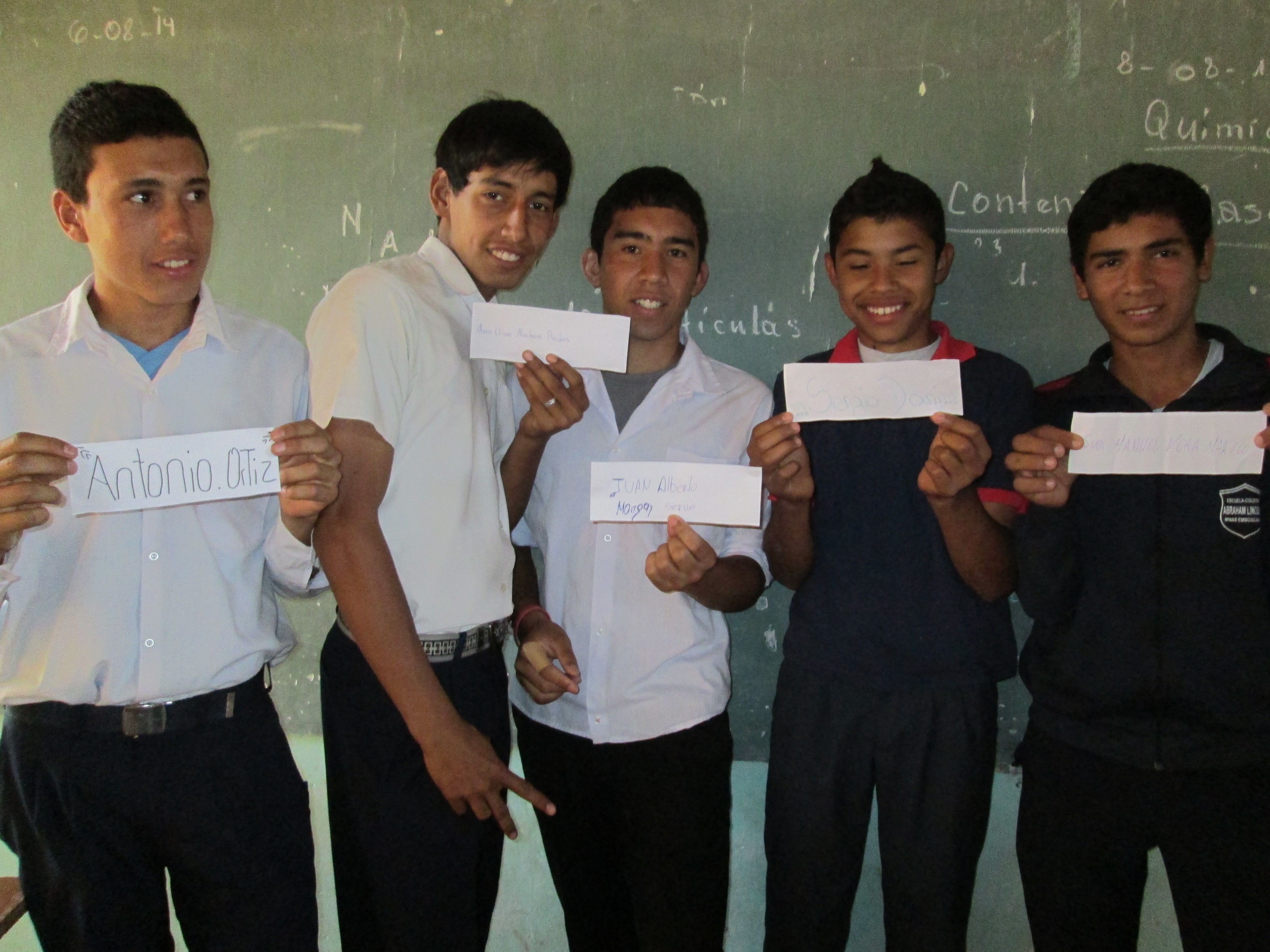
I took photos of my students with name tags so I could study.

I took photos of my students with name tags so I could study.

I’m working with 200 students, spread out over 10 classes. That’s a lot of names to learn, but I’m determined to do it. Why? Answer: There’s something powerful about being able to address people by their names.

What is so powerful about a name? In Paraguay you can tell a lot about a person by their name. Almost everyone has four names—first, second, mom’s last name, and dad’s last name. Often, one of the first two names can give you a clue as to when the person was born because it relates to the saint of a person’s birthday. And, in a community where few people move away, the two last names can help you make connections between people. It’s a relatively safe bet that if two students share one of their last names they are related somehow.

My worked is founded on relationships. I’ll never know how my time here impacted the lives of the people in my community—development and public health are a slow process. And, on top of it, I’m focusing on intangibles like self-esteem. The way I see it, the one thing I can do is set example. I can really only control what I do, so I might as well try to exemplify the life skills about which I’m preaching. For me, that starts by respecting people. Respect starts with giving people the time they deserve.

When working with youth it’s easy to lump them into categories—the studious, the bad kids, the troublemakers—but that practice won’t help anyone. I’ve noticed that as I get to know my students a little better each has his or her own way of being, a way of being that is as unique as their name. I want know the person behind the name, so I might as well start by learning the names.

The Only Thing to Do Is Laugh

I learned very quickly that most Paraguayans are on the hunt for a laugh. And, as a stranger here, my mere existence is inherently funny. Yes, the constant jokes can be wearing, but I’ve also realized that looking for the next laugh is a pretty nifty way to live.

Paraguay, as a place, seems to reflect the humor of its people. It was not more than a day after posting Squashing More Than Roaches, in which I boast that I’m not scared to squash roaches with my flip-flops that my claims were put to the test.

On that evening I came home from visiting a family. I was in a good mood because I got invited to two lunches, a soccer game, and a party. I turned on the light and a large roach was chilling in the middle of my floor. The occasional roach is not a surprising occurrence, so I prepare to smash it. The only option is to annihilate a roach when I see it because of the anger (maybe unjustified) that boils up in me upon the sight of one.

If you’ve never had to go after a roach yourself, you can take my word when I tell you they are quick little buggers. So, this particular roach I tried to whack several times, with a floor detergent bottle I was saving for some recycling project, before I landed a good one. During the pursuit, I discovered 2 things: 1) there was another roach on the inside of the backdoor, which I proceeded to demolish as well, and 2) these two roaches were not alone. Concealed in the corner behind my bathroom door was a nice little cavern in the brick wall that was serving as a roach condominium.

An hour or so later the roaches were mostly defeated. I’d smashed nearly 15, maybe 20, with my detergent bottle, of various sizes. I’d probably poured more than a cup of bleach in to the roach cave. Like a cat I waited for more to emerge every time I flung more bleach into the roach hole. When they were mostly gone, according to a good inspection by the light of my headlamp, I decided to seal the rest of the roaches into the hole. I thought that maybe the bleach would finish them off, though I was doubtful because I’m pretty sure roaches could survive a nuclear ambush, but I handed it to fate. Plastic from an old soda bottle and duck tape closed off the roach den. I swept the shells of the roaches I had caught out the door—the ants or some other animal would disappear them.

I noticed my neighbors were hanging out in the back of their house, an odd thing because people in my site tend to hunker down when it gets dark. I looked at my now dented and stained detergent bottle. I had to laugh. The ruckus my insistent banging created was probably alarming, and I’m sure my expression during the fight was that of a crazed fanatic. Okay, Paraguay, you win, I walked right into that one.

Squashing More Than Roaches

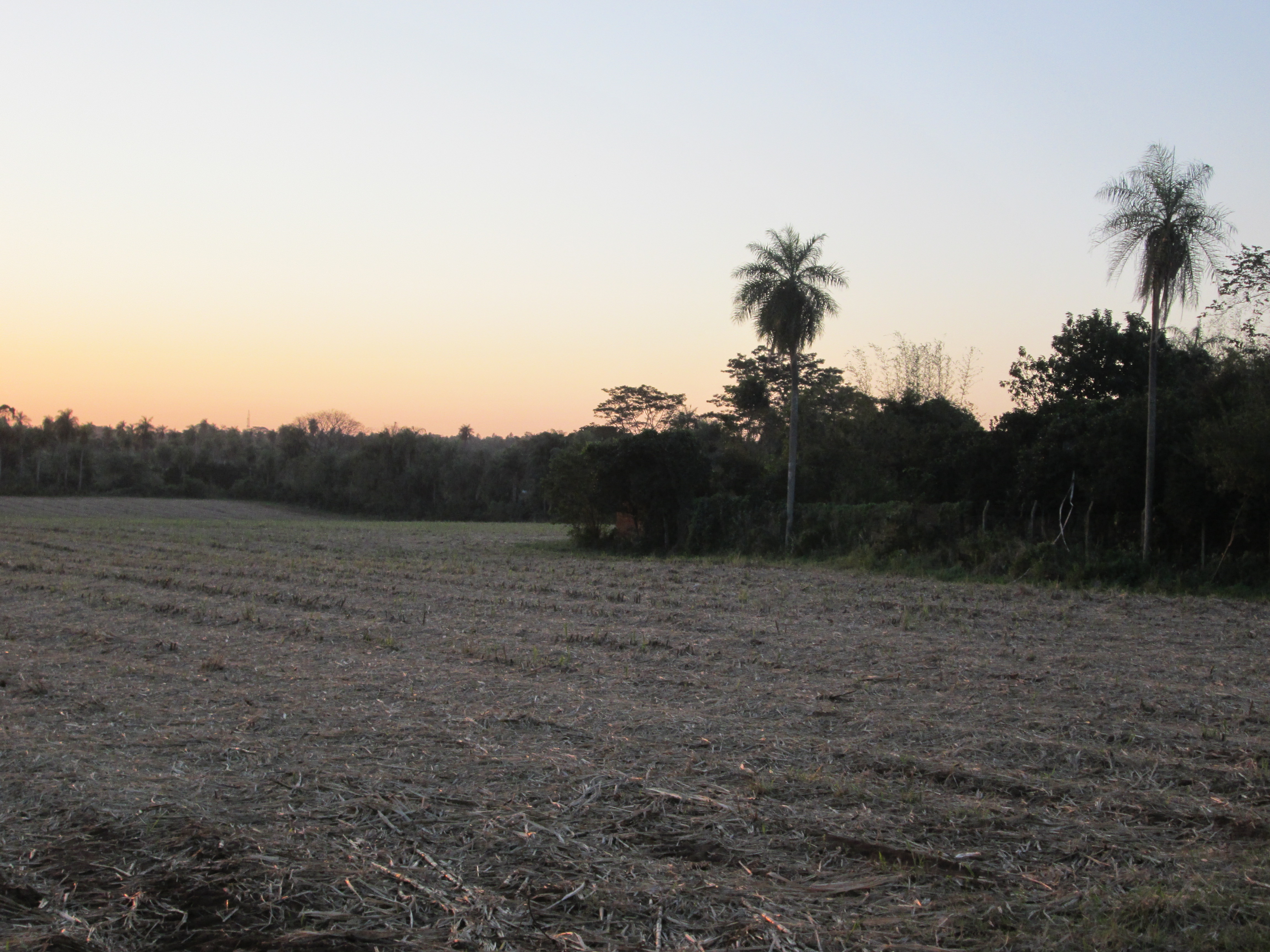
Sunset over a sugarcane fieldThere was a time when I’d scream when I saw a cockroach in my apartment and shakily dumped powdered soap on it because I was too freaked out to get close enough to crush it. That’s over. Now, I’ll even stomp on those buggers in my flip-flops—shiny backs, kinked legs, and oversized antennae aren’t going to save those creepers anymore.

I haven’t had to battle a tarantula yet, though I’m sure the opportunity will arise before I leave Paraguay, but the fears I once had are fading. I don’t mean to say I’m becoming fearless, that’s just irresponsible. What I mean is that my prospective is changing.

Things that were overwhelmingly important are less important, like clean floors, and things that weren’t important, like actively greeting everyone, are more important. Things that were petrifying have lost some of their adrenaline pumping abilities because, well, there are just more stressful things and more unknown things to pit myself against daily than there ever was before Paraguay.

No, Paraguay isn’t a scary mess. But, having to re-learn things and live in a different language and culture keeps you always on your toes. For sanity’s sake, I’m learning to not give things more credit than they’re due. The truth? I’d rather use my energy to get better at greeting people than being intimidated by bugs.

I Can’t Speak Any Language Anymore

The ViewAs volunteers we joke about the fact that we can’t speak any of the 3 languages we know as part of our service—English, Spanish, and Guaraní. When we get together we speak a confusing mix of the 3 that no one but another Peace Corps Paraguay volunteer will understand easily.

Sample Conversation:

[Location Peace Corps office in Asunción]

Volunteer 1: “Hola! ¿Qué tal?”

Volunteer 2: “Fine. What have you been up to?”

Volunteer 1: “Not much. Everything is tranquilopa, but I’ve been trabajando un poco in the high school. You?“

Volunteer 2: “¡Que guapa! I don’t know. Che kui’gue.”

Volunteer 1: “Qué piko”

Volunteer 2: “I’ve just been visiting families, mostly.”

Volunteer 1: “Japu. Aren’t you working with una comisión de mujeres?”

Volunteer 2: “Más o menos. I presented a couple of ideas to them, but we haven’t started anything. Tranquilo, nomás. I mostly work with the niños in the escuela. Tengo a PE class.”

Volunteer 1: “!Que guapa, entonces! Where do you want to go for almuerzo?”

Volunteer 2: “Ndaikuaai, depende en vos nomás”

Volunteer 1: “I was thinking pasta, but I don’t need the carbs.”

Volunteer 2: “Igual nomás. The pasta place at the mall?”

Volunteer 1: “Yeah, he’tereri”

Volunteer 2: “Do you want to come back to the office after lunch?”

Volunteer 1: “Puede ser. I should call mi madre.”

Volunteer 2: “Jahama, entonces.”