Blurred Lines: Outside or Inside?

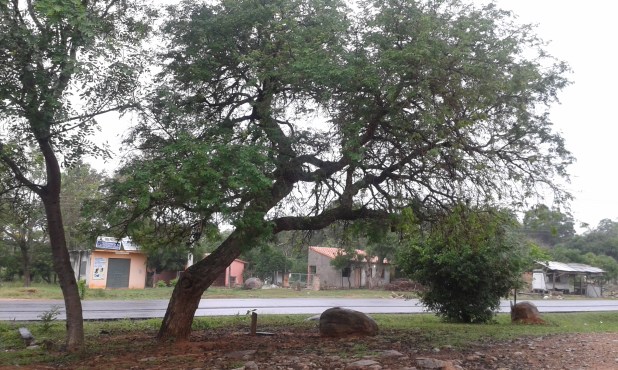
Everyone living in Paraguay struggles to stay cool in the almost constant heat. Sometimes there is a breeze. Sometimes it rains. But, with the regularity one should expect from a tropical region, Paraguay swelters in a humid heat. Because of this, the way people live here, in terms of housing, is very different from what I knew in the northeastern United States. Mainly, the lines between the indoors and the outdoors are blurred.

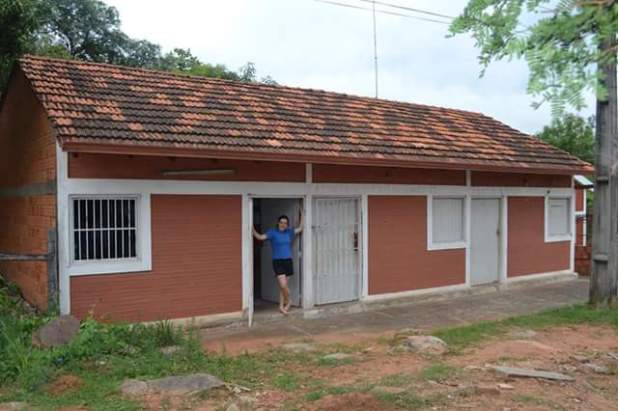
Most families with any wealth live in houses built of bricks and with tile roofs. The bricks are hollow terracotta and about half the size of a cinder block. Families with less money live in wooden houses with thatch or metal roofs. There is no insulation and most people do not have AC or a heating system in their home… fans are a staple.

Many families cook outside using either wood or charcoal fires. Some of these outdoor cooking spaces have a roof, but not always. Smaller houses, perhaps the norm in Paraguay, do not always have a living room or a dining room. Those rooms are not necessary because relaxation takes place outside. Paraguayans use their patios as the main living space. They sit out there to drink terere and to hang out. Some families even eat outside and will move their TV so they can sit in the shade of a tree to watch their favorite show or the soccer game.

The challenge of beating the heat does not only dictate where people spend most of their time but, also, influences how Paraguayans construct their homes. Paraguayan architects and home builders erect houses with doors and windows positioned carefully to create a cross breeze. Homes may have few windows, because the sun coming in is too hot, but the openings in a house maximize air flow. Further, Paraguayans leave all their doors and windows wide open until they go to bed.

I never thought about how much time I spent locked away from fresh air, but since coming to Paraguay it has been hard to ignore how much of my time in the States was passed in buildings. It is rejuvenating to see the sky, feel the wind, and sit among plants.

Blogging Abroad's Boot Camp Blog Challenge: Starting January 2015

Fewer Than 100 Days Left

The end of December marked 100 days left in my Peace Corps service. The mix of heart-break and joy I feel thinking about leaving Paraguay is beyond my power of words to describe. But, this moment is a good chance to think about why I came to Paraguay in the first place and where I could see myself in the future.

I came to Paraguay to grow. I came to help others, and myself, cultivate new skills and ideas by sharing—my dream is that Paraguayans have learned something from me over the past 2 years. Paraguayans have changed my way of being, from adding terere to my routine to warping how think about machismo. In the formal setting of my classes, I hope that some students grabbed something that they can use…whether it be how to put on a condom or a vague understanding that there are ways to see the world that are very different from their own. On a personal level, I look forward to life-long friendships with the amazing people I’ve met.

New Years 2014, I was getting ready to leave the USA for 2 years. I was excited and petrified. I wanted the adventure of living in another country for a chuck of time and I was eager to see what would come of my Peace Corps service. But, every single piece of service preparatory literature and every former and current volunteer I talked to said to try not to form expectations about Paraguay and what my service would be like because I could not know until I started. The fog about my future was chilling. I did my best to have a blank slate mind when I landed in Asuncion after an exhausting flight filled with raw nerves. I remember it was sunny and hot when I arrived in Paraguay. Everything here was new and exciting when I piled into the van that took me away from the airport and the world I’d known.

Since middles school, perhaps before but I don’t remember, the world beyond my itsy, bitsy town in rural Vermont held my interest. Places outside the borders—state, country, and continent—called to me. In 8th grade I began a love affair with Spanish, which continues to fester and prod me to evaluate every move as not only a personal or professional decision, but also a language choice. When I fell head-over-heals for Spanish, I knew that one way or another my path would meander beyond the land of the free and home of the brave to places whose values and virtues were unknown to me.

With fewer than 100 days left, I can say the hardest part is leaving. Leaving friends and loved ones. Leaving routines and places that are familiar. It is easy to float along doing what seems logical and secure. It is comforting to have a home-base, a set schedule, and a clear purpose. And, going abroad destroyed all those things for me. But, in their place equal, though different, pleasures germinated. I now know I can bend and sway and operate in foreign lands. I know that there are parts of myself that will always be true and strong; for example, I value honesty above all things and will never drink alcohol. And there are parts of me that will adapt to the environment, such as what I eat and how I spend time with people.

Volunteers like to ask each other, “If you knew what you know now about how your service would be, would you still have decided to do it?” My answer is a definitive “yes.” I would choose to come to Paraguay when I did in every alternate path of my life that could have been. This New Years, welcome 2016, I am not the lady I was 2 years ago. My biggest crop in the Paraguay season of my life has been me. I could not be who I am today without the laughs, frustrations, and pleasures Paraguay gave me. I am leaving Paraguay soon, I may only return for vacation (who knows), but Paraguay has a piece of my heart.

Am I achieving what I came here to do? Heck yeah, I just didn’t know in coming to Paraguay that my main accomplishment would be learning how to crack the hard shell of life and let happiness sprout wherever the wind takes me. We can not foretell the future, just as we can not guess the weather no matter what meteorologist try to make us believe, but Paraguay was the thunder before a storm. Bring it on 2016.

Blogging Abroad's Boot Camp Blog Challenge: Starting January 2015

When the Wind Comes From the South

My señora friend and I sat behind her house in a shady patch amongst the trees and not so far from the fire where she was cooking beans for lunch. We were sitting there because everywhere else was too hot. It was a suffocating heat that leaves one misted even if she lies down or sits like a statue. We talked about the heat, perhaps the most important topic of conversation except when it’s raining, and drank terere.

“At least there is a strong wind,” she said.

“Yes. That means it’s going to rain for sure, but maybe not because it is coming from the North,” I said. Paraguay has taught me how to feel the rain before it arrives. Life changes when it rains. It is critical to know when a storm is coming.

“That doesn’t matter, the wind can come from whatever direction,” the señora said. She smiled.

“When the wind comes from the South even the girls’ faces are ugly.”

“What?” I asked.

“We say here that when the wind comes from the North girls smile and there are flowers, but when it comes from the South even the girls are ugly. You know that everything unpleasant, the cold and rain, come from the South,” the señora said.

She got up to check on her beans. She was making a dish that when done would have beans, vegetables cut too small to see, noodles, cheese, milk, animal fat to get it started, and potatoes. It was one of the yummiest dishes I have had in Paraguay. While she cooked, I stayed to nurse the terere. I am not from here. The señora knows I can’t handle the fire smoke, it makes me cry and hack.

The thunder started that night. I hurried to fill every empty container with water. I did my dishes right away. The water went out as soon as I was rinsing my laundry. I would have liked to rinse it one more time and fill the basin, but one can’t have everything.

The rain started just before 11 pm. It poured so hard that it was still going at dawn. When the first drops pelted my roof I sprung out of bed. My ceiling leaks in a couple of places. It’s not a huge problem because most of the leaks are over nothing important and I have a cement floor that soaks up the water. I put out pots. The tat-tat-tat of the drips beat like a drum. A new leak started last rain storm, so I had to move one of the chairs I use as a bookshelf. To be safe I put a plastic bag over the fan motor. It was raining so hard the water blew in the peak at the crest of my roof. I slid my bed as far to one side as I could without getting too close to the window that even though closed was letting in a small stream. I was thankful the power didn’t go out. Last storm, I was surprised by the wind and caught by 27 hours without power.

The thunder made our community sound like a war zone. I have never heard thunder or seen lightening as dramatic as Paraguay. I doubt there is a sky more beautiful than Paraguay’s, and though I decided this long before my first Paraguayan lightening show, the electricity in the air confirms my judgement every storm.

The morning after the conversation with the señora and the following storm, I carefully observed the few girls who passed my house in the rain. They looked as they did the day before, however the plants around them were a brighter shade of green. Maybe the North wind didn’t change the girls or bring flowers, but it did highlight the best side of the foliage.

Time Passes Before We Know It

It’s been a while since I posted and not because there was nothing to write. The days pass slowly, but afternoon seems to fall before the morning begins. I wake up and it is already Friday. Where did the week go? I ask myself. December 8th marked exactly four months until my days in Paraguay end and a new adventure begins. The ghosts of my service past, service present, and service future have come knocking. They’ve taken me on dream walks to see what I accomplished, what I am doing, and what I will achieve. Unlike the ghosts of Christmas, the service ghosts aren’t here to make me repent. They came to remind me that time passes before we know it, and therefore I should live every second to the max.

People from America, land of the brave, often say that, “It’s the journey that counts” or some phrase that means the same thing. They say this and then grow angry that there is a line at the grocery story, show impatience because there is traffic, or become testy when there are no electronics to amuse them. They say it when they put in long hours on the job and then rush around to the bar, the gym, friends’ houses… And at such hectic times, they say another phrase, “Every moment counts.” And they say that phrase when they refuse to sit quietly, with friends or alone and without the simulation of media or a purpose.

Before my two years in Paraguay, I used those phrases just as “they” do. But now, to me, those sayings have a meaning caught between what the land of the brave believes and how I think Paraguay, the land of time, puts those phrases into practice.

The land of time is hazy and hot. Mangos grow in December, when the land of the brave is dreaming of a white Christmas. Paraguay’s infrastructure is speeding towards better days, but for now the water goes out often and the electricity falters when storms come or too many people use their fans. People have motorcycles and the number of families with cars has skyrocketed since I moved here. However, all personal transport beside, the main staple of commuting remains the buses. One can go almost anywhere on a bus in Paraguay, if one is patient. Some places have a bus only sometimes or on some days and bus schedules are at best a suggestion. Business is accomplished over long meetings that begin with the weather, ease into family, and, at long last, mention the job at hand. It is easy for those from the US to fixate on the inefficiencies of Paraguay. We see the millions of lost moments, moments that could have been spent “doing something productive.”

Time passes before we know it, but in the hours and minutes that have ticked away since I landed in Paraguay I have seen another side of time. On those hot afternoons when the mangos hang overhead, school is out for the summer and many people have vacation. Those days are spent following the shade as it moves across the patio. Families and friends sit and watch the bright sunshine sift through the trees and make patterns of light and dark on the red sand. As families and friends watch the sun move, they talk. They talk about the heat, times shared, what absurdities the neighbors are up to, and the next barbeque. They drink terere. They take siesta. Interspersed among the bouts of sitting are the daily chores. Sometimes an adventure to the river or a party breaks up the listlessness.

The thing about these lazy days of summer when nothing happens, is that my Paraguayan friends waited all year for them to arrive. They got up at four to catch the bus at five to go to work at seven, to work, to get home at seven-eight-nine, to clean and cook and tend the animals, to say “hi” to the children, to sleep, and to get up at four to shower…they did that so their children and grandchildren could have nice clothes and cell phones and study something better. The difference between the land of the brave and the land of time is that in Paraguay, one does not work to work. One works because one has a family. As long as the hours may be, it is not the job itself nor one’s own professional standing that give life meaning, but the people who inspired one to leave the shade of the patio and go forth.

In Paraguay most of time is burned during the journey. Traveling is time consuming. Washing clothes by hand is an afternoon. Cooking with charcoal or wood and also the gas or electric oven are skills that one learns over years of practice. Navigating without power and water when the sun beats down and a shower or a fan would be nice is a test. But every moment counts. In Paraguay the moments are counted not by what one did, but by with whom one was.

Time passes before we know it, and dear reader you might be appalled at the number of moments I spent sitting in the shade of mango trees. I was shocked when I first thought of those seconds given to history at no cost. But, what I have come to see is that quiet instants are not a waste. I will never have the endurance of my señoras. They have given the better part of most years to sitting. But, what I have learned from Paraguay is that there is joy in taking time to do nothing. Peace is found in letting one’s mind wander aimlessly. Of course, too much emptiness is terrible, but my land-of-the-brave upbringing would never let me take too much time for pause. The ghosts of my service have let me face my biggest fear as the reality that I will leave Paraguay comes into focus. I fear that once I leave Paraguay I will never again have time to just be. It is a real possibility that I will descend into the ant hill again, but I hope that I can always carry with me the calm I found here, no matter where I end up. Because, happiness is not found in running from place to place worried about the moments. It is found when one stops and smiles at where the journey has plopped her and takes a moment to laugh with the family and friends around her.
The Paraguay I Know Is Catholic

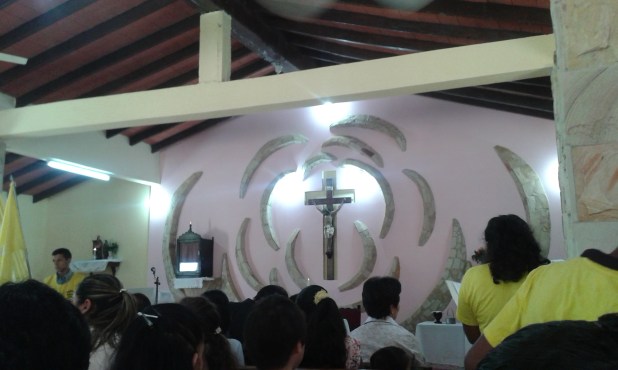
It is not necessary for me to say, but it is worth sharing two facts. First, the Paraguayans I know understand the world as Catholics. They may not go to church all the time, but they think about Jesus often and use God to explain most things. Social lives are largely centered around the church. Many of the biggest parties and drinking events spring from patron saint celebrations. Second, I am not Catholic. But, my beliefs do not prevent me from participating in Catholic religious activities if and when I want.

I traveled to Paraguay with the desire to help make the world better, but I came here as a student. My openness and curiosity to experience and to understand how Paraguayans practice Catholicism has given me great insight, despite putting me in the occasional uncomfortable situation. “Catholic” has come to represent, in my mind, the life philosophy of some of my closet Paraguayan friends. These days, when I go to a church function it’s not only to learn what issues my community thinks are important enough to bring before their God, but also because a friend invited me. For example, I know it means a lot to my señora friend when I do the rosary with her, and her happiness is enough to dedicate 60 minutes of my day to her God every so often.

It is impossible to escape Catholicism in Paraguay if one lives here and talks to Paraguayans. If one mentions an event in the future or tries to make plans to do something Paraguayans say it will happen “if God and the Virgin Mary permit it.” If one talks about marriage, it involves the church. If someone is sick or something is bad one prays. Families are divided by the Catholic Bible study to which they send their children. Public buses have Jesus painted on them and tout slogans like, “My path is guided by Jesus.” Passengers on buses cross themselves when they pass churches and cemeteries. Churches host parties and cookouts. People wear crosses and have saints’ cards in their wallets, religious photos as their profile pictures, and Jesus images hanging on their bedroom walls.

The way I see it, Jesus and Mary are Paraguay’s way of setting a moral code and giving meaning to life. In the end, it doesn’t matter that my Paraguayan friends and I have different reasons for why we think it is right to be honest or to treat people with dignity. What is important is that we share the values of truthfulness and respect.

I never needed to think about what “tolerance” meant before coming to Paraguay. But, Paraguayan tolerance is how my community embraced me and my tolerance is why I have learned and done so much since coming here. Paraguay has taught me that tolerance is not just letting people practice their customs in peace. It is being open to learning how people’s cultural practices relate to their lives in general and, more profoundly, what their beliefs boil down to in their simplest form. We all have a lot to learn from people who see the world differently from us. And, we all have more values in common than it might seem at first glance.

Overheard In Paraguay: Friendship

We sat in a half circle around the grill. The men were cooking large slabs of meat, ribs and some unidentifiable cut, for the mother of the family’s birthday dinner. The husband of one of the birthday mother’s daughters sat by the grill passing one can of beer among the men there. A nephew walked up to the daughter’s husband. The husband was around 30 and the nephew was about 11.

The husband hugged his nephew first with one arm and then the other, squeezing him. The nephew squirmed, and they both smiled. The husband held the nephew at arm’s length and put on an almost serious expression. “Will we always be friends?” the husband asked.

“Yes,” the nephew said.

“Even when I am old and you are my age?” the husband asked.

“Yes, even when you are old and I have kids,” the nephew said.

The husband smiled and pulled the nephew into another hug. The nephew pulled away again and they looked at each other, the husband still squeezed the nephew’s shoulder.

“Even when you are in Heaven and I am old we will still be friends,” the nephew said earnestly.

The husband laughed. “And I will look after you from Heaven.” They hugged again. “And, when you come to Heaven, we will be friends in Heaven. We will be friends forever.”

The boy nodded and ran off to find his playmates.

Incense

My house gets musty sometimes. I have a cement floor and my house has no foundation so the damp seeps in when it pleases. Scented candles are hard to find in Paraguay. I spray air freshener when I think of it. Most of the time my doors and window are open, so the smell is blown to the wild outside. But also, it is only sometimes that my house smells and one gets used to it quickly and forgets.

I’ve thought about incense before, but I haven’t found a smell I like. I’m also very sensitive to smoke, any and all kinds. I haven’t had the motivation to really look for a nice incense.

One day the señora friend who lives close to me stopped by on her way home and invited me over for lunch. She must have thought my house smelled because she gave me a stick of incense toward the end of my visit. I smelled it and found it to be surprisingly pleasant.

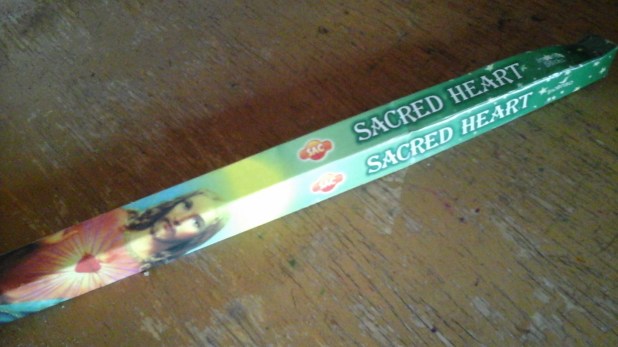
I told her that it smelled good and explained how it was hard to find good incense. She reached over and showed me the front of the incense box. The box was green with a drawing of Jesus and his heart with light rays radiating from it. “It says the sacred heart of Jesus, right?” she asked. She didn’t have her glasses.

“Yes,” I said.

“That’s why,” she said. ”Of course it smells good.”

Rain Days in Paraguay Are Like Snow Days in Vermont

I sat down ready to write, propped up against the wall and sitting on my bed. I was working on my first novel. The bedcovers were pulled up over my legs. My mate was set on my bedside chair. My princess canopy, mosquito net was pulled to one side. Though it was cold and I wore a sweatshirt, all my doors and window were open. Cold in Paraguay is fifty-something degrees Fahrenheit. A light breeze made the laundry on my indoor clothesline flutter.

As I poured another draft of mate my mind absently started to wonder to where I left off in my novel. I stared out the window. At that moment, the misty rain was floating down at an angle. It was quiet. The rain started two days before; it brought with it a tranquility beyond any calm possible in the blistering heat that came before the rain. The rain sent people indoors and blanketed everything with a film of water that amplified birdsongs. There was less loud music than usual. Watching the mist fall made me suddenly remember my favorite childhood days. It had been a long time since I last thought of them.

The best days growing up in Vermont were snow days. I would find myself inside drinking hot chocolate and watching the snow drift from the sky. Those gray mornings were lazy, but they marked the calm in the storm. Snow fall followed a crescendo with a climax of me putting on my boots, snow pants, sweater, jacket, mittens, scarf, and hat and then plunging out into the sideways-sailing snow. Sometimes the desire to sled in fresh powder drove me away from the fireside. More often, however, it was my unexplainable interest in the absolute silence that descends on the forest when it snowed. Silence so thick I could hear fluffy flakes stick to the ground after sifting through the barren branches overhead. I could hear the trees groaning under their white burden.

I would sit in the woods or walk noticing animal tracks and the painted fans created by bird wings in the winter crust when they took off from the shimmering ground. I love snow from the tips of my toes to the top of my hat. I always have.

It seems ironic that it took me a grand adventure all the way to subtropical Paraguay to remember. To recall just how much wading through hip-high snow made me smile or how much I laughed when I would accidently dump a tree-full of snow down my neck by poorly selecting which tree bow to grab. But, then again, it’s not so strange I tucked away my memories of snow days and forgot where for many years. I was swept up in a life too busy to stop and listen to the weather happen around me. It is so easy to always doing in America. It is important to do, but we all should take snow days. Without night there would be no day, and similarly without pause we can not see from where we came or to where we are going.

An Encounter With Jesus

“Let’s go for a drive,” the mother of the family said. Her two daughters, a 3-year-old nephew, and his brother got ready to pile into the car. Going for a drive can mean many things in Paraguay. It could be a few-minute trip to the house-front store down the street or it could involve an hours-long journey to another town.

I hurried to the bathroom, the key is to always go before leaving, and asked what we were going to do. “Get the saint,” the mother said. She said it as though it was both obvious and I should have known what she meant. But, of course, I had no clue what “getting the saint” involved. Questions raced through my mind: What saint? Are we going somewhere to pray? Is it okay if I go in the athletic shorts and tank top I’m wearing? Are we bringing a statue of a saint somewhere? Where? How long are we going for? I climbed into the car, and we were off. I decided my attire was acceptable because one of the daughters was wearing a house dress.

“What are we doing?” I asked again.

“Getting the saint,” the daughter in the house dress said.

We stopped at a little store and picked up bread, sugar, and several pastries. I wondered, “Are we going to be gone so long we need food? Is the food going to be some kind of offering?”

We drove down a road on which I used to live. The road wound into a forgotten part of Paraguay and connected my town to another town. It was lined with pink and gold grasslands. We slowed down to let free-range cattle cross the road. Dusk was falling and its heavy light washed over the tiny school and houses we passed. It was strange to journey to no where as night shadows came. Paraguayans tend to stay home after dark.

The mother told me, almost in passing, that the little girl who had lived with them for about a year was gone. The little girl’s mom came with police and a judge and took the girl without warning. The reason the girl was living with them in the first place was because her mother was neglecting her.

We stopped. There were no houses close to the road. There was no visible reason for stopping at that point. The mother and the daughter in the house dress got out of the car, the others didn’t move. The mother said I could stay in the car if I didn’t want to walk. My curiosity was burning. Why so much mystery?

We started to walk on a little footpath. I asked the mother, “What is the saint? Why is it here? What is it for? Where are we bringing it?”

As we wove between the brush and grass the mother finally explained. We were getting a cross with Jesus on it. The mother said that this cross was a special one, a specific one, that was hard to find. A single man was the keeper of the cross and it was passed down to him from his mother. When something bad happens in my friend’s family they come and get the cross and bring it home for a night to pray.

We got to the keeper of the saint’s house after a short walk. He was an old, thin man. He had two teeth and his clothes were faded. His house was one room, with space for a bed and a table where the saint and its alter sat. The house was made of wood slats. Off to the side was a shower and toilet; the painted metal wall around them was starkly modern compared to the rest of the homestead. Two basins with dirty dishes were sitting on wooden planks. The beige sand around the house was swept like a Japanese garden. There was an ax with a new tree-limb handle. The daughter reminded me that the man lived all alone. She commented that he needed someone to break the solitude. Giant trees, like those that inspire poems, stood at the edge of his swept space. They created a canopy. His house stood on a ridge, and below spread the grasslands. It was perfectly silent.

The mother handed the man the bag of food. He pulled together the assorted chairs he had so we could sit. He was a chair short. The mother began to chat. The daughter chimed in at appropriate times. They spoke Guarani. They smiled and laughed. The mother followed the man to the alter to get the saint.

Anyone who has been in a Paraguayan Catholic place of worship knows what I mean by the Jesus cross. The cross is carved out of wood and has a bleeding Jesus nailed to it. He is wearing a crown of thorns. The one we were getting was about one and a half feet tall. It was painted blue and there was a little angel that attached to Jesus’ chest. I thought of vampires, but imagined the angel was supposed to be healing him.

The mother walked slowly as she carried the cross. We returned to the car and went back the family’ home. When we arrived the grandmother came over, she lives across the street. I couldn’t tell if the grandmother was crying, but she kissed the Jesus on the face. “Welcome to our home,” the grandmother said to the saint.

The Dark Side of Tranquilopa

Tranquilopa

One could fall in love with Paraguay for it’s tranquilopa attitude, and many have. “Tranquilopa” is a word that is a mix of Guarani and Spanish and could be translated as “tranquil.” But, the word means a lot more than “tranquility.” It is really a way of saying “life is good,” “I am happy with life,” “I am grateful for what I have and my lot is not bad in the slightest,” and “I am satisfied, fulfilled, calm, peaceful, and enjoying the time given to me.” Tranquilopa means all these things, but it’s not just a saying. The word and its meanings summarize the Paraguayan view on life. Paraguayans are grateful for what they have and they let themselves take time to be happy. They have time for their families, a lot of it. They pass long and short hours with their friends. They always look for the next joke and way to smile. They are laid back, generally calm, and not always searching for the next best thing.

Contrast

As someone who grew up in the hustle and bustle of big dreams, fast and furious work schedules, and endless to-do lists I like the lull of tranquilopa. With practice, I’ve become more patient and accustomed to the slow pace tranquilopa gives to life. I enjoy having time free of an assigned activity in which I can do or not do whatever I want. But, in recent times, I’ve  discovered that tranquilopa has a deep dark side, and it’s not the boredom I sometimes feel drinking terere or chatting and staring into space for hours. I still can’t do nothing as well as my Paraguayan friends, but I’m a lot better at it than when I got here. Doing nothing is an art, and for me it’s a work in progress.

The dark side of tranquilopa is the tendency to turn the other cheek or joke rather than address a negative aspect of life. Tranquilopa sometimes provides an excuse for inaction, and thereby can be a barrier for social change, professional achievement, and project completion. Here are some examples.

Example one

A certain guy is known for being a drunk. He comes to the family party already plastered and drinks more to a point of extreme drunkenness. This man then does one of several things, he could be very rude and hit on whatever women, he could pass out, he could get in a fight, he could piss himself, or he could do something to hurt himself. I’ve seen or heard tell of all these outcomes in Paraguay. With the exception of a stereotypical frat party, most of these actions would be actively addressed in the US, especially because this happened at a party where children were present. But, in Paraguay the most common response is to joke about what happened, and do nothing to prevent it from happening again. Turning problems into a joke is a classic tranquilopa response and is an obstacle in preventing the same thing from happening again.

Example two

Tranquilopa causes one to live in the present, which is good in many ways. Some of us in the US will spend our whole lives overlooking the present, caught in the past and dreaming of the future, until the moment we die and realize that all we wanted was right there in front of us we just forgot to look. But, some things in life require long-term planning to realize. Going to college, getting the career you want (rather than doing just whatever job you can get), starting your own business, completing bigger projects like building a house, saving for larger ticket items like a car or a vacation…the list goes on. And, tranquilopa can deter people from making and following-through on long-term goals. I have found this particularly interesting working with youth. Many of the Paraguayan youth with whom I work struggle to imagine where they will be (in life) in 5 or 10. When I ask what they want to have or do, they give me blank stares. Or, some youth tell me they want to go to college,  but when asked what they want to study, where they want to study, and how they are going to work out the logistics (like paying for it) the students shrug. Tranquilopa creates a sense of security that says, “what is meant to happen will,” and sometimes this idea prevents the efforts necessary to achieve complex goals.

Conclusion

Like most aspects of Paraguayan culture and US culture, I think a half-half mixture of the tranquilopa life philosophy and the US equivalent which I will call “pull yourself up by your bootstraps” would be the ideal for a life of happiness and prosperity. There is no denying the happiness of the people who live by tranquilopa. Paraguayans smile and laugh more than any people I’ve known before, and it’s not because they have it all in term of material goods. But, I also see people in Paraguay suffering more than they have to because tranquilopa is slowing change. Laughing things off rather than fixing them and only thinking about today are good skills, but they must be executed with even-handedness.