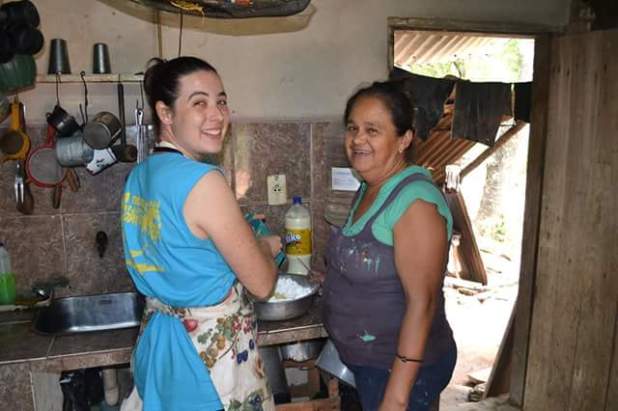
Helping to Decode a New Language

She wrote the number “8” smoothly. Months prior, it would have taken her five tries to get it. She was close to remembering all the colors of her home country’s flag. She wrote her name and birthday without issue – things she hadn’t yet learned when we started working together. Her English vocabulary was expanding. She understood simple words and phrases I said often during our classes together. Perhaps the progress was slow, but she was learning English and how to write.

For the past year I’ve taught English to a new American. I’ve taught English as a second language before, on multiple occasions, but she was my first student who couldn’t read or write. She was also my first student who couldn’t speak Spanish fluently. The lack of Spanish mattered since it was the only language I spoke other than English. She and I had no language in common, but we came together over her desire to learn English and my hope to teach her English. We came together over her desire to learn how to read and write and my belief that such knowledge is a human right.

Before she and I started working together, I’d never taught someone the alphabet or how to write. I found it interesting how her writing progressed just like children’s writing does. At first, her letters and numbers were large and sloppy. With time the shapes of the letters and numbers became more precise and smaller. At first, her spacing was off – she frequently ran out of room on our little whiteboard halfway through a word. Now, word spacing is seldom a challenge for her.

She impressed me with her focus and hard work. It was apparent she studied between our weekly classes. She studied English despite running a household and raising four children – three of whom were in middle school or younger. While helping her learn important things, like her birthday so she could fill out forms, I discovered we were born the same year.

Our life journeys have been different despite sharing a birthday year. Yet, our paths intersected over English. I wish that we could communicate better. I want to learn more about her. I want to hear her thoughts about the world. Perhaps, someday, we’ll be able to have such a conversation.

Is It Luck? Is It Privilege? Or Is It Something Else?

She was in my thoughts more than I expected for how little time we’d spent together. She and I crossed paths while I was volunteering for a local organization. We were born the same year. Yet, she was born in Afghanistan and I in the US. She can’t read any language, as she reminded me, women are not allowed to attend school in her country. As a US physician, I’m among the most educated in the world. She has multiple children. I have none. We do not speak any common languages. Despite the differences, I noticed a few commonalities between us beyond our birth year. We are both married. We are both women. We both drink tea.

Soon after meeting her, I read updates in The Economist about the Taliban. Summarized, the Taliban issued more limitations on women in Afghanistan. It is so difficult to be a woman in Afghanistan that the EU has made being a woman from Afghanistan a criterion for asylum – no other qualifications necessary. 

Yet the horrors that I’ve heard about Afghanistan and the complex interconnected history of the US and Afghanistan are not how I want to know this Afghan woman. Life has taught me that the stories the media tell are not the stories of individuals. The negative thoughts and the sadness I have about how different my life is from this Afghan woman I know originate in my biases and my ignorance of her.

I do not know enough to guess what she thinks or feels about her history and her future. I do not know her story while living in Afghanistan. I do not know her story of coming to the US. I do not know what she thinks of her life in the US.

We were born the same year. Was it luck, privilege, or something else that I was born in the US and she in Afghanistan? How can one compare two lives so different? What does she think about when she has a quiet moment? What does she dream of? What does she enjoy? What makes her happy?

I interact with many people who have different backgrounds and cultures. But this woman and I seem even more different than most people I encounter. The Peace Corps taught me that difference is not better or worse just different. It also taught me that what I believed to be laws of humanity were theories – theories with counter theories, and most importantly, not proven to be true or correct. I know this Afghan woman and I have more in common than I can see now while also acknowledging that our views of the world are likely as different as views can be.

As I write this post, I wonder if I will ever have the chance to learn more about her. I hope so. I have grown most profoundly when given the opportunity to learn about new cultures and about new people. It is the diversity of humans that makes us so remarkable. And while I imagine her story is one marred with sadness, I know she has things she is proud of, moments of joy worth remembering, and stories of success. I hope that someday she can choose which stories and things I know about her, rather than my limited knowledge of her culture fabricating a story of her. Reality, I’ve found, is always sadder and more beautiful than imagined worlds.

I’m grateful that being born in the US allowed me to become a doctor and choose my own path. I hope that the US is as generous to her, whatever her hopes and dreams upon coming here are. The future is one we are each molding in our own way. Be it luck, privilege, or something else clearing the path.

Stand Up for Yourself Sister

“Stand up for yourself sister…because if you don’t stand up, no one will.” This was the theme of my thoughts as I walked home recently. I’d learned this lesson over a series of experiences, most significantly the Peace Corps and the 20ish jobs I had before medical school. It’s a skill improved with the help of pivotal women throughout my younger years who showed me how to advocate for myself (not just others). And it’s a skill I’m always improving.

Medical school forced me to practice standing up for myself over, and over, and over again. Medicine isn’t designed to be kind to its trainees. The journey to doctorhood is fraught with unpleasantries. A self-aware and self-confident person can minimize these annoyances if she chooses to face them and address them as they arise.

“Stand up for yourself sister” had popped into my mind after chatting with a younger co-resident who described several instances where she was asked to do work that wasn’t her responsibility by senior trainees and didn’t feel comfortable saying “no.” These instances were like the time in medical school when I found one of my classmates in the hospital hours after her work was done because a resident asked her to do a non-medical errand (meaning it was a personal favor and had nothing to do with the student’s learning). The student had also not felt comfortable saying “no.”

In both of the above cases, if the junior trainee has said “no” to their superiors they would have been in the right and may have prevented their time from being wasted. Further, both cases were examples of misconduct by the senior trainees as defined by the governing bodies that oversee medical trainees. Because of the hierarchy of medicine there are clear guidelines of conduct designed to protect junior trainees from abuse by senior trainees and physicians. The above cases were not reported to governing bodies.

Weird and questionable situations arise all the time. What I’ve learned is that being confident to say “no” is important. It is possible that there will be ramifications when one says “no,” but if one is in the right it is often worth the risk. Further, reporting unreasonable requests to the governing powers in our institutions is another form of self-advocacy that has the added benefit of helping to prevent others from being put in similar situations in the future. I don’t think it was coincidence that the two above examples happened to female trainees.

America calls itself “land of the free and home of the brave.” I find this tagline misleading. One reason is the different way many fractions of America raise their women and men. Even in a place that screams equality as its core value, many American sub-cultures (including my own) teach their boys to be confident, embrace conflict, ask for things, and demand better. At the same time, these sub-cultures (including my own) teach their girls to be cute, create harmony, strive for pleasantness, advocate for others (especially the weak), and be tactful. The lessons we teach girls are fine except they don’t cultivate the skills girls need to stand up for themselves the way the lessons we teach boys do.

American women from these subcultures are then at a disadvantage in many situations including when they negotiate employment contracts, ask for promotions, and define boundaries in relationships. Of course, many girls and women learn to negotiate and advocate for themselves anyway. But, what I’ve noticed, is that these skills aren’t default from culture in America like they are for men. Many of the women I know who stand up for themselves are self-learned after facing challenges or inequitable treatment next to men. A lucky subset of women are great self-advocates because other women took the time to teach them (despite American culture) in the hope of sparing them some frustration.

There are women who never find a way to feel comfortable standing up for themselves. I feel for these women because I know what it is like to be averse to conflict and scared to speak up. I know what it’s like because that is the default American subculture from which I come. But, like I told my co-resident, we can learn new skills and grow our personalities if we choose to do so.

I’m thankful I invested in cultivating my ability to self-advocate. American women are often amazing advocates for others (such as their children, their parents, their patients, their friends, and many other groups) while being uncomfortable advocating for their own needs. But, advocating for oneself is just as important as advocating for others. There is no reason to believe self-advocacy is a fixed ability or a trait only man can have. Even as I write this, I’m still not as good at self-advocacy as my husband is. Thankfully, I have many years left to practice… You better believe I’m striving for self-advocacy excellence.

Happy Birthday Soul Sister

Mbaé’chepa means How are you? ” I said. They repeated after me.

Ipora is the response, it means good,” I said. They practiced. I smiled at their pronunciation; it was great by my ears, but they probably had my accent in Guaraní which would make every Paraguayan laugh.

A few of the dengue field researchers I was working with in Puerto Rico had asked me to teach them some Guaraní words when I told them I learned Spanish in Paraguay. Spanish speakers always want to know where I learned my Spanish because it surprises them. Whenever I say I learned Spanish in Paraguay I also explain that it’s a bilingual country because it’s important. I was happy because even though I was from New England and the gringa of all gringas (the whitest Anglo) and currently in Puerto Rico, I was teaching Guaraní while speaking Spanish. (The above conversation was in Spanish.) It was fitting, and the timing couldn’t have been better.

Recently one of my Paraguayan mothers, best friends, and soul sisters turned 70. I ached because I couldn’t be there. We would have danced until the wee hours of the morning, so late I’d have spent the night at her house because leaving would have seemed silly. She’d have danced with a one-liter glass bottle on her head, perfectly balanced, as I cheered her on. We would have feasted. There would have been a cake. Luckily, she sent me pictures which proved that she had all those things and more without me. It was the quinceañera she never had, she told me. She deserved it. She looked radiant in her yellow shirt. Her hair was short for the first time ever; it was always well past her butt when I lived in Paraguay. She sent me a video of herself dancing on a chair. 70 looked good on her.

My soul sister was on my mind before her birthday. I’m in a sunny place with palm trees – it’s the kind of situation that always reminds me of Paraguay and makes me long to go there again. As I drink my mate alone in the morning and tereré alone in the afternoon I know that if I were in Paraguay, I’d be drinking them with her.

When I lived in Paraguay and I told her I was single (Paraguayans always asked my relationship status, sometimes before my name), she was among the few to say “good for you” even though she had had one or two kids by the age I was at that time. She’d raised one daughter so independent that her daughter adopted a couple of children which is unusual in my Paraguayan community; her daughter went to college; and her daughter left the men she didn’t like, something my soul sister’s generation didn’t always do.

My soul sister only finished the sixth grade, but she spoke perfect Spanish because she’d worked in Paraguay’s capital city, Asunción. Usually, folks from her generation and the countryside (as she was) spoke mostly Guaraní. When she was young, she took a bus to Brazil without her mother’s permission. She came back eventually. On one hot afternoon she told me about her trip while we drank tereré and she cooked.

My soul sister is the only person in Paraguay who came looking for me when I needed finding. Culture shock is real, especially when you’re trying to build a life in a new country. The Peace Corps is the wildest emotional rollercoaster I’ve ridden. Which is to say that some days in Paraguay I needed real finding. She’s the one who knocked on my door and told me to come out and have lunch. She’s the one who welcomed me into her home whether I felt like talking or not. She can fill the silence as much or as little as needed. It’s her cooking I think of when I miss Paraguayan food.

She sometimes walked me part of the way home after our days that ran into evenings together. Always she blessed me and said a prayer for my safety when I left her home, even though for about half my time in Paraguay our houses were 50 meters apart and kitty-corner across a street.

I dreamed of seeing her mother one last time. But COVID and medical school delayed my return too long. We lost my soul sister’s mother before I could visit again. My soul sister was her primary caretaker. She was devastated when her mother died, but she’s also freer now. The grandson she’s raised is a teenager now (he was a kid when I lived there). I like to think it’s easier being a grandma raising a teenage grandson than a child grandson; but I don’t know if it is. Perhaps I’ll find out when I visit. I’m also overdue to see that same grandson who was like a baby brother to me. I was supposed to go back for his 15th birthday, but COVID squashed that plan. I’ve always had a sweet spot in my heart for that kid; it’s funny because my husband, who I met years after Paraguay, has the same name as my soul sister’s grandson. I wonder if I’ll recognize her grandson now that he’s almost a young man.

And just as she did when I lived across the street, my soul sister checks in now and again even though I’m seemingly lightyears away. She always asks when I’m returning to Paraguay. I’ve been back twice since I moved to the US, but that’s not nearly as much as I would have liked. Life doesn’t follow the course you expect. But when she sent me birthday pictures recently, I had a real answer: I’m visiting the first half of this year. Si Díos quiere (to use the Spanish phrase so popular in Paraguay, “If God wants”). I’ll bring my husband so that my soul sister and my other Paraguay friends can meet him. I also want him to see the country that stole my heart. I’ll visit my soul sister during her 70th year even if it’s not on her exact birthday. Luckily, Paraguayans are more flexible about time than Americans.

Remembering Her This Mother’s Day

This week I lost a kindred spirit. I met her in college, over 10 years ago now, when I visited a college friend’s home over winter break. She was his mom. And in the decade since I graduated, I lost touch with the friend but never his mother. It was her efforts that kept us connected. In my life she was a cheerleader, frequently offering support and sending messages of encouragement.

In the last decade, she was brave – divorcing, taking on new jobs, moving across the country, and entering seminary – all while being a mom and a middle-aged woman with all the challenges that come with those realities. She was a loud advocate for many people including women and people with disabilities. She was a staunch supporter of her sports teams.

Her death was unexpected. This week my thoughts have been with her children who are without her this Mother’s Day. I have also spent the week reflecting on the positive force she was in my life. I admired her for her fiery spirit and her devotion to the people she loved. As she was a dedicated reader of my blog, I wanted to write a post in her honor.

She believed strongly in God. If the world is what we believe it to be, then she is with her God watching over her children and the others she took under her wing from a new vantage point. May she rest in peace.

One Example of Sexism in the Operating Room

Often enough to be considered a pattern, the men in the operating room chose to discuss the annoyance of the hospital’s anti-harassment yearly training videos and anti-harassment policies when I was the only female in the operating room with them or when it was just an older female nurse, them, and me. And while I also find the hospital’s anti-harassment training videos frustrating (for entirely different reasons than my male counterparts), I did not appreciate when a surgeon said he could get tips from the scenarios in the video. I did not appreciate his comment (despite his humorous tone) because the truth is that harassment doesn’t just occur in training videos. It occurs all the time and in all settings of women’s lives.

And I found it interesting that these men were complaining when most of them are fathers of daughters, and many are fathers of young daughters. And if the risks weren’t so high for me, I would have asked them the questions I pose now, “How old do you think your daughter will be when she first gets cat-called so badly she feels unsafe? How long riding public transportation will it take before she has a set of rules she follows because of the physical and verbal harassment she experienced from male passengers?” The use of “when” and not “if” is intentional.

You see, women close to me have been strangled and shoved into walls. I’ve sat by as a younger woman asked for advice from an older woman about what to do because her husband raped her every night. I’ve been called by friends in tears because they were cat-called so badly they were shaken. I’ve sat with women as they hid behind dark glasses waiting to get photos of their bruises to use in court. On my first day of one of my first jobs, my preceptor told me how to use the printer and warned me to be careful of our male boss. He left the company before I had to worry about exactly how careful I had to be. By the time I’d worked in healthcare two years, two of my female friends had been groped by male patients. I’ve only been training in the hospital as a medical student for six months and already two female physicians have taken time out of their busy schedules to have lengthy conversations about how to keep my head up and build my career despite disrespect from male colleagues and male patients.

And the reason I would ask the fathers of young daughters the questions above is because I know they love their daughters. And I know they can’t fathom that they are being exactly the type of men who will get in their daughters’ way as they reach for their dreams. And I would ask the fathers of young daughters these questions to remind them that they cannot protect their daughters from the future. And, truth be told, they will likely never know the harassment episodes of their daughters’ life. And I would ask these questions to recommend that they learn how to respect women so that they can set an example for their daughters of what it’s like to be respected. That way, when their daughters do experience disrespect, they know it is not their shortcomings but the shortcomings of the disrespectful one. In other words, it’s worse to be a daughter of a father who doesn’t know how to respect women because he sets a poor example of the male gender. And the behavior of these men in the operating room made it clear that they still had much to learn about respect despite surgeons being among the most highly educated people around. What an unsettling reality to have so many years of education and still lack competency in a basic principle like respecting all humans.

You can look up the statistics in the US for harassment and rape of women (and other demographics) if you’re curious. It’s an easy Google and the numbers are almost as bad as the news that makes the front page of the newspaper. If you want to get really dark, look up statistics related to intimate partner violence. The numbers are horrific. And the numbers always surprise me because all women are daughters and perhaps sisters, mothers, and partners. Fathers and mothers see the statistics and are inclined to tell their daughters to be careful. To not drink too much. To not wear too revealing clothing. To never set down their drink. To not walk alone at night. To not live on the first floor. To lock their windows and doors. To always go out with friends….the list goes on. But the question I always wonder when I hear these statements of warning is why don’t parents just tell and teach their sons that “no” means “no,” “stop” means “stop,” respect applies to all people regardless of genitalia, and that drunk or not you are responsible for your actions? Because all men are sons, and many are brothers, fathers, and partners. It would seem more helpful to prevent the problem of people harassing others, than react to the problem by telling the victims to avoid harassment.

I also find parents’ lectures of caution stifling because they do not address so many of the manifestations of sexism their daughters will experiences. Yes, there is the risk of rape and physical abuse. But for those women going into competitive or historically male professions many of the troubles we face as women are more subtle and persistent than acts of violence. The times we’re told we’re mean or bossy when a male counterpart with the same behavior is considered strong. The times we’re ignored, spoken over, interrupted, and discredited despite consistently being correct. The times (like in the operating room when men decided to complain about harassment protection for women) when we’re othered and made to feel like demanding respect isn’t a right, but a burden we place on our male counterparts. The times we’re underpromoted, underpaid, and passed over simply because we are women. The times we must dig deeper than our male counterparts not because of shortcomings but because our parents taught their daughter to be cautious and taught their sons to be bold.

And as these fathers of daughters discussed sexual harassment policies as an annoying restraint placed on them, I thought about their daughters. I knew when they’d be cat-called. I knew how long it would take on public transportation before they developed their safety rules. And I hoped for those daughters’ sake that they would have men that set an example of what it’s like to be mutually respected. It had made such a difference for me to coexist with many men who looked at me as a person and not some different creature. You see, it’s helpful to know respect is possible because at times it seems like a fictional concept. I thought about those young daughters one day standing where I was. I sent them strength. As much as I hoped the world would change in the years between us, I wasn’t sure it would because these men I stood with in the operating room would still be here. And their sons who had them as role models would be here too.

And I was once again weary, not so much because of the long hours I was spending studying or the fact that I was scoring equal or better to many of my male counterparts in medical school while also getting cat-called and navigating colleague and patient sexism, but I was weary because these men in the operating room, like so many others, stood in the way of my father’s daughter. They stood in my way because they made things more difficult for me than my brothers simply because of my genitalia. None of this was new or surprising, but it did make the hours in the operating room seem especially long. And if the operating room had been a safer place for me, I would have told these fathers the reason I didn’t like the hospital’s anti-harassment videos was because they were triggering for those of us who have been sexually harassed and spoke of a justice system that I have not found anywhere I’ve worked. And I’ve worked in many places.

When They Told Me She Had Died

The years pass quickly. Already, Paraguay hasn’t been home for 4 years. But my mind often still wanders back to the 27 months I lived there. When I see the sun dancing in the summer I am always transported to the homes of several women who made my time in the land of the Guarani exceptional. I think of those women when I drink my mate each morning. Even when I’m excited about the amazing things I’m doing and discovering in the US, part of me longs for our quiet mornings, afternoons, and evenings together sitting under the mangos or by a wood cooking fire. Since living in Paraguay, I’m always pulled between my type-A, American self and the person I got to be in Paraguay.

A few years ago, I received a text from a Paraguayan friend telling me a tía (an aunt) had died. It took me until I visited Paraguay later that year to confirm who the friend was talking about because many people in Paraguay use many names. My friend had used a name for the tía that I did not know.

The woman who had died was a dear friend of mine. We were one of those odd pairings of a woman in her 20s and a woman in her 60s. The name I called her was Estelva. She is the quietest heroine of my Paraguayan story. She could easily be forgotten, but to leave her out of the story would be to leave a gaping pit in my journey. Today, the sun is shimmering on my living room floor and reminded me of her.

Estelva was a woman of work. She was a baker and I’d joined her many afternoons to help bake chipa, cake, and pastries. For most of my time in Paraguay, she cared for her bed-ridden husband. He was very sick. He had a lung disease from working in the quarries and perhaps other ailments. She also helped support one of her daughters and her daughter’s 3 sons. One of the 3 sons was a hard worker as was the daughter, but Estelva’s work ethic was unlike anyone I have ever seen. She’d rise early and she’d still be working when I walked home after 10pm at night. Her feet and body would ache and she would continue, hardly a word of complaint.

Estelva was a quiet woman. We’d spend many afternoons with few words. She struggled to understand my accent and I hers. We didn’t really need words. She was one of those people who could just feel what was going on. Early on in my time in Paraguay, I needed somewhere safe. Somewhere calm. Because, where I was living wasn’t any of those things. No, I wasn’t in danger…but, the first few months I lived in my Paraguayan community were hard.

Estelva had rescued a giant dog left behind by a previous Peace Corps volunteer. The dog was 4 times larger than any other dog in the town and had no business being in Paraguay, but she had rescued it anyway. She fed it well and spoke to it often. She loved that dog, just as she had loved the volunteer who left it. She would tell the dog often that her mother, the volunteer who left it, would visit them soon. That volunteer has not visited since I’ve known the community.

Often when I arrived we’d drink terere together on her patio. We’d work hours. We’d knead chipa dough, sweating from the heat that streamed in through the tin roof of the bakery. On rainy days, the tin roof was deafening as the raindrops pounded down. The walls of the bakery had recipes taped to them, written by the same volunteer who left the dog. Estelva never used nor needed those recipes. The bakery was part of a cooperative that included bakers and other crafts women like the women who wove hats, baskets, and fans from palm leaves.

Estelva ensured that I never left her home empty-handed. She’d send me with chipa or pastries we’d made. She’d send me with guava jelly she’d cooked in a huge pot over a roaring wood fire in her patio.

Many times I would sit and do the rosary with Estelva at the alter that was set up in the corner of the bakery. We were usually doing the rosary on behalf of her husband, praying for his health to improve. Sometimes when I arrived, she was dressed in her nicest shirt and we had to cancel because she was preparing to bring her husband to the hospital (a 2-plus hour bus ride) because he’d gotten worse during the night.

At the end of my time living in Paraguay, her husband died. It was both sad and a relief. Estelva’s life had centered on caring for him for many years. It’s hard to describe the toll caretaking takes on a person, especially in a place where there are no resources and in a family where all money is hard-earned and travel in the sweltering heat is by bus. I remember Estelva’s sadness during the days of prayer after her husband’s death. I also remember seeing her look rested for the first time in the weeks thereafter. She even slept in until 7am some days.

Sometimes, when we were sitting waiting for the next project, Estelva would tell a story.

On one occasion Estelva stared out across the room, glancing at me, but mostly lost in her thoughts. “The children always loved him,” she said of her husband. “He was so loving and boisterous. It was so easy for him to show love.” She paused. “I have never been that way.”

Her words settled like dust, floating on sunbeams to the floor of the bakery. Her love was a quiet, diligent one. The kind of love that makes you strong. The kind of love that if you don’t look, you’ll never notice just how big of a difference it has made in your life. She was right. Her children and community would always think of their fond memories of her husband.

But, how would I remember her? Would I remember her? I knew she was asking me those questions. And, I had known my answer long before she’d asked.

Mansplaining Women’s Empowerment

I went to a training on managing aggressive patient behavior, mostly via verbal de-escalation. The class included a section on basic physical defense—such as getting out of a chokehold and escaping when someone grabs your arm. The skills were useful, but I found myself more frustrated than fulfilled by the class. What ruined the class was that one of the instructors preached for 20 minutes about how the young women in the class should feel empowered by the self-defense skills he just taught us. He told us some stories about women who were raped and killed because “they didn’t put up a fight.” He explained how we should be careful, avoid bad situations, and if attacked fight back.

Mansplaining: definition from the wiki article, “(of a man) to comment on or explain something to a woman in a condescending, overconfident, and often inaccurate or oversimplified manner.”

I was insulted by the lecture because as a woman I’ve been told countless times to be careful. When I told my family I was joining a night crew on an ambulance squad, almost before I was congratulated on finally starting as an EMT, I was asked if it would be safe for me to sleep at the station with my male crew members. Throughout my Peace Corps training, we had sessions on gender relations and how to avoid getting raped in our host country. In college, our advisers used to give us party-going strategies to avoid getting drugged. The list goes on.

It is NOT empowering to be told that you’re a victim and will always be a target. It is NOT empowering when people create boundaries (perceived or real) for you. It is empowering when others complement you on your success, offer intelligent advice as you work through challenges, and lend their support as you strive to reach lofty goals. Let me offer an example of what disempowering and empowering look like:

Disempowering: In a recent conversation with a male nurse, both the fact that I’m applying to medical school and my age (I’m almost 30) came up. The nurse didn’t comment on my age until I mentioned I’d applied to medical school. Upon hearing about my professional ambition, he “jokingly” asked why I wasn’t married and pregnant at my age. That is such a classic example of sexism it could be in a textbook. He never would have asked any man that question, even in jest, about applying to medical school.

Empowering: Upon telling one of my mentors about a test score I wished was higher, he said that he was sure I’d be just fine and turned to the other person with us to explain that “good” by my standards was quite different than “good” by most standards because I have high expectations.

Being an adventurous, single woman does clash with society’s view of women. How can I travel to foreign countries alone? It’s so dangerous. How can I go hiking or camping alone? It’s so dangerous. I’m not going to argue that those activities are safe. What I wish to suggest is that I have the intelligence to decide for myself what is safe and not safe, worth the risk and not worth it, and how to avoid unnecessary danger. I don’t need people to remind me how awful the world is. I need people to help me figure out how to overcome the challenges between me and reaching my goals.

What I wish that the instructor of the class about managing aggressive behavior knew is how many creepy men I’ve avoided in my life already, long before his class. I wish he understood that I don’t need him to tell me I should be careful and fight back. It is not empowering to be viewed as a potential victim of aggression, especially sexual aggression, even if you know how to fight back. It is empowering to be seen as a peer and fellow human with dreams, strengths, and weaknesses that transcend sex and gender. That is what women’s empowerment is all about; being viewed as an intelligent being and not an object or target or static lump.

Pulling Up the Bootstraps

I’ve been trying to wrap my mind around the anxiety, anger, and sadness I’ve felt since the 45th president of the US took office. It blows my mind how quick he began attacking:

  • Women: protection against discrimination, protection against violence, access to health care, freedom of choice
  • Everyone who needs health care and isn’t floating in money (aka most people): affordable health insurance, access to health care, security for those most in need of care
  • Immigrants: melting pot
  • Native Americans: protection of their land, respect of their culture
  • Americans living abroad: ambassadors, protection of foreign service officers abroad and American expatriates
  • The media: transparency, truth
  • Science: climate change (um, like come on…must we really repeat the “Earth is round” history?)…

…the list grows with each passing hour.

I went to the Women’s March in Montpelier on January 21. It was inspiring to see so many people energized to fight for human rights. But, I wondered, “Are we too late? Where were we between August and November 2016?”

The answer came in a common phrase:

When it is dark enough, you can see the stars.

America has never been perfect. We were founded by people who were fleeing oppression, who in turn stole land from the people already here. We won independence proclaiming high ideals, but enslaved millions of people, conquered others, and fought dirty wars with our southern neighbors and across the globe. We ended up a world power, but we still fell short of our ideals—all people in this country do not have equal access to life, liberty, and the pursuit of happiness.

Imperfect America has always strived to be better. We eliminated slavery, we changed legislation to give all citizens the right to vote, we’ve made net improvements in the rights of all minorities and women in this country, we’ve made progress protecting the rights of the LGBTQIA community; we’ve achieved many other wonderful things. But what we’ve done is not enough.

After much contemplation, I am certain that we are not too late. Perhaps Trump’s election was a necessary evil. It made me fall to dark places. And in the dark, I saw so clearly what had been easy to ignore in the gloom of modern America. In recent times, I and many people like me have been lethargic. We plodded along accepting what is even though it is not good enough.

The 2017 inauguration woke me. I saw the stars. And I’ve joined the struggle to improve this Nation. Regretfully, like a large mass starting from rest, I’m off to a slow start. I’m still not entirely sure what my role is and will be, but I know I have one.

On one hand, I’m already doing good work. I’m forging along on the Doctorhood Quest because my vision of delivering primary care services to underserved populations only becomes more vivid as the days pass. I will not let a man with disregard for the life and wellbeing of others allow millions of people to be cut off from the health care services they need and deserve. Also, in my current professional life, I help ensure that homeless young adults and at risk youth have the resources they need to build their own success. On the other hand, I know that I must do more than just study and work.

I have some ideas for action. Small stepping stones. I do not know where exactly I’ll end up or how my rejuvenated commitment to improving my country will unfold. All I know is that America has never chosen the easy path, but we are brave. I’m brave. It’s time to pull up those bootstraps, not just to elevate myself, but also as many as will come with me.

I’m proud that the momentum of the Women’s March has, thus far, translated into sustained action to fight for human rights. Let us stay together and be strong. Let us not leave anyone behind or push anyone who is part of us down. Let us continue to not only talk, but also do. As Margret Mead put it:

Never doubt that a small group of thoughtful, committed citizens can change the world; indeed, it’s the only thing that ever has.

So my question, what are you going to do?

The Women of Paraguay

Last week I attended a girls’ leadership camp, the Paraguayan version of the international initiative Girls Leading Our World (GLOW). It was my second year helping plan and attending GLOW. The camp is 3 nights long and brings together 50 girls from across Paraguay to talk about being leaders in their communities.

A fantastic group of young women attended this year’s GLOW and we, the volunteers who helped organize the event, were thrilled to have speakers and support from many Paraguayans. GLOW inspired me to reflect on how Paraguayan women have helped me make sense of Paraguay since I started my service.

My biggest struggle in Peace Corps is navigating Paraguayan gender roles, many of those for women are contrary to who I am and many of those assigned to men make me uncomfortable. I’ve had a plethora of eye-opening experiences with regard to how different people see men and women in Paraguay. But, one positive aspect of the female reality in this hot, little country towers above all else, and that is the strength and cohesiveness of Paraguayan women.

There is a bound among women in Paraguay that I never experienced in the States. When I came to Paraguay it was like returning to kindergarten. I was still an adult with adult thoughts, but I understood Paraguayan culture about as well as a five-year-old understands how to live independently, which is to say I felt lost. The Paraguayan style of teaching is to criticize and instruct through jokes. It is hard to deal with at first, I think most of us like to be taken seriously as humans. Between the jeers and the hiccups during my first months, Paraguayan woman after Paraguayan woman gave me advice.

As a result, I grew as a person. I’ve absorbed a little of the Paraguayan woman’s ability to defend herself. I know how Paraguayan women usually act, even though I don’t always follow the rules because I don’t like most of them. I’ve come to understand that while men in Paraguay are free and powerful, women are not as disempowered as I thought they were at first. And, in fact, I would go as far as to say that many Paraguayan women have a strength that many American women I know lack.

The Paraguayan woman is a nurturer. When she is young she looks after his siblings. She treats her father like a king and her brothers like princes. She cooks and cleans and works to make the men in her life happy, even at times when those men do nothing. But, while I as the outsider often find this sickening, there is a positive side to the Paraguayan female sacrifice. She is proud of her work. She is good at negotiating with the men around her, and leading them to compromises that benefit her too. She is close to the women in her family. By her teens she knows her mother, sisters, female cousins, aunts, and grandmother as well as life-long friends in the States know each in their 80s. She knows the needs of every member of her family. She knows how to barter and form strategies to meet those needs.

By the time a Paraguayan woman becomes a wife, a professional, and/or a mother she is the heart of her family. She is the life force and the glue holding people together. She remembers everyone’s birthdays. She does little things to make children feel loved. She can plan a party like a professional event planner. She never misses a detail. She can plot the path of her children so that one day they will be even greater than she is. She knows the powerful members in her community and she knows how to win their respect. She can not control her husband or her brothers, but she is a master of limiting damage. She looks to her core and her female friends to find the power she needs to get through the worst obstacles. She is beautiful. She laughs and she never forgets the women growing up around her.

Paraguayan women are proud. They may not be able to shut down the catcalls that follow them everywhere they go. They may not be free to do all that they desire. They may be afraid to break the norm. But, they don’t let these things stop them. They know how to deal with a rude, drunk man with eloquence and a smile. They know how to see the essence of a person. They know how to fight and to forgive. They know what it is to fall and to get up again, and they know how to win.

When I think about the girls who attended GLOW it makes me happy. They will one day lead their communities.They will improve the lot of the women who come after them. I believe that they have all they need to be and do whatever they want in their lives, and I am honored they shared a bit of their greatness with me.