The Sly English Teacher

Now I’m happy to teach English in my community, but I was against it in the beginning. I am acutely aware that there are many more pressing things for youth in my community to learn than English, from reading Spanish well to using a condom correctly. And, even if I were the best teacher in the world (very doubtful) my students could not master English studying just 1 or 2 hours a week. Language just doesn’t work that way. But, English lessons are one of the things people in my community want; and I’m here to serve them.

So, then, the question arose: If I have to teach English and my students aren’t attacking it with the tenacity necessary to become fluent, how can I most effectively use our time together? Some volunteers turn to games. Games are a good solution, but I struggled with them.

My solution came when I realized that I was looking at teaching English all wrong. My English classes aren’t about English. (But, I like to think they will give those kids who choose to pursue more English study later an advantage.) My English classes are about mentoring and sharing my culture. Defense: We also discuss English grammar and vocabulary.

How do I start the cultural sharing? Music. In my English class, we usually listen to a song in English, talk about what it means, and pronounce the words. Listening to music is a good language-learning activity, but that’s not actually why I do it. I try to pick songs for a reason. Half the time I just pick a song because I know my students will like it, but the other songs I choose because they have an interesting cultural message. “Dear Future Husband” by Meghan Trainor was a successful choice—the youth even like the song. Most of my students are young women. It was neat to talk about how women don’t have to fall into the stereotypical role of “the perfect wife” when they marry.

“Hard to Love” by Lee Bruce was a silly chance to talk about how we should say “thank you” to people when they do things for us. Most women in Paraguay are expected to clean and deal with food while men (not all!) sit and watch. I’ve seen young men get up from the table, leave their plate as a disaster for some woman to pick up, and not even say “thanks” for the meal (rage almost not repressed). I also used “Hard to Love” to talk briefly about the differences between how Christianity is practiced in Paraguay and the US.

As I get to know my students better, they feel more comfortable asking questions about the States or about my life. Sometimes the questions make me laugh: Is it true that people in the States wear their clothes once and then throw them out? Bit-by-bit I think they are forming a more realistic notion of the States, and at least they are opening their eyes to the idea that not all people do things the same way.

In the end, English class isn’t just a time to talk verbs and articles. It’s also a chance for my students to talk about life. It’s an open space that encourages learning.
Discovering Children

There are kids EVERYWHERE in Paraguay. It might be comical, but that is strange to me. I come from a part of the world were people tend to have few kids, later in life. Further, where I grew up it was rural so families were spread out. The distance between houses limited child congregation. When I moved out of my parents house, I lived on a college campus and then in a “young professionals” neighborhood—so basically no kids.

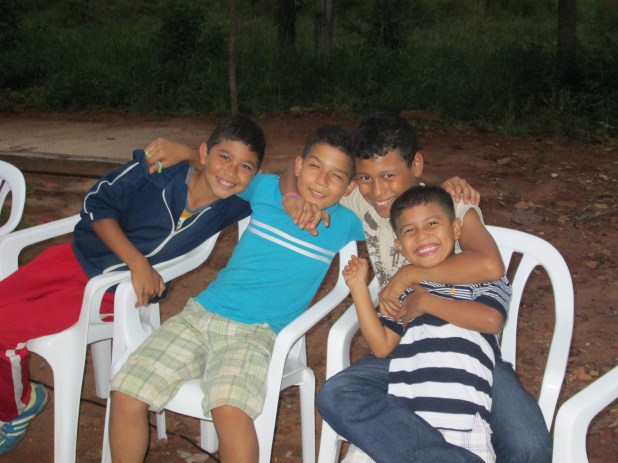
You might already be aware, but kids are hilarious. They’re always laughing and screaming and running. They get excited over the strangest things and distracted at the drop of a leaf. Did you know that 2-year-olds say the silliest things? Did you know 4-year-olds pronounce words wrong…and it’s hysterical?

Kids are so easy to please. One candy and they’re on top of the world. Kids are grumpy when they’re tired. Paraguayan children look at me and laugh—I’m not sure if that’s because I’m foreign, weird-looking, or just funny.

I think I’m going to miss all the kids around when I move back the States (though my position on having some of my own hasn’t change…um, no…maybe later, but probably not). I still haven’t figured out how to explain to Paraguayans that where I come from kids aren’t as profuse. I don’t know how to explain that I wasn’t raised having to take care of other people’s kids like all (maybe not all, but it seems that way) girls in Paraguay. In Paraguay, “woman” basically means “child bearer and nurturer.” I haven’t exactly figured out how to explain that I see myself as a woman, but I don’t think my main duty is life is to have children.

Culture: It’s the little things that get me…every…single…time.

Anatomy of an Average Classroom

Since coming to Paraguay I’ve done a lot of teaching. I passed 100 classes a while ago. Though 100 is a humble number for a professional teacher, it’s a huge feat for me, as someone who never thought I’d teach (officially) in a school. Trying to teach 32 8th graders—or 20 unruly 11th graders—has given me a new appreciation for my teachers from 1st through 12th grade. I do sincerely believe anyone who teaches 8th grade for more than a couple of years should be sainted.

I think I get better with every class I teach, but who am I to judge? However, I am certain of one thing: Classes have personalities just like people do. The personality of a class depends on the parts and their ratio. Here’s my summary of the average class’ anatomy.

  • Front Center: Type A’s. They want to help. They want to participate, and they help control the other students.

  • Front Side: Students that come off as type A’s, but on second glance are just good at hiding their distraction. They’re interest and will participate, but it’s easy to lose them.

  • Middle Center: Reserved, quiet types. They are probably paying attention, but it’s hard to know because they’re almost always too shy to participate.

  • Middle Side: Students that are quiet and slightly distracted—typical cell phone users. It’s questionable as to whether or not they are paying attention.

  • Back Corner: Rabble rousers. They talk over the teacher and their classmates. They run around the classroom. They throw things at each other. They will participate, but their participation comes at a high cost.

  • Back Center: Aggressively abstinent. They will not participate no matter what. They won’t speak in class. They won’t do individual work. They don’t contribute when there is group work.

Tea bags: Preening

I think all tea bags should have quotes. Why? Because quotes are awesome and tea is awesome—so they’re obviously a perfect pair. Okay, seriously, I like pondering a quote as I start my cup of tea. Tea puts the mind in a contemplative state.

Today’s topic is based on the tea bag quote, “Care about what other people think and you will always be their prisoner” brought to me by Lao Tzu. And the topic? Beauty and how that shapes the female experience. Sounds like a sociology thesis, but it’s just some observations.

Warning, I will be talking in generalizations. As with all generalizations, they are an average. They are a way of summarizing data and are not true for all individuals in the data set. Okay, we are going to talk about free time pastimes by gender in Paraguay. But, first I’d just like to say that family, terere, parties, and mate are cross-gender pastimes.

Paraguayan men have a common set of free time pastimes: soccer, volleyball, drinking alcohol, barbecuing, playing cards, and wooing ladies. Of course not all Paraguayan men do all these things and some do other things, but this list is the baseline.

Paraguayan women have a different set of pastimes: praying, watching TV, and looking pretty. There are others, but they are not as common (according to my observation). I want to talk about the umbrella category “looking pretty.” This category includes: selecting clothes and shoes, doing hair, painting nails, putting on makeup, and being in places where one can be seen.

As a general rule, Paraguayan women look impeccable. I’ve often wondered how they do it. I don’t know how they beat the humidity, but I’ve gained a better understanding of how they do it in general. Paraguayan women dedicate a great deal of time and energy to their look. The hours men use playing or watching sports (and cards), women spend on preening. That is a lot of time—maybe 30 and up to 70 percent of all waking free time. Women chat over manicures and pedicures, men chat over cards or on a playing field. Women gossip while straightening each others’ hair, if men gossip (I don’t know) they do it over beer.

I used to wonder why I sometimes felt disconnected from my young, female, Paraguayan friends. But, I finally figured it out, as best as I can at least. I am not a preener. I know how to dress well, contrary to my mother and sister’s beliefs. I know what hairstyles look good on me, how to do makeup, and match my accessories even though my Paraguayan friends might not believe it if you told them. But, I don’t do those things everyday. If fact, I only do those things when I have to—like when I’m going to a wedding, an interview, or that time I had a job where it really mattered.

I feel pressure to step up my game when I’m hanging around my Paraguayan friends. I feel like I’m constantly going to an interview. Well, I felt that way until I stopped caring and started wondering what it implies that a large portion of women’s free time is spent on preening. It was harsh when I realized to keep up with Paraguayan women how much time I’d need to primp. Not happening. I’d rather do…well, almost anything else.

The thing about time is that it passes and once it’s gone there’s no getting it back. We can choose to do whatever we want each moment, but we can’t earn back what we’ve already spent. Many women enjoy pedicures and manicures. Great, awesome for them. But, I’ve come to wonder what it says about us, women, if a lot of our free time is spent doing stuff to impress others.

Some say that women dress to impress other women. Perhaps. But, the point is still that time spent on preening is mostly to influence the thoughts of others, and only partly done out of self-interest or for personal amusement. It starts to become clear why gender lines are so clear in Paraguay, when so much effort is burned (by women) on maintaining the image of beauty generally accepted by society. Girls wear earrings. Girls do their hair. Girls wear pink. Girls wear uncomfortable shoes. Girls do not climb trees…

Free time is free time and individuals should spend it how they wish. But, what about when maintaining an image of beauty starts to get in the way of other aspects of women’s lives? I am specifically thinking about my female, eighth grade students. Should they spend much of their class time applying makeup, peering into mirrors, taking selfies, and doing each others’ hair? I don’t know, but math, language, and history seem a little more pressing.

My claim is straightforward. As long as women spend much of their free time doing activities related to their look, they will remain disempowered. To rise up women must find a way to value themselves by their actions and using their own rubric—not by hoping to fulfil someone else’s definition of beauty.

Motivation

Che kaigue,” means “I don’t have the motivation or energy to do anything.” Che kaigue is almost always an acceptable excuse in Paraguay, and it is neither positive or negative. This phrase has been on my mind lately.

The general idea of kaigue bothers me. Not in the context of culture or Paraguayans, but in my own life. I recently hit a roadblock in my Paraguayan life and felt devoid of the desire to continue working. I fell into the dangerous trap of wondering if what I’m doing is actually worth the effort, and questioned what exactly I’m doing with my life.

Now pondering purpose and meaning of life is beyond the scope of kaigue, but none-the-less they are connected in my mind. And they are connected by the simple question: Where does motivation come from?

As a volunteer my main purpose is to prompt others to act. I inspire my counterparts to work with me. I incentivize my students to listen and learn what I want to teach them. I motivate my community members to include me in their already full lives. I energize my friends and family back home to (emotionally) support me even though I’m thousands of miles away. I do so much cheerleading for others, I sometimes forget to cheer for myself.

Where does motivation come from? If the answer to that question were simple, public health would be easy as pie and teaching my students smooth sailing. But, it’s not easy. Worse, it’s just as hard to think about one’s own motivation as it is to think about motivating others.

I’ve taken some time to think about the origin of my desire to do things and then my ability to follow through with those desires. There is a distinction between the things I want to do and the things I actually do. There is an endless list of things I want to do, and a finite number of things I achieve. Why is there such a big discrepancy? Hint: While time is a limiting factor, it’s of little importance in this discussion.

You might have guessed: Motivation. For me to be motivated to do something I must have a strong, tangible reason for doing it or it won’t happen. I also need to feel like I am successful—even if it’s only a hope for future achievement. I will not actually do things if I don’t have a clear reason for doing them or a hope for success.

Let’s look an example of how I applied this understanding of my own motivation to banish kaigue from my life (mostly).

Since March I’ve been teaching 10 sections of life skills to grades 8 through 12. Life skills to me means doing activities that help my students identify their strengths and weakness, communicate well, take an active role in their communities, take charge of their lives by feeling good about who they are, understand their health, and understand how to navigate life challenges like relationships. Our first topic was abilities: What do my students know how to do? How can they galvanize their strengths? How can they learn new skills? What can they do with their abilities? My second topic was leadership: What is a leader? What do leaders do? How do my students’ personalities relate to their leadership styles? What can my students do as leaders to improve their communities? Looking to the future, I will discuss sexual health, and specifically HIV and STI prevention.

I think those topics are pretty flipping awesome and darn important. Don’t you? Well, try telling that to a bunch of adolescents—ha. The point is this. I believe down to my toes that the skills my students could gain from my classes could help them make their lives happier someday. So, I have a good reason for doing the work. Check.

So, why didn’t I want to go to class anymore? Because I didn’t feel like my classes were achieving their objectives. It’s disheartening to go to class after class and have something like 20-30 people ignore me. I found myself wondering, daily and often, if my students acted out because my classes sucked or for some other reason. Regardless, my classes always go better when I start them with a positive attitude and lots of energy. That’s why my growing kaigue-ness was detrimental to my work.

My solution to motivating myself again was to do some self cheering. Self cheering began with identifying what I have done well. I have achieved something with some of my classes. Those groups that are finishing up the last class about leadership are doing better work than they once did. My students are learning to think for themselves; at least they’ve stopped asking if they should copy things. I very much dislike classes based entirely on copying other people’s ideas, which is the most popular class format in my school. My students are starting to find self reflection easier. I know this because they are doing it with less hesitation. In the classes where most or all the students give me the time of day we, my students and I, are winning. They don’t know it but they are reaching my goals for them.

I’m not winning in all of my classes. Part two of self cheering was realizing that it’s okay to give up sometimes. That’s a new conclusion of mine. I hate, yes hate, not completing projects I start. And I hate not starting something I say I’m going to do. But, life is complex. Part of my process of re-energizing has been allowing myself to say goodbye to the groups of students who don’t want to work with me. Rather than beat myself up by the clear failure of some classes I’ve come to accept that I can not motivate everyone I want to work with to work with me. Further I won’t make people work with me, so if I can’t motivate them we are at an impasse. Clearly, the classes where fewer than half the students listen or do the work have something demotivating them. I haven’t managed to figure out what that is, but I don’t have to let that negative energy devalue all of my work and affect the classes that are going well. I now teach 7 classes of life skills. I struggled to keep all 10 afloat, and I lost 3 times out of 10…or, better, I won 7 out of 10.

The example of my life skills classes is one of many motivation explorations that have robbed my sleep and filled my mind these kaigue weeks. I did the same exercise of flushing out my motivations and influences with my English tutoring, studying for the GRE, exercising, planning for my future, and other projects. Today, I accept that kaigue is a feeling I’ll have from time to time, but I refuse to let it be my state of being.

Perspective Warp

At the beginning of June, I had my mid-service training—the last training with my group of volunteers until the close of service training. (Ten months to go in Paraguay.) We had a session during mid-service training in which we talked about how our perspectives on life and our work have changed throughout our time in Paraguay.

The idea is that everyone’s perspectively is constantly evolving as we experience new things. This evolution is accelerated for Peace Corps volunteers because we face so many new ideas, people, and places. As volunteers, everything (just about) we ever believed in or thought to be true is questioned and undergoes a thoroughgoing examination. You don’t have to be a particularly meditative person for Peace Corps to change you—actually, no matter who you are it will change you. Change is inevitable.

Change is neutral, so when I talk about changing perspective I’m not saying that one perspective is better or worse. The truth is that ranking perspectives is useless, and comparing them is only useful in the sense of 1) following one’s own progression and 2) understanding others more deeply so that living with them is easier.

I won’t try to explain my perspective on life; it’s too complex for a blogpost and likely to change tomorrow. What I find more interesting and tangible is how my perspective on perspective has changed since I arrived in Paraguay. Honestly, before coming here I didn’t think much about perspective outside of the arena of politics. In US politics we talk about policies and what the Constitution means. We talk about freedom and justice. Some people think abortion is just and an inalienable right and some people think it is sin and murder. Some people see love as love and some people see it as something that should and can only happen between certain individuals. Some people think everyone should have access to healthcare and some people don’t. The list goes on and on. And, I’ve only listed the black and white perspectives, there are infinite gray perspective in between white and black.

Perspective is more than politics. Actually, perspective is everything. That’s the first lesson I’ve learned. Perspective is the lens through which we see the world. We only see things within the scope of our lens and as our lens allows us to see them. Think of it this way: If your lens is sepia, nothing is pink or green.

Second lesson: One can’t force a perspective on others. Why? Well, first it’s impossible. Second, there is no justification for demeaning someone’s perspective. There are no ranks, just differences. People will change their own perspective, and the more smooth you are about your interaction with them the greater your impression can be. No one likes to be attacked, beaten over the head, and threatened with new ideas. Everyone can be trapped into exploring their beliefs. And sometimes that exploring leads to reflection and evolution.

Lesson number three: Perspective is interesting. Remember opinions, beliefs, and thoughts are different than perspective. Perspective is the bigger picture—the whole—while everything else is a pixel in the image. It comes back to a classic question: Is the blue that I see the same as the blue you see? Answer: No. Of course not. But, it’s okay that you and I don’t see eye-to-eye on blue, or yellow, or the meaning of beautiful, or…on anything. It’s okay because it makes things more exciting. A good storybook quote: “If every flower looked just the same, “Flower” would have to be each flower’s name.” Do you know the book?

What I’ve learned about perspective from Paraguay is that life is perspective and because we all have different perspectives life is fun. We won’t follow the same arc of perspectives in our lives. We won’t always agree or understand each other. But, we can certainly amuse ourselves trying.

Rainy Season

Ever lived in the tropics? Even been there during the rainy season?

Well, it’s not the rain that gets me (I live on a mountain so flooding isn’t a problem). It’s the inescapable dampness that permeates everything.

There are parts of my cement floor that haven’t looked dry since the first rain. I had to put my opened pack of gum in a ziplock bag…because the air turns the sticks of gum into a sticky, mushing goo. Every leather item in my house—wallet, belt, bracelet—I regulated to a ziplock bag. Even though I stored those items well off the floor and in the driest places in my house, a nice blue-green film grew on them. My wooden cooking utensil are now spotted with mold from just waiting to be used.

Washing clothes is a bear because the clothes won’t dry on the line. And despite my diligence, a small crop of mold started to form in my wardrobe. I had to wash about three quarters of my clothes as salvation from the infectious growth and certain squalor.

It’s between 60 and 75 degrees Fahrenheit and it feels like the pits of winter (and technically is here). It’s partly the breeze that cuts through my uninsulated house without shame that makes mild temperatures seem frigid, but it’s mostly because in the shade the dankness is finger-numbing.

Of course, winter only lasts a couple months. I have grapefruits, oranges, and mandarines sitting on trees, ripe and ready for picking, whenever I need a vitamin C boost. The sweatpants, knitted socks, sleeping bag, and heavy comforter that seem outlandish in the thick of summer are my key to survival when bedtimes comes these days. Bedtime comes hours early and wake up time comes hours late. It’s just too dark or too cold to function at optimal rates.

What would you say?

Celebrating Teachers' Day

Celebrating Teachers’ Day

Community member: Do you have a boyfriend?

Me: No.

Community member: But you’re pretty.

Me: …

~

Community member: When are you going to have kids?

Me: I don’t want to have kids.

Community member: You’re bad.

Me: …

~

Community member: Give me your eyes.

Me: What?

Community member: I want your eyes.

Me: …

~

Community member: Have you gained weight?

Me: No, I’m the same as I was.

Community member: You’ve gained weight.

Me: …

~

Community member: Do you have a boyfriend?

Me: No.

Community member: In your country?

Me: No.

Community member: How about a Paraguayan?

Me: No.

Community member: Why not?

Me: …

~

Community member: What is your religion?

Me: I don’t practice religion.

Community member: But you’re Christian, right?

Me: I don’t have a religion.

Community member: God exists.

Me: …

Teachers’ Day

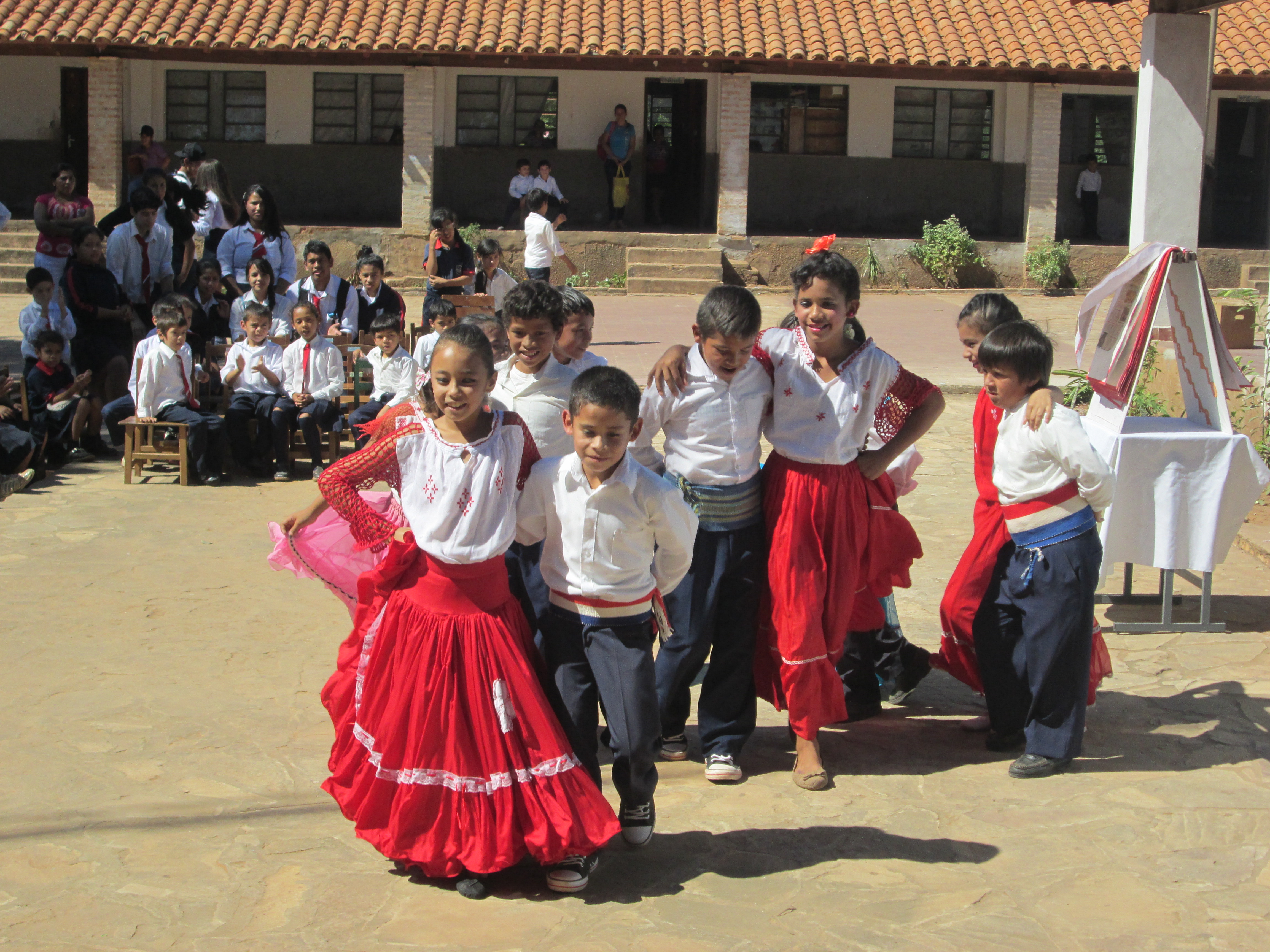
Traditional Paraguayan dance

Traditional Paraguayan dance.

In early May, Paraguay celebrates Teacher’s Day, and it’s no small thing. In fact, in an almost ironic way, schools have the day off. The school where I work also got the day before off—because we held a celebration for teachers. In the morning of the celebration, students performed skits, dances, and poems. The school recognized one teacher who retired last year after 30 years of teaching. Then, there was a lunch for all the teachers. We had cake, danced a little, and sang traditional Paraguayan songs.

When my school invited me to participate in the teacher’s lunch not as a special guest but as a teacher it hit me: I am a teacher. I never thought I’d be a teacher. There were brief moments in high school when teaching, the profession, crossed my mind. My Peace Corps projects have brought me back to high school (I teach grades 8-12 primarily). My days, in Paraguay, are filled with life skills classes, English tutoring, and sometimes helping with communications class (Yes, I am helping with Spanish homework even though my students make fun of me for my errors in Spanish when I speak. It stems from the fact that I’m good at literary analysis, and that’s a challenge for many in my community).

Even if my role as a teacher wasn’t formalized by my work in the school, I still think my main project in Paraguay would be teaching. Whether I mean to or not, I push the people I interact with in my community to expand. First, they have to put in a good effort to understand me—which is not just a lesson in active listening, but also clear communication. Second, and more profound, we have different cultures and understandings of the world, and together we are helping each other grow.

It is easy to forget or demean the importance of exposure to people different from yourself in the grand scheme of life and Peace Corps service. But, in the end, that’s the core of it. Peace Corps volunteers do a range of work that can be reported—lectures, classes, building things, camps—but in the end the only sure things that change are the volunteers and the people with whom they spend the most time in their community. I can’t summarize personal growth neatly in a report. But, many things that are worthwhile are hard to quantify—love, friendship, goodness, happiness, kindness, respect—that’s what makes life so damn exciting.

Meaning of Military

My grandfather was a veteran. That has many layers of meaning to those born in the USA. For me it invokes conflicting thoughts. But, in Paraguay the understanding of the military is different. I do not know how the history of the dictatorship or the history of several high-casualty wars influence Paraguayans’ views of Paraguayan soldiers. I know soldiers are respected here. But, from what I understand (grain of salt) joining the military is held high in Paraguay because it’s a good, solid job. One has to work hard to get in, and once he or she is in he or she will always be able to provide for his or her family.

In Paraguay, the military is a providers’ choice. Paraguay doesn’t wage wars these days like the States still does. Paraguay has never been charged by scholars as trying to be the “world’s policeman.” In Paraguay, the military is a secure way to pull oneself up his or her bootstraps. Paraguayan soldiers have a small chance of being shipped off to a land they don’t know to fight a guerrilla war. In the current political climate, they seem unlikely to use their weapons on any kind of battlefield.

Several of the most difficult conversations I’ve had in Paraguay were about military service. I’m close to the family of a young man who is studying in the Paraguayan military academy. His sister once asked me if I like soldiers. His aunt talked about what a hard-working person the soldier-to-be is. His mother and father explained how they’ve had to sacrifice to send him to military school. They hope he will help his younger sister when it’s her turn to go to college.

During those conversations, I thought of Arlington cemetery and the news—why I don’t like watching the news. I thought of the base shootings. I thought of the pledge of allegiance. I thought of baseball games and the National Symphony Orchestra’s concert each Memorial Day on the Capitol lawn. I thought of my grandfather in uniform. I thought of the star spangled banner.

In those conversations with Paraguayans about the military I chose to listen. I chose to limit my commentary. There are cultural things that can be explained—food, for example. There are parts of culture that run too deep to neatly fit in words. What do Paraguayans think when I tell them my grandfather was a soldier? How would they react to his funeral? Do Paraguayan soldiers have special burial rites? If so, who gets them and under what circumstances? Are Paraguayan mothers worried about their children or just proud when they enlist?