Rain Days in Paraguay Are Like Snow Days in Vermont

I sat down ready to write, propped up against the wall and sitting on my bed. I was working on my first novel. The bedcovers were pulled up over my legs. My mate was set on my bedside chair. My princess canopy, mosquito net was pulled to one side. Though it was cold and I wore a sweatshirt, all my doors and window were open. Cold in Paraguay is fifty-something degrees Fahrenheit. A light breeze made the laundry on my indoor clothesline flutter.

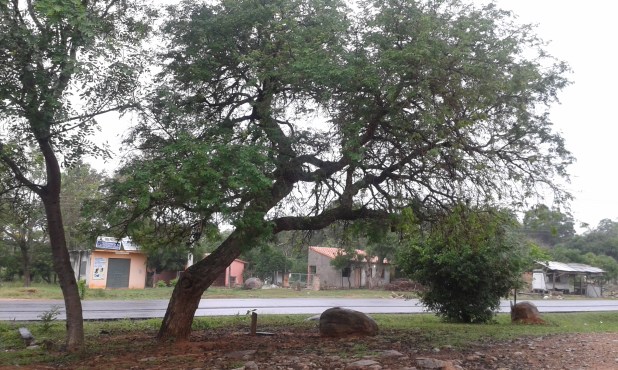
As I poured another draft of mate my mind absently started to wonder to where I left off in my novel. I stared out the window. At that moment, the misty rain was floating down at an angle. It was quiet. The rain started two days before; it brought with it a tranquility beyond any calm possible in the blistering heat that came before the rain. The rain sent people indoors and blanketed everything with a film of water that amplified birdsongs. There was less loud music than usual. Watching the mist fall made me suddenly remember my favorite childhood days. It had been a long time since I last thought of them.

The best days growing up in Vermont were snow days. I would find myself inside drinking hot chocolate and watching the snow drift from the sky. Those gray mornings were lazy, but they marked the calm in the storm. Snow fall followed a crescendo with a climax of me putting on my boots, snow pants, sweater, jacket, mittens, scarf, and hat and then plunging out into the sideways-sailing snow. Sometimes the desire to sled in fresh powder drove me away from the fireside. More often, however, it was my unexplainable interest in the absolute silence that descends on the forest when it snowed. Silence so thick I could hear fluffy flakes stick to the ground after sifting through the barren branches overhead. I could hear the trees groaning under their white burden.

I would sit in the woods or walk noticing animal tracks and the painted fans created by bird wings in the winter crust when they took off from the shimmering ground. I love snow from the tips of my toes to the top of my hat. I always have.

It seems ironic that it took me a grand adventure all the way to subtropical Paraguay to remember. To recall just how much wading through hip-high snow made me smile or how much I laughed when I would accidently dump a tree-full of snow down my neck by poorly selecting which tree bow to grab. But, then again, it’s not so strange I tucked away my memories of snow days and forgot where for many years. I was swept up in a life too busy to stop and listen to the weather happen around me. It is so easy to always doing in America. It is important to do, but we all should take snow days. Without night there would be no day, and similarly without pause we can not see from where we came or to where we are going.
An Encounter With Jesus

“Let’s go for a drive,” the mother of the family said. Her two daughters, a 3-year-old nephew, and his brother got ready to pile into the car. Going for a drive can mean many things in Paraguay. It could be a few-minute trip to the house-front store down the street or it could involve an hours-long journey to another town.

I hurried to the bathroom, the key is to always go before leaving, and asked what we were going to do. “Get the saint,” the mother said. She said it as though it was both obvious and I should have known what she meant. But, of course, I had no clue what “getting the saint” involved. Questions raced through my mind: What saint? Are we going somewhere to pray? Is it okay if I go in the athletic shorts and tank top I’m wearing? Are we bringing a statue of a saint somewhere? Where? How long are we going for? I climbed into the car, and we were off. I decided my attire was acceptable because one of the daughters was wearing a house dress.

“What are we doing?” I asked again.

“Getting the saint,” the daughter in the house dress said.

We stopped at a little store and picked up bread, sugar, and several pastries. I wondered, “Are we going to be gone so long we need food? Is the food going to be some kind of offering?”

We drove down a road on which I used to live. The road wound into a forgotten part of Paraguay and connected my town to another town. It was lined with pink and gold grasslands. We slowed down to let free-range cattle cross the road. Dusk was falling and its heavy light washed over the tiny school and houses we passed. It was strange to journey to no where as night shadows came. Paraguayans tend to stay home after dark.

The mother told me, almost in passing, that the little girl who had lived with them for about a year was gone. The little girl’s mom came with police and a judge and took the girl without warning. The reason the girl was living with them in the first place was because her mother was neglecting her.

We stopped. There were no houses close to the road. There was no visible reason for stopping at that point. The mother and the daughter in the house dress got out of the car, the others didn’t move. The mother said I could stay in the car if I didn’t want to walk. My curiosity was burning. Why so much mystery?

We started to walk on a little footpath. I asked the mother, “What is the saint? Why is it here? What is it for? Where are we bringing it?”

As we wove between the brush and grass the mother finally explained. We were getting a cross with Jesus on it. The mother said that this cross was a special one, a specific one, that was hard to find. A single man was the keeper of the cross and it was passed down to him from his mother. When something bad happens in my friend’s family they come and get the cross and bring it home for a night to pray.

We got to the keeper of the saint’s house after a short walk. He was an old, thin man. He had two teeth and his clothes were faded. His house was one room, with space for a bed and a table where the saint and its alter sat. The house was made of wood slats. Off to the side was a shower and toilet; the painted metal wall around them was starkly modern compared to the rest of the homestead. Two basins with dirty dishes were sitting on wooden planks. The beige sand around the house was swept like a Japanese garden. There was an ax with a new tree-limb handle. The daughter reminded me that the man lived all alone. She commented that he needed someone to break the solitude. Giant trees, like those that inspire poems, stood at the edge of his swept space. They created a canopy. His house stood on a ridge, and below spread the grasslands. It was perfectly silent.

The mother handed the man the bag of food. He pulled together the assorted chairs he had so we could sit. He was a chair short. The mother began to chat. The daughter chimed in at appropriate times. They spoke Guarani. They smiled and laughed. The mother followed the man to the alter to get the saint.

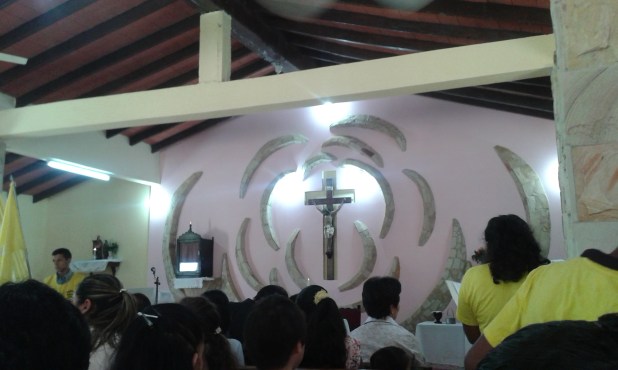
Anyone who has been in a Paraguayan Catholic place of worship knows what I mean by the Jesus cross. The cross is carved out of wood and has a bleeding Jesus nailed to it. He is wearing a crown of thorns. The one we were getting was about one and a half feet tall. It was painted blue and there was a little angel that attached to Jesus’ chest. I thought of vampires, but imagined the angel was supposed to be healing him.

The mother walked slowly as she carried the cross. We returned to the car and went back the family’ home. When we arrived the grandmother came over, she lives across the street. I couldn’t tell if the grandmother was crying, but she kissed the Jesus on the face. “Welcome to our home,” the grandmother said to the saint.

The Dark Side of Tranquilopa

Tranquilopa

One could fall in love with Paraguay for it’s tranquilopa attitude, and many have. “Tranquilopa” is a word that is a mix of Guarani and Spanish and could be translated as “tranquil.” But, the word means a lot more than “tranquility.” It is really a way of saying “life is good,” “I am happy with life,” “I am grateful for what I have and my lot is not bad in the slightest,” and “I am satisfied, fulfilled, calm, peaceful, and enjoying the time given to me.” Tranquilopa means all these things, but it’s not just a saying. The word and its meanings summarize the Paraguayan view on life. Paraguayans are grateful for what they have and they let themselves take time to be happy. They have time for their families, a lot of it. They pass long and short hours with their friends. They always look for the next joke and way to smile. They are laid back, generally calm, and not always searching for the next best thing.

Contrast

As someone who grew up in the hustle and bustle of big dreams, fast and furious work schedules, and endless to-do lists I like the lull of tranquilopa. With practice, I’ve become more patient and accustomed to the slow pace tranquilopa gives to life. I enjoy having time free of an assigned activity in which I can do or not do whatever I want. But, in recent times, I’ve  discovered that tranquilopa has a deep dark side, and it’s not the boredom I sometimes feel drinking terere or chatting and staring into space for hours. I still can’t do nothing as well as my Paraguayan friends, but I’m a lot better at it than when I got here. Doing nothing is an art, and for me it’s a work in progress.

The dark side of tranquilopa is the tendency to turn the other cheek or joke rather than address a negative aspect of life. Tranquilopa sometimes provides an excuse for inaction, and thereby can be a barrier for social change, professional achievement, and project completion. Here are some examples.

Example one

A certain guy is known for being a drunk. He comes to the family party already plastered and drinks more to a point of extreme drunkenness. This man then does one of several things, he could be very rude and hit on whatever women, he could pass out, he could get in a fight, he could piss himself, or he could do something to hurt himself. I’ve seen or heard tell of all these outcomes in Paraguay. With the exception of a stereotypical frat party, most of these actions would be actively addressed in the US, especially because this happened at a party where children were present. But, in Paraguay the most common response is to joke about what happened, and do nothing to prevent it from happening again. Turning problems into a joke is a classic tranquilopa response and is an obstacle in preventing the same thing from happening again.

Example two

Tranquilopa causes one to live in the present, which is good in many ways. Some of us in the US will spend our whole lives overlooking the present, caught in the past and dreaming of the future, until the moment we die and realize that all we wanted was right there in front of us we just forgot to look. But, some things in life require long-term planning to realize. Going to college, getting the career you want (rather than doing just whatever job you can get), starting your own business, completing bigger projects like building a house, saving for larger ticket items like a car or a vacation…the list goes on. And, tranquilopa can deter people from making and following-through on long-term goals. I have found this particularly interesting working with youth. Many of the Paraguayan youth with whom I work struggle to imagine where they will be (in life) in 5 or 10. When I ask what they want to have or do, they give me blank stares. Or, some youth tell me they want to go to college,  but when asked what they want to study, where they want to study, and how they are going to work out the logistics (like paying for it) the students shrug. Tranquilopa creates a sense of security that says, “what is meant to happen will,” and sometimes this idea prevents the efforts necessary to achieve complex goals.

Conclusion

Like most aspects of Paraguayan culture and US culture, I think a half-half mixture of the tranquilopa life philosophy and the US equivalent which I will call “pull yourself up by your bootstraps” would be the ideal for a life of happiness and prosperity. There is no denying the happiness of the people who live by tranquilopa. Paraguayans smile and laugh more than any people I’ve known before, and it’s not because they have it all in term of material goods. But, I also see people in Paraguay suffering more than they have to because tranquilopa is slowing change. Laughing things off rather than fixing them and only thinking about today are good skills, but they must be executed with even-handedness.

Teaching Sex Ed

I never imagined myself teaching sex education before Paraguay. But since late August sex education, focusing on HIV prevention, has been the center of my work world. And, it is some of the most gratifying work I’ve done in my ever-elongating life. What I enjoy most is watching how my students giggle more knowingly rather than awkwardly and show greater confidence as we work through sexual health topics. During my first class, my students wouldn’t say words like “penis,” but now they can tell me exactly how and for what one uses a condom with only a slight smirk betraying underlying tension.

Just like in the States, many families and schools in Paraguay skim or entirely skip sex education because adults are embarrassed or don’t know how to discuss the topic with youth. As a result, “sex education” is learned through experiment. It’s not that experiment is entirely bad but when it comes to sex, experiment without some basic knowledge and protection can often lead to unwanted pregnancy and sexually transmitted disease.

Because I’m using a program that focuses on HIV prevention, I talk about condoms a lot. As you know, they are the only form of birth control that prevents pregnancy and STDs. Just like in the States, condoms are under utilized in Paraguay even though they are widely available and often free. You might ask, “Why?”

Unlike in the US where there is a poisonous link between condoms and religion in some circles, the officially Catholic country of Paraguay, for the most part, does not view condoms as a negative thing. Myths and mistaken beliefs about condoms are one reason many Paraguayan men are reluctant to use condoms. Myths like one can not feel pleasure during sex when using a condom. Another, and perhaps more important reason, is that many people, both genders, are too embarrassed to talk about sex or get information about how to protect themselves that they just go for it. It takes confidence to get a condom and then ask your partner to use it. And, that’s where I think sex education enters the picture.

Sex education is partly explaining how things work, like how to use a condom, and telling what resources are available, like the different forms of birth control. But, I think almost more importantly sex education is a time to clear the air and help young people become more comfortable talking about their bodies. I like to think that my students don’t only learn how to protect themselves from HIV, but also become self-advocates so that if faced with a partner who asks them to take a sexual risk they don’t like they can stand up for themselves. One can know about all forms of protection and the ins-and-outs of sex, but if one is too nervous to say what he or she wants in the moment it does no good.


The Bosses

One knows when elections in Paraguay are on their way because public works, so long neglected, magically get finished in record time. The muddy street next to my school got cobblestones and it took less than a month. In a few weeks the highway by my house got repaved. The candidates also advertise themselves with signs plastered on every power pole and billboards propped above faithful business fronts. Conversations about what needs to happen in the community become more pointed, people of the same party meet to discuss politics, and candidates start visiting their supporters.

In other words, when elections are around the corner in Paraguay it’s not so different from September of a US election year. But, it is different when the elections are over and everyone is settled into their winning posts.

Paraguay is still a land with a mark of political corruption and political bosses —I guess you can argue the same for the States in some areas. Corruption by nature is often hard to see, especially from my view as an outsider, but Paraguayans grumble about it. The mayor a few towns over from my site was found guilty of taking large sums of money from the town coffers, yet I think someone told me he might run again. While I will leave the judgement of how much corruption there is among politicians in Paraguay to someone who has quantifiable data, political bosses are hard to miss for even someone like me who tries to steer clear of all Paraguayan politics.

Like most places, or at least the limited list of places I know, the best way to get a job in Paraguay is to know someone who has an “in” and who can help one by-pass the black pit of faceless applications. This is particularly important in a high context culture like Paraguay, where who one knows or is related to is often more important than what one achieved. Relationships in Paraguay are built over long conversations that develop slowly. Time saving and directness are not part of the traditional culture. But, in Paraguay there is often a deeper level of connectedness that will win one a good job, not just an okay job, and that is the political boss. If you’re like me and know US history by way of the different immigration movements and development of labor unions, you will know that politicians in the States had a long history of giving out jobs to win votes and saving the best posts for their most fervent supporters. And that is Paraguay today in a nutshell.

I don’t mean to say that without a political connection it is impossible to work in Paraguay, because that is not true, and I can’t speak for all Paraguayan towns when it comes to politics and work. But, this is what I can say. I’ve talked to a mother about her visiting the mayor so her daughter doesn’t have to…and the daughter ends up with a job in the city government. I know families that tow the party line and get side jobs in the local government, to supplement the money they already earn. I have seen families take steps to ensure that someone from their family is always at the political meetings and that the candidates they support pay them a visit to hear the family’s ideas. I don’t yet know first hand what will come of the political meetings and candidate visits, but if unemployed members of those families get work when their candidate wins, that will make me think a political boss had something to do with it.


You’re not fat, so why do you exercise?

Paraguayans in my site love to comment on my weight periodically…you know just in case I’m not aware of the current state of my own body. And as much as they like to say I’ve gained or lost weight, I’ve stayed about the same since I got here. Well, until recently. I turn 26 this I year and I decided that because I’m now closer to 30 than 20 I should stop putting off my body goals. In July, I started to take steps to lose weight by my birthday in October. At the same time, a friend asked me to run a 10 km race with her for fun. The race brought back my running bug, which I lost sometime in 2012. The point being two fold. First, I’ve started controlling what I eat and how much. Second, rather than just exercising in my house—which I did consistently for most of my service—I started running. Now, everyone in my community can see me exercising.

I think most people know the basic math of weight: if you eat fewer calories than you burn you lose weight, if you eat the number of calories you burn you maintain your weight, and if you eat more calories than you burn you gain weight. Depending on what you are doing weight gain can be muscle or fat. That said, I think many people in Paraguay and the US overestimate the power of exercise in this equation. If you want to lose weight the most effective way to do it is to watch what you eat. Why? Because it is hard to do enough exercise to burn more calories than you consume if you are eating many high-calorie foods.

We are now in late August. I am a little skinner, and Paraguayans like to tell me so, and they attribute it to my exercise. Well, actually, first they say it is because I am in love. A common Paraguayan wives’ tale is that you lose weight when you’re in love (I always thought it was the opposite…). But, after I assure them that I am still single they turn to the exercise excuse. While I was visiting a señora the other day she asked, “You’re not fat, so why do you exercise?” The question struck me. I do link exercise and body image, but for me the connection is muscle tone rather than jiggle or skin-and-bones not exactly weight. And, I exercise more because I feel like crap if I don’t, not because I’m worried about muscle tone. The señora’s question made me think about exercise theoretically, and why so many people don’t do it.

Obviously, it takes effort and time to exercise, but after considering those things I think there is a greater force preventing people from being motivated to exercise. And I think that force relates to how society talks about exercise. Many people, in Paraguay and the US, regulate physical activity to the castigation of the overweight and the amusement of a special elite class of “fit” people. Just as my señora friend’s question suggested, exercise is considered by many to have the single purpose of helping one lose weight. I see this belief as dangerous.

If I had been quicker on my feet I would have explained the following to my señora friend: You don’t have to be fat to exercise. You don’t have to be special. Nor do you have to do a specific type of exercise; all exercise is not equal but most ways of exercising are better than not exercising. Exercising helps your heart, your bones, your brain…everything.

I can’t remember what I told that señora, but I see a greater opportunity, based on her question, for public health wonks. Maybe we should focus less on telling people to exercise and focus more on changing how people talk about physical activity. After all, exercise is for everyone not as a punishment or as a chore but because our bodies need to move to work correctly. Exercise should not be thought of as extra. It should be lumped in with things like vitamins, necessary and required.

Ghost Buildings

On the 2-hour bus ride from my home to the Peace Corps office are many sights that have come to symbolize Paraguay in my mind, but the most vivid is a vacant lot it which stands several incomplete apartment buildings. Those buildings don’t have roofs or windows and the walls are unfinished. The brick, mud, and cement skeleton of what might have been the home of generations of families grays with age. The grass grows tall and a sign that probably announced the development project when someone broke ground on the construction is too faded to read.

When I first saw the buildings I thought of a war-zone or a devastating fire. I wondered, “What happened here?” I still don’t know why that complex stands destitute until the rain washes the structures away, but I now know enough about Paraguay to be confident it wasn’t a tragedy that condemned the place. Most likely, the person funding the project ran out of money and walked away. Just as was the case with so many little houses I see scattered about when I travel—some with finished walls, some with partial roofs.

With little access to credit and varying access to good-paying jobs across the country improvement projects and development move slow. Paraguay is a place of dreams. A dreamland where the bridge between reality and aspiration is still being built. Some people are able to paddle across the gap, and some decide to dream on and live as they always have. Paraguay is a land of opportunity, but only the lucky and the determined make it big.

They Tell Me It Was Different Then

Paraguayans don’t usually talk about the dictatorship in Paraguay that ended in 1989. It’s a taboo subject. There are many reasons why one can’t talk about it, but one important reason is that Paraguayans are fiercely proud of their country and will not criticize themselves in an extreme way. Of course Paraguayans now, like all citizens of democracies, grumble about their new government, corruption among politicians, and what the government is not doing.

Despite the general silence, there is one way señoras talk about the dictatorship; it is usually in a positive light. It relates to security. Señoras are fearful of crime and degeneration of youth in their country—especially the older señoras. They think that women can not and should not walk around alone after dark. Regardless of whether it is late or not. Now, in some parts of Paraguay, like certain barrios in Asuncion, no one should walk around alone late at night. But, if one compares Paraguay to just about any other country in South America, Paraguay is pretty safe. I’m not suggesting that one should throw caution to the wind, but in the quiet towns of Paraguay usually señoras’ fear exaggerates the danger of nighttime. Darkness falls early in the winter months. It’s hard to be home by 5 pm even in  tranquil rural Paraguay.

When señoras talk to me about their concerns for security and the development of youth sometimes they reference the dictatorship. They tell me that things were different then. They tell me there was hardly any crime. They tell me that it was safer and the government was in control. I imagine they are right, but I am not well informed and I wasn’t here to know. Among the few pre-1989 Paraguayan history facts I know is that there was a curfew. I also read that people died if they criticized the government during that time. I will leave judgement of the government before Paraguayan democracy to history experts. However, every time a señora tells me “It was different then” in a hushed voice that is not critical or supportive my mind stirs with questions. Some questions can not be asked. And sometimes after I’ve narrowly avoided being walked home unnecessarily just after the sun sets, I wonder what it was like in Paraguay “then.”


Conversations With My 2-Year-Old Neighbor

Sometimes my 2-year-old neighbor decides to pop over for a visit. She’s in that wonderful stage where she asks questions about everything…usually more than many times.

Our conversations usually start with my bed. I live in a one-room apartment and my bed takes up more space than any other thing I own. It also has a mosquito net, thanks to Peace Corps’ effort to limit my chance of getting dengue.

Here’s one particularly memorable visit, boiled down:

“Is this your bed?” the little girl asked.

“Yes,” I said.

“Do you sleep here?” she asked.

“Yes,” I said. She then asked about the mosquito net, which we’d talked about close to 10 times before, and I answered.

“Do you sleep here alone?” she asked.

“Yes,” I said, starting to smile because I know what the next question will be.

“Why?” the little girl asked.

I don’t really answer. She asked about where my father and mother are…Where do they live? Why aren’t they here?

We then move on to the things on my table. She asked about a chap stick, the pens, some jars. After I explain each thing she exclaimed, “How pretty!”

On that visit I was in the middle of making lunch, which was salad and beet juice. I already knew from previous conversations that she doesn’t like veggies and most fruit. I knew she wouldn’t want my food, so I didn’t offer to share. I pulled out my dejected blender. My blender is held together by duck tape because there are huge cracks in the plastic. Surprisingly (wink), despite my half-hearted washing of the blender after every use, the base is grubby. It takes a special trick to make the top click into the base. I like to think it only works for people who love it.

“My mother has a blender like that,” my little neighbor said.

“Really? That’s great,” I said. I started to make juice.

“How pretty!” she said about the blender.

I look at her with fake surprise. I glance at the blender. “It’s a little ugly, isn’t it?” I asked.

A smirk like those kids wear after doing something they were told not to do in front of the person who told them not to spread across my neighbor’s face. Her little baby cheeks bulged and her eyes sparkled. “Yes,” she said and giggled.

The conversation ended there; she started repeating questions and then her mother called her for lunch. Now, every time I use or look at my blender I see her little smirk and it makes me smile. I learned that even an old, rundown kitchen appliance can add a little happiness to life if you let it.

Crosses in the Sand

One day as I was walking up to one of my favorite señora’s house I saw her out in her yard chopping at the ground with a machete. Now, machetes are perhaps the most used tool in Paraguay, and it’s quite normal to see people just casually walking around with them. I was not particularly surprised she was using one. I thought she was weeding or mowing her patio…a common use of machetes. But as I got closer, I realized her motion she was not right for weed control. Finally, as I stood next to her I saw a zillion little crosses that she’d etched in the sand.

“What are you doing?” I asked, not hiding my confusion. Paraguayans are nice about explaining things, and by this point the people with whom I hang out most in my community are quite used to my questions, which I’m sure seem ridiculous to them.

“I’m drawing crosses,” she said.

“I see that, why?” I said.

“Ants. They were all over. You know they come out with the rain. I didn’t see them and they bit me when I walked to the sink!” she said. Her clothes washing sink is outside. The patio, like most in my community, is sand.

“Oh, I see them. Wow, there are a lot,” I said. The mean biting ants covered part of her patio, moving around like electrons. Between the rains the ants come out in droves. They can turn your whole floor or wall black or brown with a moving army of little six-legged devils waiting to bite you. Some Paraguayans call them a free cleaning service. After the rain they will pass through your house, or whatever path they choose, and eat all the dead bugs and delicious refuse in their path. “What do the crosses do?”

“They stop the ants,” she said.

“How?” I asked.

“The ants won’t cross the line of the crosses. Once you draw the crosses they leave quickly. Look, they are already leaving,” she said.

“Why?” I asked. I knew I sounded like a toddler in that questioning stage of life, but there is always a deeper answer to why my Paraguayan friends do things I don’t understand.

The señora straightened her back and looked at her handy work. She squinted at me. “Ants are creatures of Satan. The crosses send them away,” she said. The conversation about ants ended there as we prepared to drink terere.

The ants moved. Within twenty minutes of drawing the crosses not an ant wandered the area where they had once swarmed. I told myself that the x’s must disturb their communications signals—I read or heard somewhere that ants use their antennae to communicate to each other. I’m not sure if that’s the right explanation either, however.

The lore of señoras has given Paraguay a special place in my heart. I love stories. Often the ends that señoras predict come to pass even if their reasoning and science have different explanations. Of course, some beliefs create obstacles for health and equality to reign, especially when it relates to sexual health, but Paraguayans have a trick for everything. I’m surprised how often ideas I think are ridiculous at first work.