Don’t Suffer, Fix It

You don’t need to come all the way to Paraguay to find little inconveniences in life. Maybe the sink drips. Maybe the door squeaks. Maybe the table rocks. Whatever it is, it works but it could be better. It wouldn’t be hard to mend but instead you let yourself deal with these little things for months, for years… What exactly keeps you from fixing them? What keeps you from making them better or eliminating them all together? Why would you deal with small annoyances rather than resolve them?

You don’t know how to fix them?

You’re lazy?

You’re too shy to ask for help?

You tell yourself that it’s only going to be for a little while?

I’ve come to ask myself these questions. I’m not lazy and I know how do fix most basic things in my house. But, still I don’t. Paraguay adds a level of complexity because I don’t always know where to get the materials I need to fix something, but that’s not an excuse.

I had an epiphany recently—why let myself suffer if I can fix the problem? Thinking about my current situation, I’m going to live in my house two years. That’s not a petty amount of time.

I find the scenario of inaction interesting. I can come all the way to Paraguay to try to help people improve their lives. But, somehow, I overlook the necessities in my own home—I should be able to fix my wardrobe knob, refresh the concrete in my bathroom, and build/get enough shelving.

My new motto: “Don’t suffer, fix it.”

Check back in a couple months to see if I’m living my motto or just blowing smoke.

The Classroom

When I say I’m teaching in the school here’s what it means. The class is filled with 20-30 students. There aren’t desks for everyone, and if it’s the first class of the day some students inevitably have to wonder off in search of a chair. The chairs have seen better days—they’re covered in graffiti, their desk arm is broken, they’re a little crooked.

The classroom door won’t stay closed, so if I want to reduce distractions I have to prop a chair against it. All classrooms have chalkboards—they don’t always have erasers, so sometimes I use a broom. My school has a projector, but I haven’t worked up the courage to try it yet, mostly because I worry its setup will take half the class period. Between transitions in the school and holidays and any number of activities that get in the way of learning time I don’t want to lose time—it’s a useless obsession of mine to attempt to have no wasted time in my class, but it’s one of those unachievable goals I strive for anyway.

There’s always a group of students in the back who hardly (or won’t) participate. In the younger grades those students do their homework for the next class, and in the older grades those students listen to music, send texts, and crack jokes. There’s usually one student who wants to help, one students who simply disappears, one student who looks utterly confused, one student who looks on the verge of sleeping, and one student who looks vaguely interested. The rest of the class falls into those categories too.

Before Paraguay, I’ve heard it argued that teaching is a gift or that teaching is something you learn. From my time in the classroom I’ve come to a hybrid conclusion. The mechanics of teaching well is something you learn—through a somewhat painful process—and the ability to find the nugget that makes any subject interesting is a gift.

Each class I teach I think is better than the last. I haven’t got the teaching thing down flawlessly, but I have plenty of time to get there. I’m getting better because I’m seeing first hand what my students like and dislike. I’m also uncovering my own limitations. Language is a problem, so I’m learning what kinds of things I can explain and which ones are just beyond me right now. Not a class passes without me wondering if and how much better the class would be if I was fluent in the language.

I don’t see any value in fighting my students. My desire is to find a way where my interest in the topic of the class is contagious. I’m getting closer. The students are starting to get used to me—I wouldn’t say that familiarity is translating to greater respect but it is crumbling some of the barriers they put up between us when I first entered their classes. I keep telling myself that I have next year. I focus on listening to them. I want to know what makes them tick. I want to know what drives them. I reflect on every class and think about what worked and what didn’t work. I’m reading about classroom management. I ask other volunteers about their teaching experiences.

Looking back, I’m mystified how my high school teachers were motivated to enter their classrooms day-in and day-out for years. There is a wonderful energy that emanates from the youth in my school, but it doesn’t always make up for the hours of preparation and grading. I keep telling myself that I never know how I’m impacting my students. I like to think that something I talk about will stick, will make a lasting impression, will have a positive impact. But, I’ll never know.

Home

My little house on top of the hill, my community, has become my home. I’m not sure exactly when it happened, but it’s happened.

I know because when I leave site I wonder what’s going on in my community. I worry that my house will be infested with mold or bugs, so far I’ve been lucky, when I get back. When I’m sleeping somewhere else, I think about my own bed with its silly mosquito net that is too small. I miss my milk over a banana, peanuts, and chia seeds breakfast. I miss my own yerba and my music.

I’ve known for a long time before Paraguay that I can endure almost anything as long as I have a home base in which I feel safe and happy. My apartment, with its brick-red walls and high, cobwebby ceiling is just that base. Maps, postcards, quotes, and to-do lists are plastered on the walls. Tons of empty bottles, leftover from a previous volunteer, clutter the corners of my one-room home. Nothing but furniture legs touch the constantly damp cement floor—even my shoes have raised resting places.

I have my normal walking route, my favorite house-front store, and the families I like to visit most. I have my places of work, and at least most of the youth in the community know who I am—I like to think their parents know too.

I have my free-time activities; I finished drafting a novel the other day. I have the same feeling that my work is never done and I could be doing more—just like the over-achiever in me felt in the States. I’m getting better at sitting and just drinking terere.

I have to pinch myself to believe it, but this little nook of Paraguay, a place I almost didn’t know existed less than a year ago, is my home.

A Selfish Sadness

Two volunteers from my group left Paraguay recently to return to the States—one might come back, but until then we’re down two (plus the two who already left). Those who left filled a specific niche in my group of volunteers that will remain empty until we all finish our service.

Peace Corps has turnover just like any job, so these departures from my group may seem routine. But, they don’t feel that way to me, one of those left behind.

I know when volunteers leave it’s because they are moving onto something better for them. I also know that those of us staying in Paraguay have good reason to carry on proudly. Despite this knowledge, it’s a confidence shaker each time someone decides to go.

When volunteers leave early, I find myself asking if I still believe in what I’m doing. I find myself wondering if Peace Corps is truly what I want. I feel a selfish sadness—selfish because I question whether their absence will impact my ability to finish my own 27 months. It’s a selfish sadness because I know they are returning to the States where they have their family, their friends from before, and their mother culture while I’m staying in Paraguay where I have none of those things.

As one might imagine, the sting of losing a group member fades with time. However, with these two recent cases a doubt as to whether or not the circumstances of the departure could have been avoided lingers. This doubt has come to faintly tint my view of the Peace Corps. The departures are a reminder of how I am facing many of the challenges of life in Paraguay alone. My feeling of aloneness led to loneliness. The loneliness will pass, but I don’t think the semiconscious feeling of aloneness will.

Revelations 1000s of Miles From Home

I’m still shedding illusions I had when I was a child. I don’t know if it’s something I’ll grow out of or if I’ll always have realizations about things that went over my head when I was growing up. But, either way, there’s something enlightening about uncovering a greater truth beneath things I thought I understood. And, it’s downright fun to bring things into my consciousness that were once lost somewhere in the recesses of my senses.

My most recent realization about my childhood: James Bond, yep 007, was a huge part of my upbringing. I never knew that until I had the opportunity to watch every James Bond movie, starting with the one from 1962—don’t ask how I fit all those movies into my schedule. I should say this is particularly surprising because movies were a small part of my youth and my parents’ still don’t have TV.

I knew my mother had the soundtracks to the James Bond movies, I think through the 80s or 90s. But, little did I know how often those songs were played. As I watched the 007 movies in my Paraguayan home, some for first time and others for a second or a third time, snapshots of my childhood came back. Mom cooking. Mom painting. Mom cleaning. Images of the kitchens of the various places we’ve lived. A mental picture of the patterned rug that seemed to always be there faded into my mind as I watched one movie introduction.

I never know when a revelation like this is going to pop up. One of my all-time favorites is, in college, when I finally realized why my father had once told me his favorite thing to do was sleep. When he told me that I was still in early grade school. I thought he was crazy—during that time in my life I could not be outside or run around enough. But, it only took one semester with a full class schedule, extracurricular activities, and two or three jobs for me to understand why sleeping is one of the greatest things in life.

Paraguayans often ask me if I miss home. They often wonder why I’m so far away from my family. I try to explain that I’m used to it because I left my parents’ houses when I was 18. I think some Paraguayans understand and others don’t. What I don’t have the language skills to explain is that I don’t actively miss my family. Not because I don’t love them, but because they are always with me. I was raised to do my own thing, but I still hear my sister telling me I’m going to get skin cancer when I leave the house without sunblock. I still hear my stepmother’s advice on how to know if I actually love someone when a good-looking guy crosses my path. When I’m not sure if I should go for it, an image of my stepfather talking to complete strangers and getting their life stories helps me take the leap.

Making This Real Life

When I’m speaking with other volunteers it’s easy to use phrases like “In real life…” or “If I were in the States…” to describe what I would do or think if I were living normally. With these phrases I infer that my time in Paraguay isn’t real life or that while I am in Paraguay I’m not who I really am.

Two years is a long time to take a break from “real life.” With this in mind, logical questions are: What makes Peace Corps life feel like it’s not part of my real life? And, how do I go about making Peace Corps part of my real life?

The first question is easy to answer. I left everything I had in the State to move to a country that has fewer resources and amenities. In addition, in my case, the life I had before the Peace Corps has ceased to exist forever. I gave up some freedoms by coming here and every day I’m fighting to navigate a culture that’s new to me. Further, I have to commutate my thoughts using a language I don’t use to think—things get lost in translation all the time.

Okay, so if that is what makes life in Paraguay feel unreal, how do I make it real? I started by changing my rhetoric and remembering that the things that were important in the US are still very relevant here. I tried to stop using phrases like, “In the States…” I also looked to incorporate the things that made me happy in the US into my life in Paraguay.

A huge breakthrough in my life in Paraguay was being invited to go to zumba classes with two Paraguayan friends, women my age, in my community. We have zumba class 3 times a week. A Paraguayan dance teacher teaches the class. It’s not a zumba you’ll find in the States—we dance mostly to cumbia and reggaeton—but it’s something I would love to do anywhere I live. There’s more to making life real, but zumba sure is a wonderful start.

Great Moments With Other Volunteers

Last week, I attended a training with the other volunteers in my group. On the second night, we had a bonfire and talent show. While we made s’mores and watched the moon rise, I thought about how lucky I was to be in Paraguay with such talented people.

For the talent show some people sang in Guaraní, others in Spanish, and most of us sang in English. There was guitar and ukulele. Volunteers performed solos, some duets, and some trios. We sang some songs as a group—but not hippie songs like you might be imagining. We sang mostly pop songs, though there were some folk songs. No kumbaya.

One volunteer presented her comic of what jobs each of us would have if our group worked for a commercial airline—G-44 Airlines. (She’s thinking about coming out with a sequel: Our roles if we worked at a mall). Another volunteer danced.

When I was thinking about joining the Peace Corps I spoke with several returned volunteers. They each said that one huge reason to do the Peace Corps is the people—the other volunteers. But, these returned volunteers had a hard time explaining how volunteers made going halfway around the world worth it—just like I have a hard time explaining why high school sucked and college was pretty cool.

I’ve come to the same conclusion as those returned volunteers: Getting to know other volunteers is an amazing part of the Peace Corps experience.

What makes volunteers an interesting group?

Volunteers are from different parts of the US (and beyond) and diverse backgrounds. We each have different ways of being, different priorities, and different dreams. But, we are all doers. We are all adventurers. We are all here for some reason. Some volunteers want to change the world. Some are using the Peace Corps to uncover who they really are. Some volunteers are in it for the challenge. Some volunteers see the Peace Corps as a stepping-stone in their career.

How do other volunteers add to the Peace Corps experience?

Conversations

Volunteers have a breadth of knowledge that leads to interesting conversations. Rather that trying to fit into common conversation themes—my most frequent experience in DC: bars, football, TV…—we like to talk about multifaceted topics. We also tend to listen well, so even if we don’t’ know much about what a person is talking about we’ll give people the time to describe their passions.

I’ve only been here 7ish months and my conversations have ranged from music to gender and string theory to recycling.

Dreams

All volunteers are going somewhere. For some, that somewhere might be heavily tied to their work. Some want to dedicate themselves to international development or education. For others, that somewhere relates to traveling the world or creating a family. Volunteers, regardless of their dreams, take action. They don’t wait for people to do things for them or for life to pass; they’re movers and shakers.

Parties

Like all good worker bees, volunteers know how to take time off. We party. But, it’s not just the crazy parties that you see in the Great Gatsby—shallow. We perform music, we dance, we talk, and we strategize about how to make life better.

Dedication

Volunteers are guapo. We get stuff done. Yeah, sometimes we have hard days when we can’t leave our houses. But, no matter how hard things seem, we bounce back. Most of us are here trying to make friendships and improve lives in whatever small way we can.

Insight

Volunteers are flexible and observant. We have opinions but we’re ready to change them when we get more information. We don’t just want to know about other people and other cultures; we want to understand what makes them tick. We take time to reflect and digest. We ask questions and look for answers so we can deepen our knowledge of our host country, our lives, and ourselves.

Creativity

Daily encounters with challenges we never imagined we’d face help bring out the creativity in each of us. Volunteers make art out of trash, develop games that make kids excited to learn about dental health, and get community-wide projects done despite political crevasses that have divided our communities for generations.
The Time We’re Given

My training earlier this week went as well as my travels there. It was a 3-day training where the first day and a half we worked with a contact we brought from our community and the second day and a half was a capacitation for volunteers in my group. I found the time, uninterrupted and focused, with my contact invaluable.

The head nurse at my health post came to the training with me. She, like the other nurses at my health post, is extremely nice and hardworking. I know her pretty well in a professional sense because I’ve spent a lot of time at the health post since coming to my site. Despite feeling welcome at the health post, I’ve been unsure how to start projects with them and I hoped that the training would give me a jumpstart.

The best part of the training was having focused time to talk with my contact about the needs in the community and possible project we could do to help address those needs. I liked having time to talk with her one-on-one outside of the distractions and pressure of our community because it enable us to talk in-depth and about topics we’ve never before been able to discuss.

It was interesting to learn what health needs she sees in the community and to hear about the ideas she has for projects. One topic that was surprising to me was the jail in my site.

In my site there are two large jails, and the national government is planning to build several other jails and make my community the biggest jail town in the country. The members of my community tend to see this as a negative thing. However, my contact sees it as an opportunity. She thinks the community will benefit from all the jobs the jails will bring. She also thinks that the jail has not impacted life here as much as the community claims. As my contact explained, the community uses the jail as a scapegoat so they can avoid addressing problems in the community. An example of this is HIV. A number of people have HIV in the community, but rather than focus on prevention the community tends to blame its presence on the jail and do nothing.

We outlined a project: Creating a recreational space in the community. Currently there are no parks, and the only real spaces for exercise are soccer fields. We think that creating a park with basic gym equipment—Paraguay has outdoor stationary bikes and walking machines in some of its city parks—would provide women and children a way to exercise more easily. Soccer tends to be a men’s domain and not an accessible form of regular exercise for women. Making a space to exercise might help address some health concerns in the community like high blood pressure, diabetes, and being overweight.

Time will tell whether our idea of creating an exercise space will blossom into a real project. To make the space we must work with two different community commissions and solicit money and/or exercise equipment from the government. Despite the uncertainty of that project, for the first time since coming here, I feel that there are concrete project opportunities for me with the health post starting to materialize.

The Kindness of Strangers

Earlier this week I had a Peace Corps training which took place in a location that I hadn’t been to yet.

In the US, the world of Google maps and cars, that wouldn’t have been a big deal. I’d have printed my directions and map and drove there. But, as a volunteer in Paraguay my only option was to take public buses.

I started gathering directions about two weeks in advanced. I started by asking the ladies I worked with—I asked two different nurses for directions at separate times. And then I asked a family I visited for directions. Why so many times?

First off, there is usually more than one way to get somewhere—and actually I got 2 different sets of directions.

Second, traveling in Paraguay involves looking for landmarks, not road signs or addresses, so it can be hard to know which mango tree or which church I need to get off at when I’ve never seen them. I figure my chance of recognizing the landmarks increases every time they are described to me.

Finally, I couldn’t pronounce the name of the town to which I was traveling. I wrote the name of the town and site where the training was on my hand before setting out, just in case.

In the end, a stranger rescued me. Before transferring from my second to third bus of the trip I asked the bus driver about my destination. He answered me politely, but I had the sinking feeling that I was going to have to ask the next bus driver a couple times to get the information I needed. But, as I jumped from the bus a woman said I should sit with her and she’d help me.

She is a nurse at the health center in the town next to my community. And, in true Paraguayan style, she asked me if I had kids, how old I was, and if I was single before asking my name. She made space for me in the line as we got on bus, told me about the towns we passed through, and made sure I got off exactly at the right spot. I am quite sure I would have gotten lost without her.

Helping me didn’t require much effort on her part, but it transformed my trip from a nerve-wracking experience to a pleasant one. As I walked down the cobblestone road to our training compound I was thankful and thought about how such a little act of kindness made such a difference in my life that day. I might complain about any number of things in Paraguay, but Paraguayan sure get the little things right.

New Norms

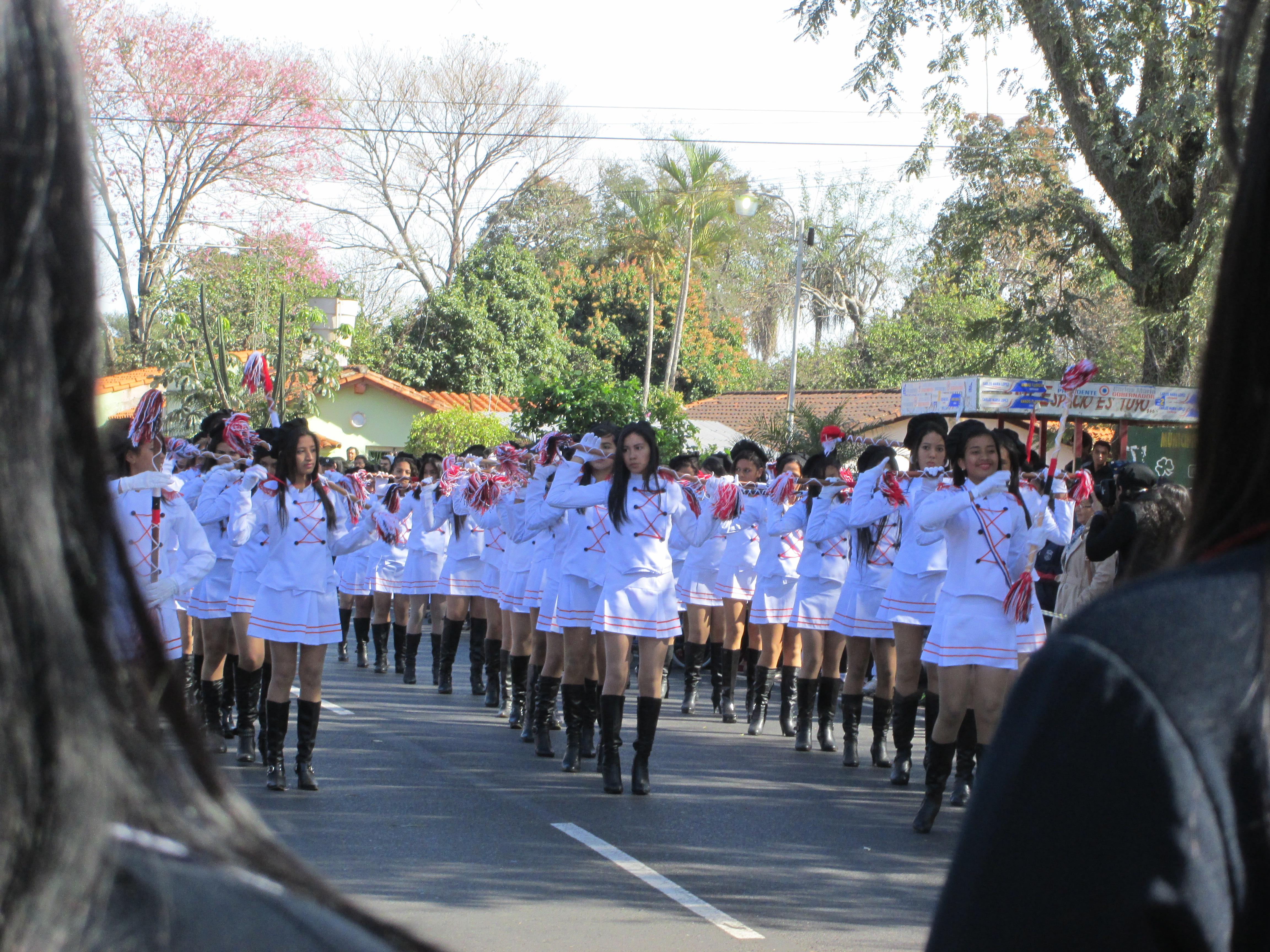
Parade I think you would surprise yourself, were you to live abroad, how quickly things you thought were weird, or never thought about before, become normal. My claim: human’s adaptability is what makes us such an overpowering (or successful) species.

Things that have become second nature to me since coming to Paraguay:

  • Throwing toilet paper in a trashcan: Paraguayan sewers (or maybe it’s the pipes and toilets themselves) can’t handle toilet paper. All bathrooms have a trashcan for paper waste.
  • Unplugging everything (including my fridge) before I leave for more than a day or during storms: It’s not uncommon for the power to go out or flicker. And, when the power comes back it can surge and fry whatever is plugged in.
  • Boiling water before putting it on the stove: Gas isn’t free and my electric water heater is very efficient. Oh, did I mention I have something like a 5-gallon gas tank that I will personally need to carry somewhere to refill.
  • Sunny, windy, warm days make me think of laundry: They are perfect conditions for clothes hung to dry to dry before they start to smell moldy. Yep, in Paraguay there are only two kinds of days: those good for laundry and those ill suited for washing.